




How to Read and Create an Evolution Concept Map with Key Mechanisms
The term evolution has been derived from the Latin word ‘evolve’ which means to unroll. Evolution can be of two types:
Chemical Evolution - Chemical evolution states that life originated on earth as a result of several physicochemical changes.
Biological Evolution - Biological evolution is an appreciable and dramatic account of life on Earth and of human origins within. The change during biological evolution is gradual and orderly from simple to complex form.
Biological evolution is also referred to as organic evolution as organisms are made up of organic matter. A concept map can be the best way to focus on each important aspect of evolution to understand this in a better way.
What is Concept Map?
A concept map is a diagrammatic tool that visually represents relationships between concepts and ideas that can take the form of charts, graphic organisers, tables, flowcharts, Venn Diagrams, timelines, or T-charts.
Characteristics of Concept Map
The main characteristics of concept maps are based on the need to build up the strength of students' concepts in learning, understanding, creativity, critical thinking, and the ability to ask new questions and respond to them successfully. These characteristics are as follows:
They have four elements such as concepts, lines and arrows, linking words, and proposals.
They are a special scheme.
These focus on answering a ‘focus question’.
These help to build new knowledge.
These help to understand elaborate approaches.
Its elaboration depends completely on the student.
These results in processes of negotiation of meaning.
These help to boost self-esteem in the student.
Definition of Evolution
Evolution is an amazing topic of Biology that explains to us the change in the genetic features of biological populations in successive generations over a huge period of time. Evolution’s two special types are chemical and biological evolution.
Evolution Concept Map
The evolution concept map describes the key concepts of evolution by natural selection, including various theories of evolution. An evolution concept map template notes the physical (fossil), biochemical or molecular, anatomical, and various other evidence that justifies evolution on a broader scale.
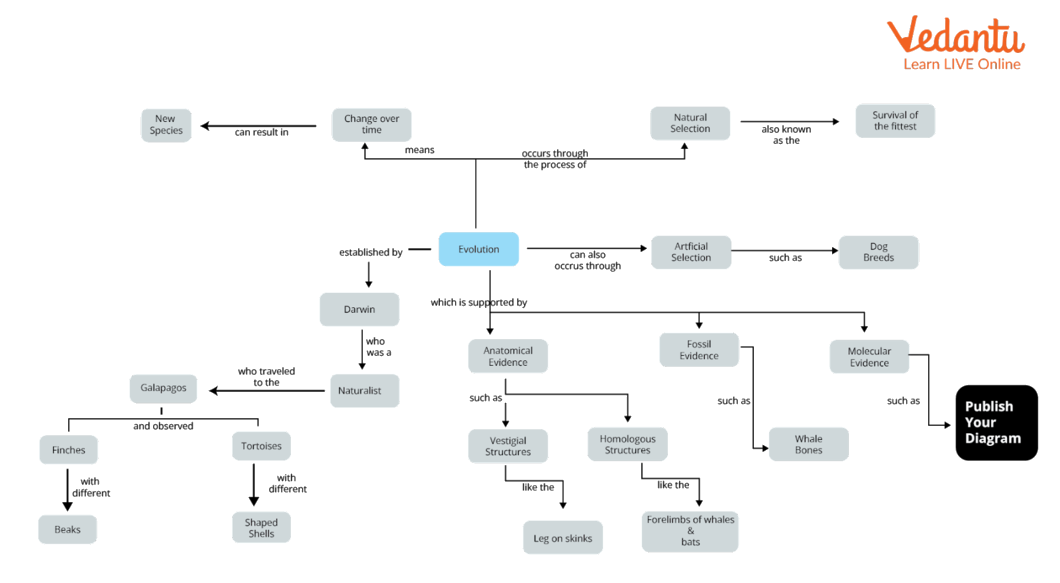
Evolution Content Map
Chemical Evolution Concept Map
The theory of chemical evolution, also known as the modern theory of evolution of life, is based on the belief that on a primitive earth, a mixture of simple chemicals congregated together into more complex molecular systems, from which, eventually came the first functioning cell.
Biological Evolution Concept Map
The cumulative changes which occur in a population over a huge period of time are called biological evolution. These changes occur at the genetic level because organisms' genes show mutation and may recombine in different ways during reproduction and are passed onto the next generations.
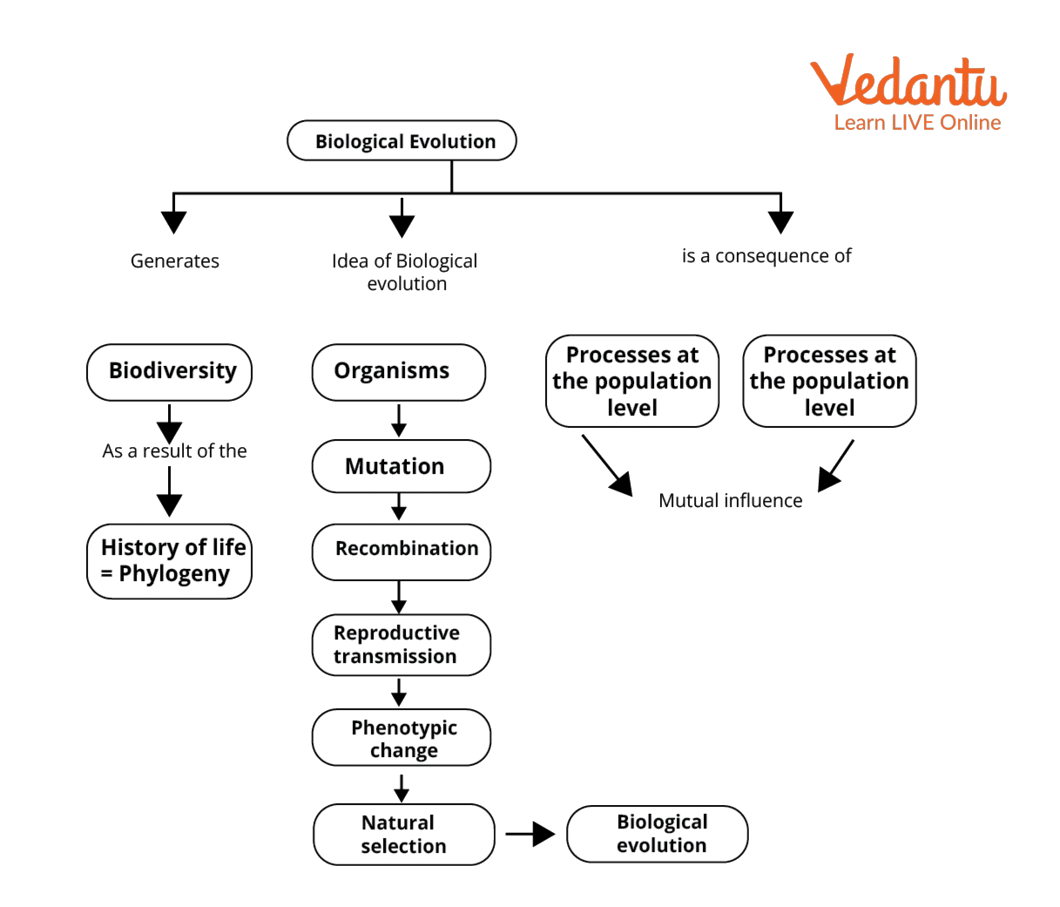
Biological Evolution Concept Map
Theory of Evolution Concept Map
The three main theories of evolution are as follows:
Theory of Inheritance of Acquired Characters by Lamarck: First theory of evolution was proposed by Jean Baptiste de Lamarck (1744-1829) in his book Philosophie Zoologique (1809). The term Biology was given by Lamarck & Treviranus. According to Lamarck,
Some internal forces are present in all organisms. In the presence of these forces, organisms have the tendency to increase the size of organs or the entire body.
Environment influences all types of organisms. Changing the environment gives rise to new needs.
New needs or desires produce new structures and change the habits of the organism.
If an organ is constantly used, it would be better developed whereas disuse of the organ results in its degeneration.
During the lifetime of an organism, new characteristics develop due to internal vital forces, effects of the environment, new needs, and use and disuse of organs. These acquired characteristics are inherited from one generation to the next generations.
By continuous inheritance, through many generations, these acquired characteristics tend to make the new generation quite different from its ancestors resulting in the formation of new species.
Theory of Natural Selection by Darwin: After the study of T.R.Malthus essay, Wallace got the idea of survival of the fittest and also wrote an essay using the title – “On the tendency of varieties to depart indefinitely, from their original type.” and send it to Darwin. Darwin, after reviewing this, postulated the theory of natural selection. According to Darwin,
Multiplication of individuals of a species occurs in a geometric proportion.
Due to the geometric multiplication and due to the availability of limited food and space for these individuals, the struggle for existence is seen.
They are the rule of nature and are provided to be beneficial for a better existence.
The operation of natural selection on the existing variability in order to select the best-fitted variations.
Natural selection is the principal element of Darwin’s theory. The principle by which the preservation of useful variations is brought about was called natural selection.
Mutation Theory by De Vries: According to De Vries, sudden, stable, inherited characteristics which are completely different from their parents are called a mutation.
Hugo De Vries believed that mutation causes the origin of new species and hence he used the term Saltation.
Saltation means single-step large mutation (variation originates in single steps and in full form) and is just opposite to the adaptation and natural selection of Darwin (variations are small and gradual, directional).
Useful mutations are selected by nature while lethal and harmful mutations are eliminated.
Evidence of Evolution Concept Map
There are different types of evidence including physical and molecular features and fossils which provide evidence for evolution and can allow us to rebuild macroevolutionary events.
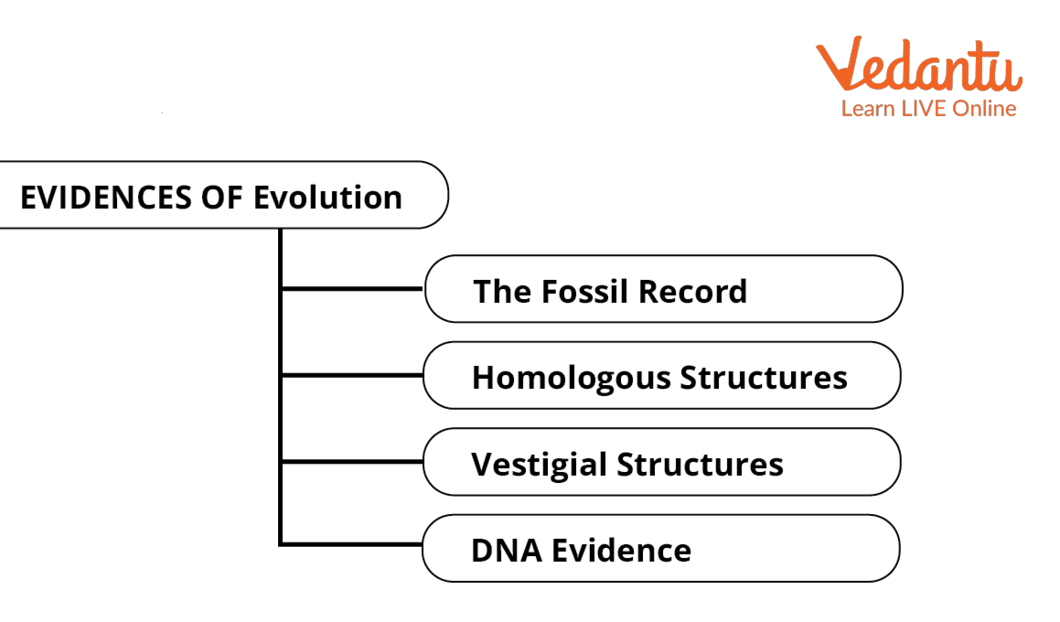
Evidence of Evolution
Interesting Facts
Humans evolved from apelike ancestors, not actual monkeys or apes.
Dinosaurs (reptiles) are birds' genetic ancestors.
Evolution is more like a tree with different branches instead of a straight line from one species to the next.
Important Questions
What is Neo Darwinism?
Ans: After Mendel’s laws were rediscovered and the concept of variations came into force, a new theory called synthetic theory of evolution or neo-Darwinisim came into existence. According to this theory, mutation and natural selection (dominant factor) play a major role in shaping the genetic makeup of populations.
What are convergent and divergent evolution?
Ans: Unrelated organisms when use the same form or structure due to adaptations, this is called convergent evolution. Divergent evolution is the process in which two or more related organisms become distinct. This evolution produces homologous structures.
Key Features of the Evolution Concept Map
A concept map is a diagrammatic tool that visually represents relationships between concepts and ideas.
Evolution is an amazing topic of Biology that explains to us the successive changes in organisms over a huge period of time.
Chemical evolution states that life originated on earth as a result of several physicochemical changes.
The cumulative changes which occur in a population over a huge period of time are called biological evolution.
There are various theories of evolution such as Lamarckism, Darwinism, Theory of Hugo de Vries.
There are different types of evidence including physical and molecular features and fossils which provide evidence for evolution and can allow us to rebuild macroevolutionary events.


FAQs on Evolution Concept Map Explained for Biology Learners
1. What is an evolution concept map?
An evolution concept map is a visual diagram that organizes and connects key ideas about biological evolution to show how they relate to each other. It typically includes:
- Central idea: Evolution
- Main branches: natural selection, mutation, genetic variation, adaptation, and speciation
- Linking phrases that explain relationships, such as “leads to” or “results in”
2. What are the main concepts included in an evolution concept map?
The main concepts in an evolution concept map include the core mechanisms and outcomes of evolutionary theory. Key components are:
- Genetic variation – differences in DNA among individuals
- Mutation – random changes in DNA
- Natural selection – differential survival and reproduction
- Adaptation – traits that increase fitness
- Speciation – formation of new species
- Common ancestry – shared evolutionary origins
3. How does natural selection fit into an evolution concept map?
In an evolution concept map, natural selection is shown as the mechanism that drives evolutionary change by acting on genetic variation. It is usually connected as follows:
- Genetic variation provides different traits
- Environmental pressures select advantageous traits
- Individuals with beneficial traits have higher fitness
- Over time, this leads to adaptation in the population
4. What is the difference between evolution and natural selection in a concept map?
Evolution is the overall change in inherited traits of a population over time, while natural selection is one mechanism that causes this change. In a concept map:
- Evolution appears as the central theme
- Natural selection is linked as a process contributing to evolution
- Other mechanisms like genetic drift and gene flow may also connect to evolution
5. How do mutations contribute to evolution in a concept map?
Mutations contribute to evolution by creating new genetic variations that can be acted upon by natural selection. In a concept map, they are linked in this sequence:
- Mutation → creates new alleles
- New alleles increase genetic variation
- Variation allows natural selection to occur
- Selected traits may become common through reproduction
6. What is speciation in an evolution concept map?
Speciation is the process by which new species arise from a common ancestral population. In an evolution concept map, it is typically shown as the result of:
- Genetic divergence between populations
- Reproductive isolation
- Long-term evolutionary changes
7. Why is genetic variation important in an evolution concept map?
Genetic variation is important because it provides the raw material for evolution to occur. In a concept map, it connects to:
- Mutation and recombination as sources
- Natural selection as the process that acts on it
- Adaptation as a possible outcome
8. How does adaptation relate to evolution in a concept map?
Adaptation is a heritable trait that increases an organism’s survival or reproductive success and is a result of evolution by natural selection. In a concept map:
- Natural selection favors beneficial traits
- Favored traits increase in frequency
- The population becomes better suited to its environment
9. What is common ancestry in an evolution concept map?
Common ancestry is the idea that different species share a shared evolutionary origin from ancestral organisms. In a concept map, it is connected to:
- Phylogenetic trees that show branching patterns
- Homologous structures as evidence
- DNA similarities among species
10. How do you create an effective evolution concept map for studying?
To create an effective evolution concept map, start with the main idea and logically connect related evolutionary mechanisms and outcomes. Follow these steps:
- Write Evolution in the center
- Add major processes like mutation, natural selection, genetic drift, and gene flow
- Link them with arrows and clear phrases (e.g., “causes,” “leads to”)
- Include outcomes such as adaptation and speciation



