




Comparison of structure function and health benefits of lycopene and beta carotene
They are more orangish-coloured and do not contain oxygen in their structure. Examples: lycopene and beta carotene. Beta carotene is reddish-orange carotene found in carrots, pumpkins, and sweet potatoes. It is a forerunner or the starting link of the formation of Vitamin A (retinol), which is essential for vision and the maintenance of heart health and kidneys. It is found in abundance in green leaves and is available as a supplement/multivitamin medicine too.
Carotene is an orange-red hydrocarbon which the plants can synthesize, and they are photosynthetic pigments themselves. They do not contain any oxygen atoms. They absorb ultraviolet, blue, and violet but scatter orange, red and yellow, so we see the bright colours of fruits and vegetables. An interesting fact is that Flamingos in Tanzania are of pink colour, and it is due to astaxanthin (a carotenoid) as they consume saltwater shrimp which is their constant diet.
Our body converts beta carotene into Vitamin A, which repairs damaged hair and is essential for good vision and a healthy heart, lungs, and kidneys. Consumption of foods rich in antioxidants lower the risk of cancer. Red Bananas provide the maximum beta carotene of other banana varieties.
Beta Carotene
Beta carotene performs the function of collection and transportation of light for chlorophyll absorption and helps in the absorption of excess energy during photosynthesis. It also helps in making the secondary structure of chloroplast.
Beta Carotene Structure
Beta carotene comprises eight isoprene units, and its molecular formula is C40H56. Its molecule has rings at both ends, hence the prefix beta carotene.
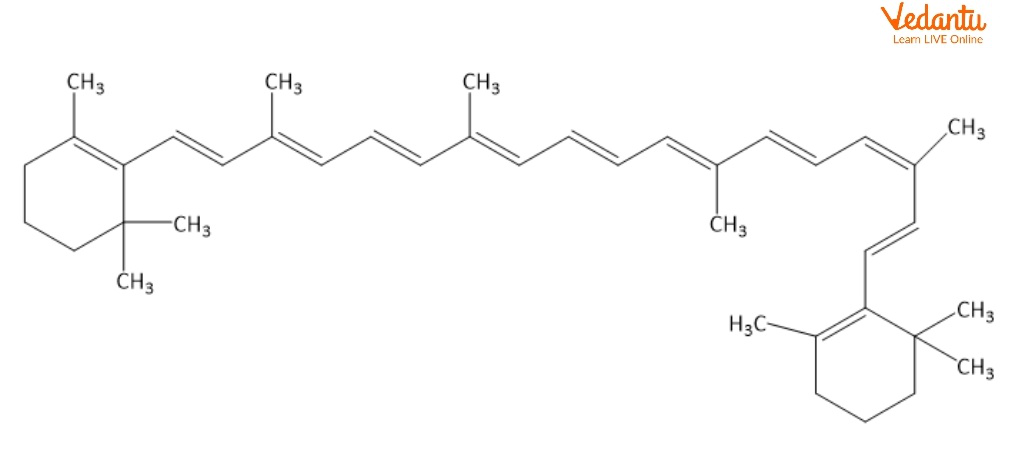
Beta Carotene
What is Lycopene?
It's a bright red hydrocarbon and a carotene only but lacking in any vitamin A activity. It is an essential part of the daily diet as it acts as a forerunner for the formation of beta carotene. Lycopene is largely found in tomatoes and serves as an antioxidant to help the body fight free radicals. It combats high blood pressure, high cholesterol, cancer etc.
It is only unsafe to consume during pregnancy and breastfeeding. It's a natural blood thinner and prevents the clotting of blood. Fat-soluble gets absorbed easily in the body, and besides providing the bright red pigment, it’s known as non-pro vitamin A in the body, having a high antioxidant activity.
Lycopene Formula
Lycopene has the formula C40H56. It has non-conjugated double bonds also in its structure and does not possess rings like beta carotene at the terminal. Lycopene is a well-known tetraterpene under the terpene classification.
Lycopene Structure
Chemically it is a tetraterpene constituting eight isoprene units. Its thirteen double bonds give it a bright red-coloured appearance. It has the molecular formula C40H56. It is a bright red hydrocarbon.
(Image will be Uploaded Soon)
Lycopene
Types of Carotenoids
Carotenoids are plant pigments which supply bright red-orange and yellow vegetables. The provitamin A carotenoid has powerful antioxidants in it. They are produced by plants, photosynthetic bacteria, and algae. Beta carotene is derived from the Latin name Carrot.
Carotenoids are classified into two categories:
Xanthophylls - They have more of a golden yellow hue and contain oxygen in their structure. Examples: Lutein and Zeaxanthin.
Carotenes – They are orange-coloured and contain oxygen in their structure. Examples: Lycopene and Beta carotene.
Interesting Fact
Both lycopene and beta carotene are two of 600 types of carotenoids known to us.
Important Questions
1. What are the health benefits of lycopene?
Ans. Lycopene is that natural compound which is found from pizza sauce to ketchup and in watermelon and grapefruit, it's a chemical known as carotenoid which imparts the natural pigment to plants, fruits and vegetables.Tomatoes are the richest source of this nutrient. Lycopene is known as an antioxidant of the carotenoid family which protects from free radicals and oxidative stress in our bodies. It has been studied on animals that Lycopene may protect against damage caused by pesticides, glutamate and certain types of poisonous fungi.
2. Are there health benefits arising from intake of Lycopene for men especially?
Ans. According to WHO, 10 to 15% of couples suffer from infertility worldwide and the cause is male infertility. Lycopene supplement intake has shown positive results in treatment of infertility amongst men. The most top at the list of cancer for men is prostate cancer, studies have shown that patients with benign prostatic hyperplasia if given a dosage of 15 mg per day of Lycopene for six months, a good response is shown then and urinary function is improved too.
Key Features of Difference Between Lycopene and Beta Carotene
The more vibrant the colour of fruit or vegetable, the more beta carotene it contains.
Beta carotene is an antioxidant that protects damaging cells called free radicals through oxidation.
Lycopene is fat-soluble and gets absorbed easily in the body.


FAQs on Difference Between Lycopene and Beta Carotene in Biology
1. What is the difference between lycopene and beta carotene?
The main difference between lycopene and beta carotene is that beta carotene is a provitamin A carotenoid, while lycopene does not convert into vitamin A.
- Beta carotene is converted in the body into vitamin A (retinol), essential for vision and immunity.
- Lycopene functions mainly as a powerful antioxidant and does not produce vitamin A.
- Beta carotene is orange in color, while lycopene gives a red color to foods like tomatoes.
2. What is lycopene in biology?
Lycopene is a red-colored carotenoid pigment found in plants that acts primarily as a strong antioxidant.
- It belongs to the terpenoid family of compounds.
- Commonly found in tomatoes, watermelon, and pink grapefruit.
- It protects cells from damage caused by free radicals.
3. What is beta carotene in biology?
Beta carotene is an orange carotenoid pigment that serves as a precursor to vitamin A in animals.
- It is present in carrots, sweet potatoes, and spinach.
- In the small intestine, it is converted into retinal, a form of vitamin A.
- It supports vision, immune function, and skin health.
4. How does beta carotene convert into vitamin A?
Beta carotene is converted into vitamin A by enzymatic cleavage in the small intestine.
- The enzyme beta-carotene 15,15′-dioxygenase splits beta carotene into two molecules of retinal.
- Retinal is then reduced to retinol (vitamin A).
- This process helps maintain normal vision and epithelial tissues.
5. Why is lycopene not considered a provitamin A?
Lycopene is not considered a provitamin A because its molecular structure cannot be converted into vitamin A.
- Unlike beta carotene, lycopene lacks the beta-ionone ring required for vitamin A synthesis.
- It does not undergo enzymatic cleavage to form retinal.
- Its main role is antioxidant protection rather than vitamin production.
6. What are the functions of lycopene in the human body?
Lycopene functions mainly as a powerful antioxidant that protects cells from oxidative stress.
- Neutralizes reactive oxygen species (ROS).
- Supports heart health and cellular protection.
- May reduce oxidative damage to DNA and lipids.
7. What are the functions of beta carotene in the body?
Beta carotene functions as both an antioxidant and a precursor to vitamin A.
- Maintains normal vision, especially night vision.
- Supports immune system function.
- Promotes healthy skin and epithelial tissues.
8. Where are lycopene and beta carotene found in plants?
Lycopene and beta carotene are found in plant chromoplasts, where they function as pigments.
- Lycopene is abundant in tomatoes and red fruits.
- Beta carotene is abundant in carrots, pumpkins, and leafy greens.
- Both are synthesized in plant plastids through the isoprenoid pathway.
9. How do lycopene and beta carotene act as antioxidants?
Lycopene and beta carotene act as antioxidants by neutralizing harmful free radicals in cells.
- They donate electrons to stabilize reactive oxygen species.
- This prevents oxidative damage to cell membranes and DNA.
- Lycopene is especially effective at quenching singlet oxygen.
10. Are lycopene and beta carotene fat-soluble or water-soluble?
Lycopene and beta carotene are fat-soluble carotenoids that require dietary fats for proper absorption.
- They are absorbed in the small intestine along with lipids.
- Transported in the blood via lipoproteins.
- Stored in fatty tissues and the liver.



