






Where Do Water Rats Live and What Do They Eat?
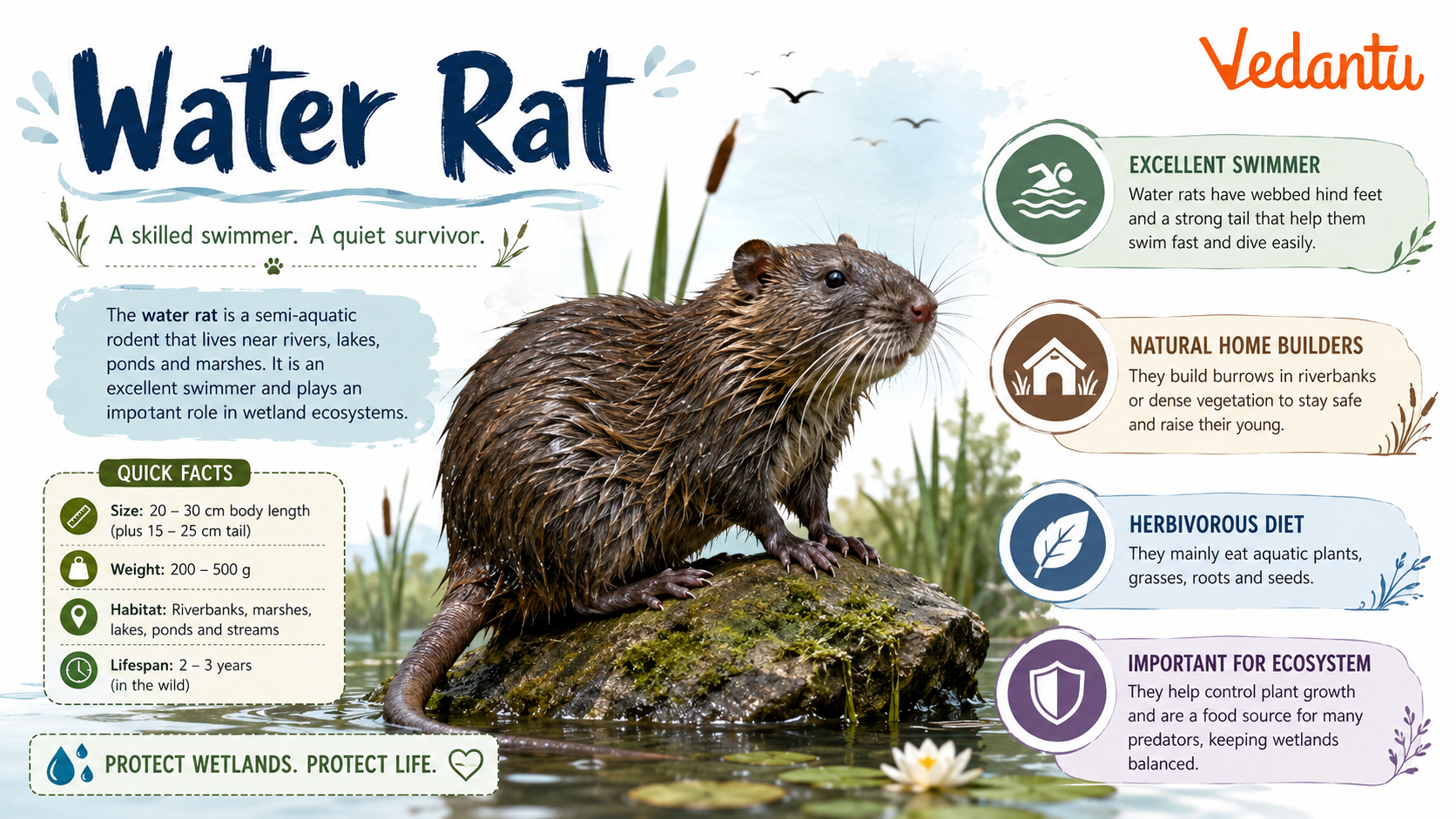
Quick Facts About Water Rat
| Feature | Details |
|---|---|
| Common Name | Water Rat |
| Scientific Name | Hydromys chrysogaster (Australian Water Rat) |
| Animal Group | Mammal |
| Size | 20–39 cm (body length) |
| Weight | 300 g to 1.3 kg |
| Lifespan | Up to 3–4 years in the wild |
| Habitat | Rivers, lakes, swamps, wetlands |
| Diet | Fish, insects, crustaceans, plants |
| Movement | Swimming and climbing |
| Conservation Status | Least Concern (varies by region) |
Appearance and Physical Characteristics
- Body Shape: Streamlined body that helps in smooth swimming.
- Fur: Thick, waterproof fur that keeps them warm.
- Colour: Usually dark brown or grey with a lighter belly.
- Tail: Long, thick tail with a white tip (in Australian species).
- Feet: Partly webbed hind feet for powerful swimming.
- Teeth: Sharp front teeth for cracking shells and catching prey.
Habitat and Distribution
- Found near freshwater rivers, lakes, ponds, and wetlands.
- Prefer areas with thick vegetation for hiding.
- Common in Australia, New Guinea, and some nearby islands (species may vary by region).
- Build burrows in riverbanks or use hollow logs for shelter.
Diet and Feeding Habits
- Small fish
- Frogs and tadpoles
- Crabs and snails
- Insects
- Water plants and seeds
They often sit on rocks or riverbanks to eat their catch. Sometimes, they leave piles of shells where they have eaten snails or crabs.
Behaviour and Lifestyle
Life Cycle and Reproduction
- Mating: Breeding can happen throughout the year in warm climates.
- Gestation: Pregnancy lasts about 34 days.
- Babies: Female gives birth to 3–5 young ones in a nest inside a burrow.
- Growth: Babies are blind at birth and depend on their mother.
- Adult Stage: Young rats become independent in a few weeks.
What Makes Water Rat Special?
Importance and Role in Nature
Amazing Facts About Water Rat
- They are among the largest rodents living near water in Australia.
- They can stay underwater for up to a minute.
- Their fur traps air, helping them float easily.
- They sometimes eat poisonous cane toads but avoid the toxic parts.
- They use whiskers to sense movement in water.
- They are excellent climbers as well as swimmers.
Interesting Facts About Water Rat
Fun Facts for Kids
- Water Rats can swim like tiny otters!
- They love crunchy snacks like snails and crabs.
- Their whiskers help them “feel” underwater.
- They build secret tunnels near riverbanks.
- Not all rats are pests—some help nature!
FAQs on Water Rat: Habitat, Diet, and Behavior Explained
1. What is a Water Rat?
A Water Rat is a semi-aquatic rodent that lives near rivers, lakes, and wetlands and is known for its strong swimming skills.
- Also called the water vole in some regions
- Belongs to the rodent family
- Has waterproof fur and webbed feet
- Often confused with muskrats or brown rats
- Common in Australia, Europe, and parts of Asia
2. Where do Water Rats live?
Water Rats live in freshwater habitats such as rivers, ponds, marshes, and wetlands.
- Build burrows along riverbanks
- Prefer areas with thick vegetation
- Found near streams, lakes, and swamps
- Some species live in coastal areas
3. What do Water Rats eat?
Water Rats are omnivores, meaning they eat both plants and animals.
- Feed on fish and small aquatic animals
- Eat insects, snails, and crustaceans
- Chew on water plants and seeds
- Sometimes eat frogs or bird eggs
4. Are Water Rats dangerous to humans?
Water Rats are generally not dangerous to humans and usually avoid people.
- They are shy and cautious animals
- May bite only if threatened or handled
- Play an important role in the ecosystem
- Rarely cause serious problems for humans
5. How can you identify a Water Rat?
You can identify a Water Rat by its physical features and swimming behavior.
- Has thick, waterproof fur
- Features partially webbed hind feet
- Has a long, often thick tail
- Smaller ears compared to common brown rats
6. What is the difference between a Water Rat and a Muskrat?
Water Rats and Muskrats are different species even though they look similar and live near water.
- Muskrats are native to North America
- Water Rats are found in Australia, Europe, and Asia
- Muskrats usually have a flatter tail shape
- Water Rats often have stronger swimming abilities
7. How do Water Rats build their homes?
Water Rats build burrows and nests near water to stay safe and warm.
- Dig tunnels into riverbanks
- Create underwater entrances for protection
- Line nests with grass and reeds
- Stay close to food sources
8. Are Water Rats active during the day or night?
Water Rats are mostly nocturnal, meaning they are active at night.
- Search for food after sunset
- Rest in burrows during the daytime
- May be seen at dawn or dusk
- Avoid predators by staying hidden
9. How long do Water Rats live?
Water Rats usually live for 2 to 4 years in the wild, depending on their environment.
- Face threats from predators
- Can be affected by habitat loss
- May live longer in protected areas
- Have shorter lifespans in harsh conditions
10. Why are Water Rats important to the ecosystem?
Water Rats play an important role in keeping wetland ecosystems balanced.
- Control populations of insects and small aquatic animals
- Serve as prey for birds and larger predators
- Help maintain healthy river and pond habitats
- Indicate clean and healthy water systems
