






What Is a Sea Lily? Habitat, Diet, and Life Cycle Explained
The Sea Lily may look like a colourful underwater plant, but it is actually a fascinating marine animal! Belonging to the echinoderm group, Sea Lilies are closely related to starfish and sea urchins. These beautiful creatures have been living in Earth’s oceans for more than 450 million years. With long feather-like arms and a stem that anchors them to the sea floor, Sea Lilies are one of the oldest and most unique animals in the ocean world.
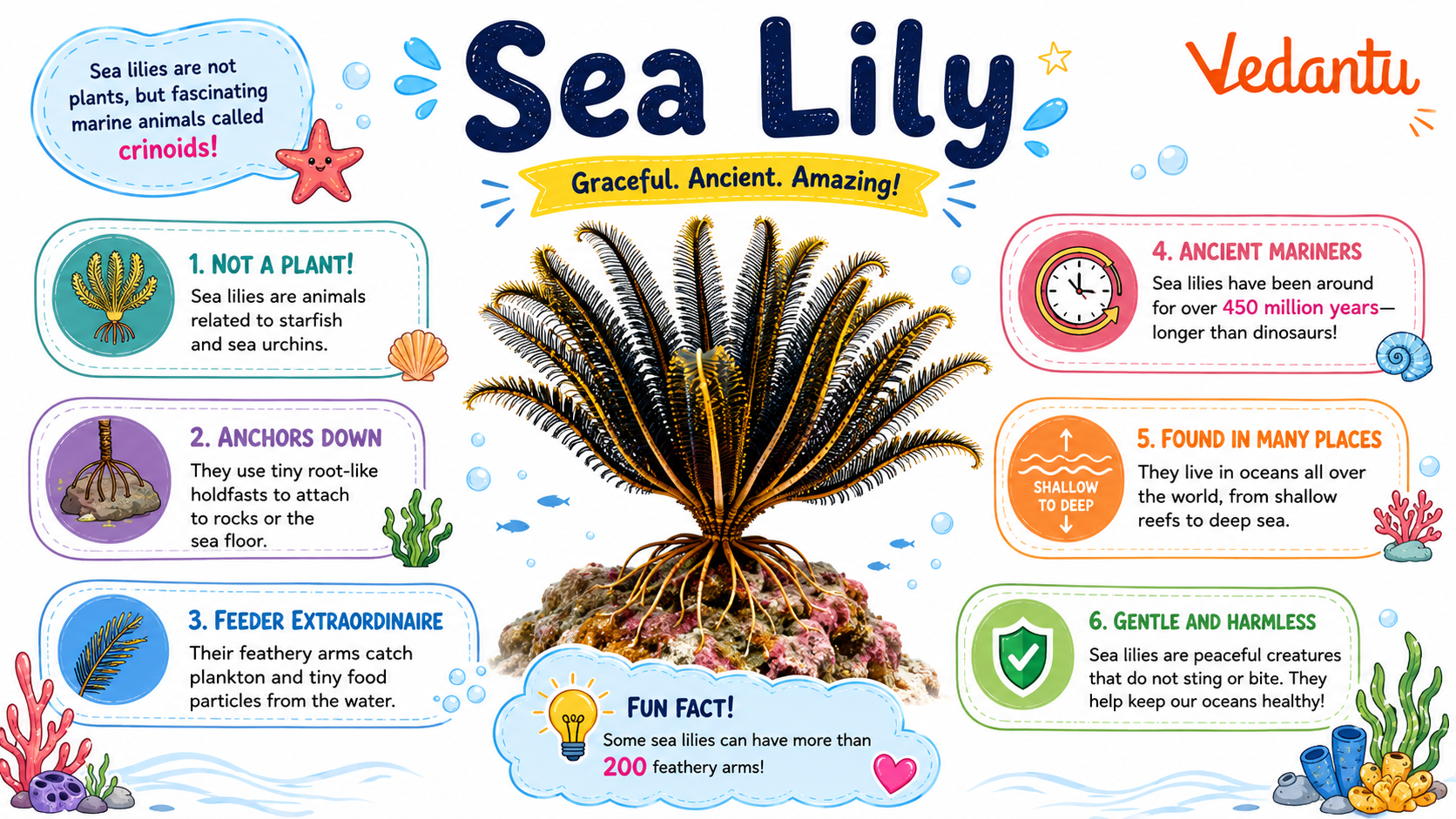
Quick Facts About Sea Lily
| Feature | Details |
|---|---|
| Common Name | Sea Lily |
| Scientific Class | Crinoidea |
| Animal Group | Echinoderm |
| Habitat | Deep sea and shallow marine waters |
| Diet | Plankton and tiny floating particles |
| Lifespan | Up to 10–20 years (varies by species) |
| Movement | Mostly fixed to sea floor; some can crawl slowly |
| Special Feature | Feather-like arms for filter feeding |
Appearance and Physical Characteristics
- Looks like a flower with a long stem and many feathery arms.
- Body has a cup-shaped centre called the calyx.
- Usually has 5 main arms that branch into many smaller arms.
- Arms are covered with tiny tube feet to catch food.
- Colour can be yellow, red, white, purple, or brown.
Sea Lily Habitat and Distribution
- Found in oceans all around the world.
- Mostly live in deep-sea environments.
- Some species live in shallow tropical waters.
- Attach themselves to rocks or the sea floor using their stem.
Diet and Feeding Habits
- Sea Lilies are filter feeders.
- They eat plankton, algae, and tiny floating organisms.
- Their feathery arms trap food particles from water currents.
- Food is passed down grooves on the arms to the mouth.
Behaviour and Lifestyle
- Mostly stationary and attached to one spot.
- Some species can slowly crawl if disturbed.
- Spread arms wide when feeding.
- Retract arms for protection.
- More active when ocean currents are strong.
Sea Lily Life Cycle
- Spawning: Males and females release eggs and sperm into the water.
- Larval Stage: Free-swimming larvae drift in the ocean.
- Attachment: Larva settles and attaches to the sea floor.
- Growth: Develops stem and arms into adult Sea Lily.
- Adult Stage: Fully grown and begins filter feeding.
What Makes Sea Lily Special?
Importance and Role in Nature
Amazing Sea Lily Facts
- Sea Lilies belong to the same group as starfish.
- There are around 600 living species today.
- Some fossil Sea Lilies formed thick underwater forests millions of years ago.
- Their stem can grow up to 1 meter long in some species.
- They do not have a brain.
- They breathe through tiny tube feet.
Fun Facts for Kids
FAQs on Sea Lily: A Fascinating Ancient Marine Animal
1. What is a Sea Lily?
A Sea Lily is a marine animal that looks like a flower but is actually related to starfish.
- Belongs to the group called Crinoids
- Lives in the ocean, especially deep sea habitats
- Has long feather-like arms and a stem
- Is part of the Echinoderm family, like sea stars and sea urchins
2. Are Sea Lilies plants or animals?
Although they look like flowers, Sea Lilies are animals, not plants.
- They cannot make their own food like plants
- They catch tiny food particles from water
- They belong to the animal group Echinodermata
- They are related to starfish and sea urchins
3. Where do Sea Lilies live?
Sea Lilies live mostly in the deep ocean, attached to the sea floor.
- Found in deep-sea habitats
- Attach to rocks or ocean beds using a stem
- Some species live in shallow tropical waters
- Prefer clean, moving ocean currents
4. How do Sea Lilies eat?
Sea Lilies are filter feeders that catch tiny food particles from the water.
- Use feather-like arms to trap plankton
- Sticky tube feet move food to the mouth
- Eat small organisms and organic particles
- Depend on ocean currents for feeding
5. What do Sea Lilies look like?
A Sea Lily looks like an underwater flower with long, flowing arms.
- Has a stem that anchors it to the sea floor
- Features 5 or more feather-like arms
- Body is usually cup-shaped
- Comes in colors like yellow, red, and purple
6. Are Sea Lilies still alive today?
Yes, Sea Lilies still live in today’s oceans, especially in deep waters.
- First appeared over 450 million years ago
- Were very common in prehistoric oceans
- Many fossil Sea Lilies are found in rocks
- Modern species still survive today
7. What is the difference between a Sea Lily and a Feather Star?
The main difference is that Sea Lilies have a stem, while Feather Stars usually do not.
- Sea Lilies stay attached to the ocean floor
- Feather Stars can move freely
- Both are types of Crinoids
- Both are related to starfish
8. Why are Sea Lilies important?
Sea Lilies are important because they help scientists understand ocean life and ancient history.
- Provide clues through fossils
- Help study marine ecosystems
- Show how ocean animals evolved
- Are part of the deep-sea food chain
9. Do Sea Lilies move?
Most Sea Lilies stay attached, but some can slowly move if needed.
- Usually fixed to one spot with a stem
- Can bend or crawl slightly
- Feather Stars (related species) move more freely
- Movement helps them find better feeding spots
10. How long do Sea Lilies live?
Sea Lilies can live for many years in stable ocean environments.
- Exact lifespan depends on species
- Some deep-sea crinoids live for decades
- Grow slowly in cold ocean waters
- Adapt well to deep-sea conditions
