






What Makes the Mantis Shrimp’s Punch and Vision So Powerful?
The mantis shrimp is one of the most fascinating creatures in the ocean world. Though it looks small and colourful, it is famous for its extremely powerful punch and super-sharp vision. Found in warm tropical waters, this marine animal surprises scientists with its speed, strength, and unique body structure. In this page, explore amazing mantis shrimp facts, mantis shrimp habitat, diet, life cycle, characteristics, and why this tiny ocean hunter is so special.
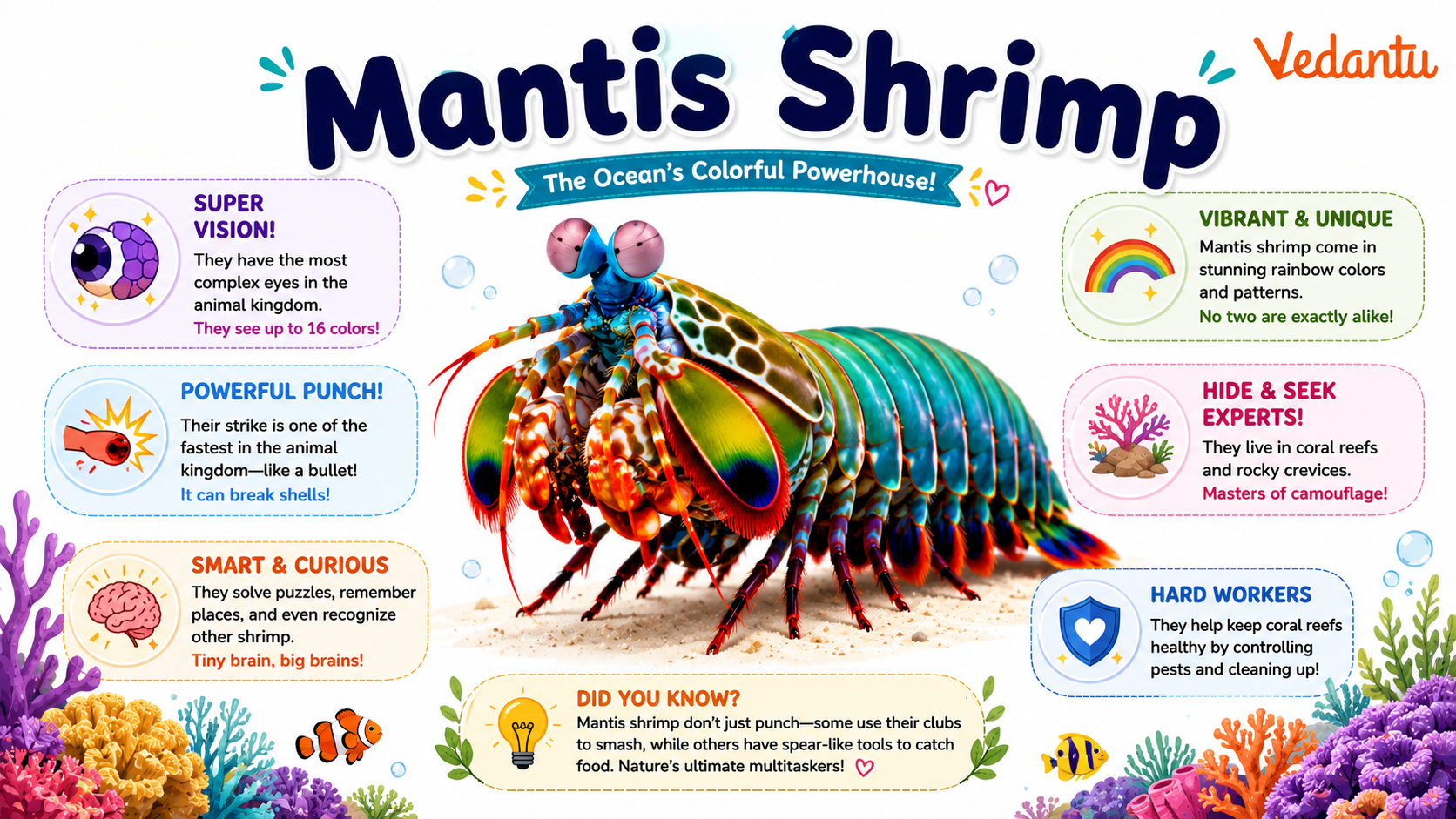
Quick Facts About Mantis Shrimp
| Feature | Details |
|---|---|
| Common Name | Mantis Shrimp |
| Scientific Order | Stomatopoda |
| Animal Group | Crustacean (related to crabs and lobsters) |
| Size | Up to 30 cm (12 inches) |
| Habitat | Tropical and subtropical oceans |
| Diet | Carnivore |
| Lifespan | Up to 20 years (some species) |
| Special Feature | Fastest and most powerful punch in the animal kingdom |
Appearance and Physical Characteristics
- Bright and colourful body – green, blue, red, or rainbow shades.
- Hard outer shell (exoskeleton).
- Large, moving eyes on stalks.
- Strong front limbs shaped like clubs or spears.
- Segmented body like other crustaceans.
Mantis Shrimp Habitat
- Lives in warm tropical and subtropical oceans.
- Found in the Indian Ocean, Pacific Ocean, and parts of the Atlantic Ocean.
- Prefers coral reefs, rocky areas, and sandy sea floors.
- Usually hides inside burrows or holes in rocks.
The mantis shrimp habitat provides safety and food. Coral reefs are rich in small fish and shellfish, making them perfect hunting grounds.
Mantis Shrimp Diet and Feeding Habits
- Small fish
- Crabs
- Snails
- Clams and other shellfish
- Waits inside burrow
- Attacks quickly
- Uses powerful punch or sharp spear
There are two main types of mantis shrimp hunters:
- Smashers: Use club-like limbs to break hard shells.
- Spearers: Use sharp limbs to stab soft prey like fish.
Behaviour and Lifestyle
- Mostly solitary and territorial.
- Very aggressive when threatened.
- Spends time hiding in burrows.
- Can recognize neighbours and avoid unnecessary fights.
- Communicates using body movements and colour signals.
Mantis Shrimp Life Cycle
- Egg Stage: Female lays hundreds of eggs and may carry them.
- Larva Stage: Tiny larvae float in the ocean.
- Juvenile Stage: Young mantis shrimp settle on the sea floor.
- Adult Stage: Fully grown, strong hunters.
The mantis shrimp life cycle includes molting, where they shed their old shell to grow a bigger one.
What Makes Mantis Shrimp Special?
Importance and Role in Nature
- Controls populations of crabs and shellfish.
- Keeps coral reef ecosystems balanced.
- Helps scientists study vision and fast-moving mechanics.
- Important part of the marine food chain.
Amazing Mantis Shrimp Facts
Fun Facts for Kids
- Mantis shrimp look like tiny rainbow warriors.
- Their punch is faster than a blink of an eye.
- They are related to crabs and lobsters.
- Some people call them “thumb splitters” because of their strong claws.
- They are one of the ocean’s strongest little fighters.
FAQs on Mantis Shrimp: The Incredible Ocean Predator with a Super Punch
1. What is a mantis shrimp?
A mantis shrimp is a colorful marine crustacean famous for its powerful punch and amazing eyesight.
- It belongs to the group Stomatopoda
- Lives in tropical and subtropical oceans
- Is not a true shrimp but a distant relative of crabs and lobsters
- Known for bright colors like green, blue, and red
2. Why is the mantis shrimp punch so powerful?
The mantis shrimp punch is powerful because it moves as fast as a bullet and creates shockwaves underwater.
- Its club strikes at speeds of up to 50 mph (80 km/h)
- Creates tiny bubbles called cavitation bubbles
- The bubbles collapse and release extra heat and force
- Can break shells, glass, and even aquarium tanks
3. Where do mantis shrimp live?
Mantis shrimp live in warm ocean waters around the world.
- Found in Indian, Pacific, and Atlantic Oceans
- Prefer coral reefs and sandy sea floors
- Hide inside burrows in rocks or sand
- Stay close to coastal tropical areas
4. What do mantis shrimp eat?
Mantis shrimp are carnivores that hunt other sea animals.
- Eat crabs, snails, clams, and small fish
- Use their powerful claws to smash or spear prey
- Some species are called smashers
- Others are known as spearers
5. How good is mantis shrimp vision?
Mantis shrimp have some of the most advanced eyes in the animal kingdom.
- Can see more colors than humans
- Detect ultraviolet (UV) light
- Have up to 16 types of color receptors
- Each eye can move independently
6. How big can a mantis shrimp grow?
Most mantis shrimp are small but some species grow quite large.
- Average size is about 4 to 10 inches
- The largest species can reach 15 inches long
- Size depends on species and habitat
- Despite small size, they are strong predators
7. Are mantis shrimp dangerous to humans?
Mantis shrimp are not dangerous unless handled carelessly.
- They do not attack humans on purpose
- Can cause injury with their powerful claws
- Fishermen sometimes get cuts or bruises
- Best observed safely in the wild or aquariums
8. How long do mantis shrimp live?
Mantis shrimp can live several years depending on the species.
- Average lifespan is about 3 to 6 years
- Some larger species may live longer
- Spend much of their life inside burrows
- Grow by shedding their outer shell (molting)
9. What makes mantis shrimp different from regular shrimp?
Mantis shrimp are different from regular shrimp because of their body shape, hunting style, and vision.
- Have raptorial claws for smashing or spearing
- Possess advanced compound eyes
- Are more closely related to crabs and lobsters
- Are aggressive hunters rather than scavengers
10. Why are mantis shrimp important to the ocean ecosystem?
Mantis shrimp help keep ocean ecosystems balanced by controlling prey populations.
- Act as important marine predators
- Help maintain healthy coral reef ecosystems
- Serve as prey for larger sea animals
- Contribute to marine biodiversity
