






Why Is the Javan Rhinoceros Critically Endangered and Where Does It Live?
The Javan Rhinoceros is one of the rarest large mammals on Earth. Once found across many parts of Asia, today it survives in only one small region. Known for its single horn and thick, folded skin, this shy animal lives deep inside tropical forests. Learning about Javan Rhinoceros facts, habitat, diet, characteristics, and importance helps us understand why protecting this species is so important for our planet.
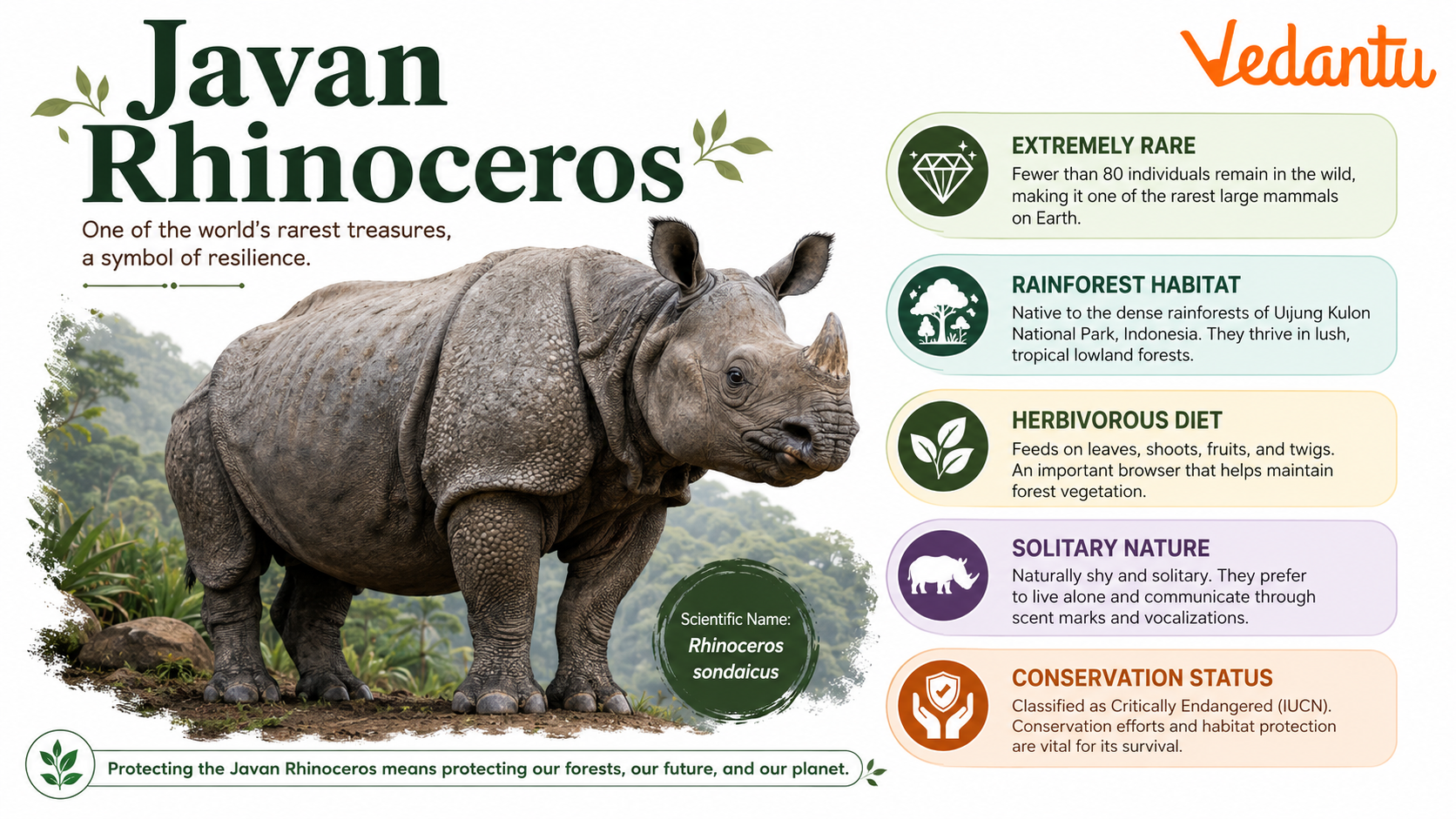
Quick Facts and Statistics
| Feature | Details |
|---|---|
| Common Name | Javan Rhinoceros |
| Scientific Name | Rhinoceros sondaicus |
| Animal Group | Mammal |
| Height | 1.4 – 1.7 metres at the shoulder |
| Weight | 900 – 2,300 kg |
| Lifespan | 30 – 40 years (in the wild) |
| Diet | Herbivore (plants, leaves, shoots) |
| Habitat | Tropical rainforests and wetlands |
| Conservation Status | Critically Endangered |
| Found In | Ujung Kulon National Park, Indonesia |
Appearance and Physical Characteristics
- Large, heavy body with thick, grey-brown skin.
- Skin looks like natural armour plates with deep folds.
- Has only one horn (usually 20–25 cm long).
- Small eyes but strong sense of smell and hearing.
- Wide mouth perfect for eating leaves and plants.
Habitat and Distribution
- Lives in dense tropical rainforests.
- Found near rivers, swamps, and muddy areas.
- Prefers lowland forests with thick vegetation.
- Today, it survives only in Ujung Kulon National Park in Indonesia.
Diet and Feeding Habits
- Herbivore – eats only plants.
- Feeds on leaves, shoots, twigs, and fallen fruits.
- Uses its flexible upper lip to grab branches.
- Can eat dozens of different plant species.
Behaviour and Lifestyle
- Mostly solitary (lives alone).
- Active during early morning and late afternoon.
- Loves mud wallows to cool down and protect skin from insects.
- Marks territory using dung and scent.
- Generally shy and avoids humans.
Life Cycle and Reproduction
- Birth: Female gives birth to one calf after about 16 months of pregnancy.
- Calf Stage: The baby stays close to its mother for protection.
- Growing Up: Calf drinks milk and slowly learns to eat plants.
- Independence: Becomes independent after 2–3 years.
- Adult Stage: Reaches maturity around 5–7 years.
What Makes the Javan Rhinoceros Special?
Importance and Role in Nature
Amazing Javan Rhinoceros Facts
- It is one of the five remaining rhino species in the world.
- There are fewer than 100 Javan Rhinoceroses alive today.
- It is closely related to the Indian Rhinoceros.
- It can live up to 40 years in the wild.
- It uses mud baths to prevent skin infections.
- It has very poor eyesight but strong hearing.
- Poaching and habitat loss caused its rapid decline.
Interesting Facts About Javan Rhinoceros
Fun Facts for Kids
FAQs on Javan Rhinoceros: The Rarest Rhino on Earth
1. What is a Javan Rhinoceros?
The Javan Rhinoceros is one of the rarest large mammals in the world and is critically endangered.
- Scientific name: Rhinoceros sondaicus
- Also called the Javan rhino or Sunda rhinoceros
- Belongs to the Asian rhinoceros family
- Known for having a single horn
- Native to Indonesia
2. Where does the Javan Rhinoceros live?
The Javan Rhinoceros lives only in Ujung Kulon National Park in Indonesia.
- Located on the island of Java
- Prefers dense rainforests and swampy areas
- Stays near rivers and mud wallows
- No longer found in other Asian countries
3. Why is the Javan Rhinoceros endangered?
The Javan Rhinoceros is endangered mainly due to human activities and habitat loss.
- Poaching for its horn
- Loss of forest habitat
- Natural disasters like volcanic eruptions
- Very small population size
4. How many Javan Rhinoceroses are left in the world?
There are fewer than 80 Javan Rhinoceroses left in the world today.
- All live in one national park
- No individuals are kept in zoos
- Population is carefully monitored
- Numbers slowly increasing due to conservation
5. What does a Javan Rhinoceros eat?
The Javan Rhinoceros is a herbivore that eats plants and vegetation.
- Leaves from trees and shrubs
- Young shoots and twigs
- Fruits and fallen plants
- Sometimes aquatic plants
6. How is the Javan Rhinoceros different from other rhinos?
The Javan Rhinoceros is smaller and has unique features compared to other rhino species.
- Has only one small horn
- Smoother skin with plate-like folds
- Smaller than the Indian Rhinoceros
- Extremely rare compared to African rhinos
7. How big is a Javan Rhinoceros?
The Javan Rhinoceros is a large but slightly smaller Asian rhino species.
- Length: about 10–12 feet
- Height: around 5–6 feet at the shoulder
- Weight: up to 2,300 kg (5,000 pounds)
- Horn length: usually less than 10 inches
8. What is being done to protect the Javan Rhinoceros?
Strong conservation efforts are helping protect the Javan Rhinoceros from extinction.
- Strict protection in Ujung Kulon National Park
- Anti-poaching patrols
- Wildlife monitoring using camera traps
- Habitat restoration programs
9. Do Javan Rhinoceroses have predators?
Adult Javan Rhinoceroses have almost no natural predators.
- Large size protects them
- Calves may be at risk from wild animals
- Main threat is humans
- Habitat destruction is a bigger danger than predators
10. Why is the Javan Rhinoceros important?
The Javan Rhinoceros is important because it helps keep forest ecosystems healthy.
- Spreads plant seeds
- Maintains forest balance
- Symbol of wildlife conservation
- Represents biodiversity in Indonesia
