






Where Do Indian Rhinoceroses Live and Why Are They Endangered?
The Indian Rhinoceros is one of the most powerful and fascinating wild animals found in Asia. Known for its thick, armour-like skin and a single strong horn, this giant herbivore plays an important role in maintaining grassland ecosystems. Indian Rhinoceros facts reveal that it is the largest of all Asian rhinos and a symbol of wildlife conservation in India and Nepal. Let us explore its habitat, diet, characteristics, life cycle, and interesting facts in a simple and engaging way.
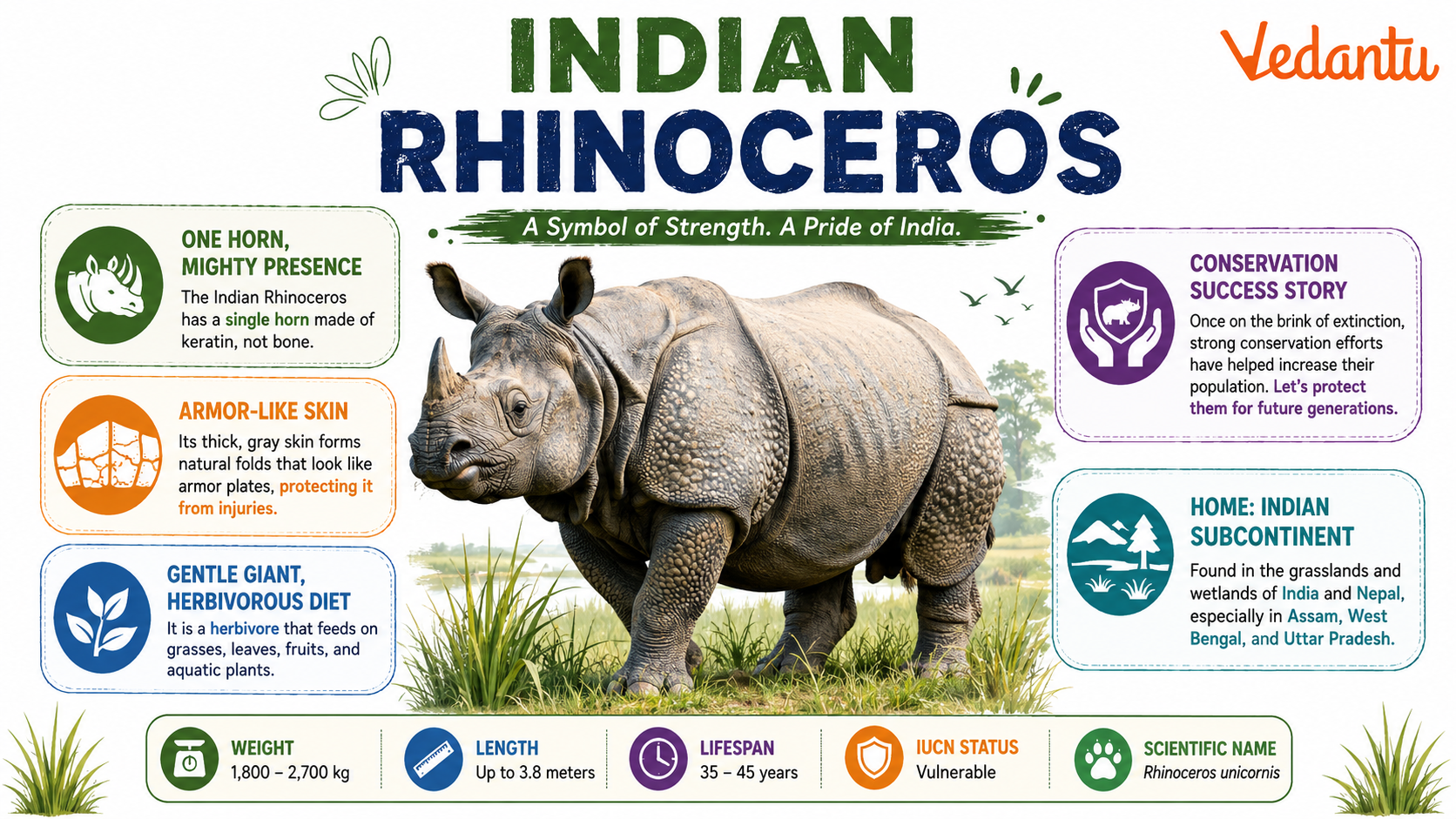
Quick Facts and Statistics
| Feature | Details |
|---|---|
| Common Name | Indian Rhinoceros |
| Scientific Name | Rhinoceros unicornis |
| Animal Group | Mammal |
| Size | 3–3.8 metres long |
| Weight | 1,800–2,700 kg |
| Lifespan | 35–45 years |
| Habitat | Grasslands, wetlands, riverbanks |
| Diet | Herbivore (grass, leaves, fruits) |
| Conservation Status | Vulnerable |
| Found In | India and Nepal |
Appearance and Physical Characteristics
- Massive body with thick, grey-brown skin.
- Skin folds look like natural armour plates.
- One single black horn on the nose (about 20–60 cm long).
- Small eyes but strong sense of smell and hearing.
- Short, sturdy legs to support its heavy weight.
Habitat and Distribution
The Indian Rhinoceros habitat mainly includes tropical and subtropical grasslands and wetlands.
- Found mostly in northern India and southern Nepal.
- Lives near rivers, swamps, and tall grasslands.
- Prefers areas with plenty of water for wallowing.
Diet and Feeding Habits
The Indian Rhinoceros diet makes it a strict herbivore.
- Mainly eats tall grasses.
- Also feeds on leaves, fruits, branches, and aquatic plants.
- Uses its strong lips to grab and pull grass.
- Spends many hours a day grazing.
Behaviour and Lifestyle
- Usually solitary animals (live alone).
- Adult males are territorial.
- Active during early morning and evening.
- Loves to roll in mud to cool down and protect skin.
- Communicates using grunts, snorts, and honks.
Life Cycle and Reproduction
- Birth: A female gives birth to one calf after about 15–16 months of pregnancy.
- Calf Stage: Baby rhinos stay with their mother for up to 2–3 years.
- Juvenile Stage: Young rhinos slowly become independent.
- Adult Stage: Reach maturity at around 6–8 years.
The Indian Rhinoceros life cycle is slow, which is why protecting them is very important.
What Makes the Indian Rhinoceros Special?
Importance and Role in Nature
Amazing Facts About Indian Rhinoceros
- It is the largest of the three Asian rhino species.
- Its skin can be up to 5 cm thick.
- Despite poor eyesight, it has sharp hearing.
- Can eat up to 40 kg of grass in a day.
- Once roamed across the entire northern Indian subcontinent.
- Population has increased due to strong conservation efforts.
Interesting Facts About Indian Rhinoceros
- Also called the “Greater One-Horned Rhino”.
- Spends a lot of time in water during hot weather.
- Calves make squeaking sounds to call their mothers.
- Its horn continues to grow throughout its life.
Fun Facts for Kids
- It looks like it is wearing natural body armour.
- It loves mud baths just like kids love splashing in water!
- Its horn is made of the same material as your hair.
- It can run faster than a bicycle in short bursts.
- Baby rhinos are called calves.
FAQs on Indian Rhinoceros: Facts, Habitat, Diet and Conservation
1. What is an Indian Rhinoceros?
The Indian Rhinoceros, also called the Greater One-Horned Rhinoceros, is a large plant-eating mammal found in South Asia.
- Scientific name: Rhinoceros unicornis
- Known for its single black horn
- Has thick, armor-like skin folds
- Native to India and Nepal
- One of the five species of rhinoceros in the world
2. Where do Indian Rhinoceroses live?
The Indian Rhinoceros habitat includes grasslands and river areas in northern India and Nepal.
- Found in Kaziranga National Park (Assam)
- Lives in floodplain grasslands and wetlands
- Prefers areas near rivers and swamps
- Thrives in tropical and subtropical climates
3. What do Indian Rhinoceroses eat?
The Indian Rhinoceros diet mainly consists of plants and grasses.
- Eats tall grasses
- Feeds on leaves, fruits, and crops
- Uses its prehensile upper lip to grab food
- Is a strict herbivore
4. Why is the Indian Rhinoceros called the Greater One-Horned Rhino?
The Greater One-Horned Rhino gets its name from its single horn.
- Has one horn made of keratin
- Horn usually grows up to 8–25 inches long
- Different from African rhinos that have two horns
- Horn is often targeted by poachers
5. How big is an Indian Rhinoceros?
The Indian Rhinoceros size makes it one of the largest land animals in Asia.
- Weighs between 1,800–2,700 kg
- Can grow up to 6 feet tall at the shoulder
- Body length is about 10–12 feet
- Second largest rhino species after the White Rhino
6. Is the Indian Rhinoceros endangered?
The Indian Rhinoceros conservation status is classified as Vulnerable, but its population is increasing.
- Once hunted close to extinction
- Protected under wildlife conservation laws
- Major threat: poaching for horns
- Successful recovery due to national parks and protection programs
7. How long do Indian Rhinoceroses live?
The Indian Rhinoceros lifespan can reach up to 40 years in safe conditions.
- Lives 35–40 years in the wild
- May live longer in protected reserves
- Calves stay with mothers for about 2 years
- Faces fewer predators as adults
8. What are the main threats to Indian Rhinoceroses?
The biggest threats to the Indian Rhinoceros are human activities.
- Poaching for illegal horn trade
- Habitat loss due to farming and development
- Flooding in natural habitats
- Human-wildlife conflict
9. How do Indian Rhinoceroses protect themselves?
The Indian Rhinoceros defense system relies on its size, strength, and horn.
- Uses its horn to fight enemies
- Has thick, armor-like skin
- Can run up to 55 km/h
- Has strong hearing and sense of smell
10. Why are Indian Rhinoceroses important to the ecosystem?
The Indian Rhinoceros plays a key role in keeping its ecosystem healthy.
- Controls grass growth in grasslands
- Spreads seeds through dung
- Creates paths used by other animals
- Acts as an umbrella species for conservation
