


Class 11 Geography Chapter 1 India - Location Notes for CBSE 2026-27
The following Class 11 Geography India Location notes explain the major topics from Chapter 1 in a structured format.
1. Geographical Location and Extent of India
India is located in the Northern and Eastern Hemispheres, in the south-central part of Asia. Its mainland extends from the Himalayan region in the north to Kanniyakumari in the south.
The country has a wide geographical extent, which contributes to differences in climate, landforms and natural vegetation.
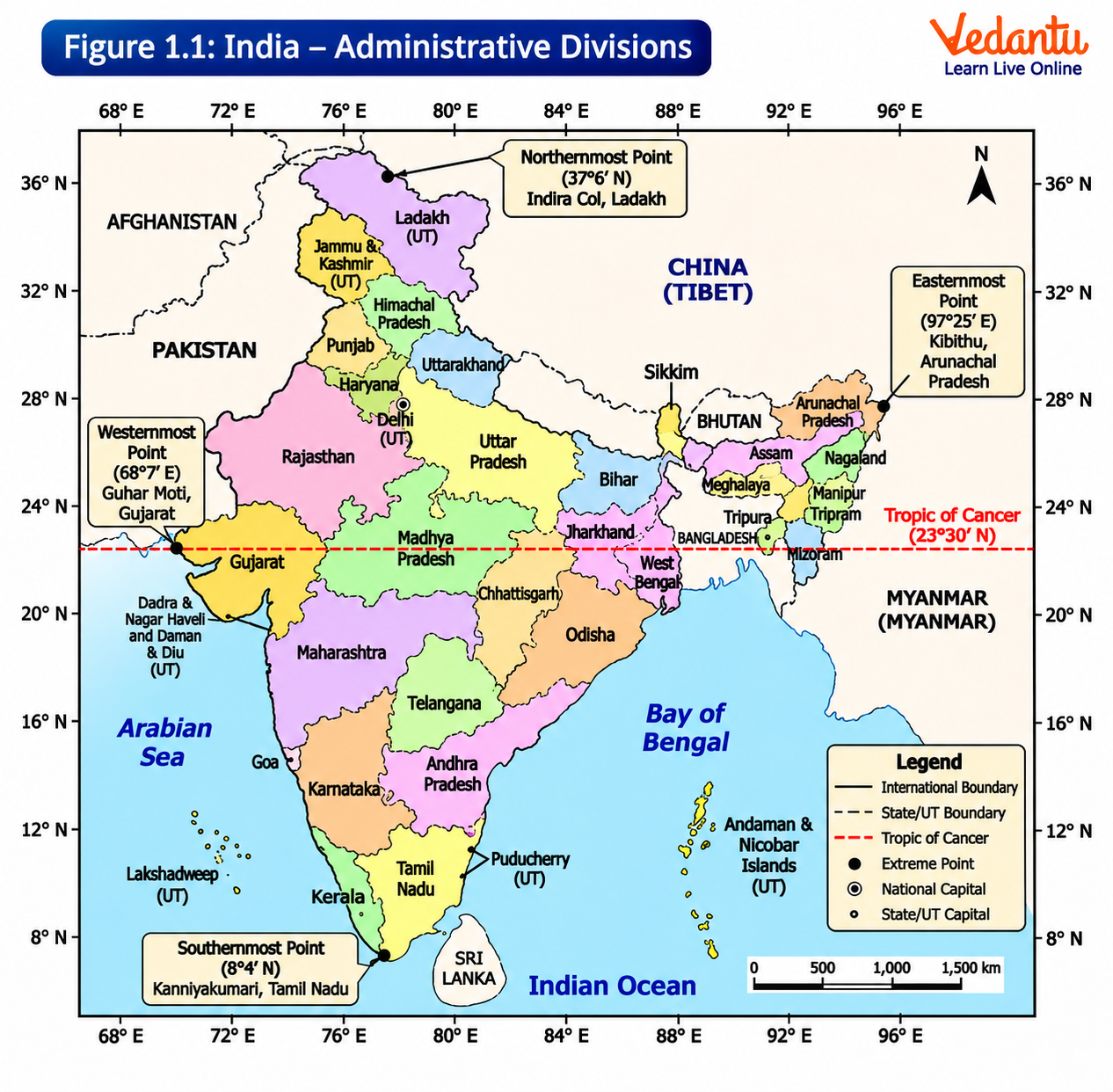
Important Concept: Although India's latitudinal and longitudinal extents are both nearly 30°, the north-south distance is greater than the east-west distance.
This happens because the distance between lines of longitude decreases towards the poles, while the distance represented by one degree of latitude remains nearly constant.
2. Latitudinal Extent and Its Influence on India
Latitude measures the angular distance of a place north or south of the Equator.
India's latitudinal extent places its southern region in the tropical zone and its northern region in the subtropical or warm temperate zone.
This contributes to geographical variations across the country.
The Tropic of Cancer, located at approximately 23°30′ N, passes through India and helps distinguish tropical and subtropical latitudinal regions.
3. Longitudinal Extent and Indian Standard Time
Longitude measures the angular distance of a place east or west of the Prime Meridian.
India extends across nearly 30° of longitude. This creates a local solar-time difference of approximately two hours between its easternmost and westernmost regions.
Why does the Sun rise earlier in northeastern India?
The Earth rotates from west to east. Therefore, places farther east experience sunrise earlier than places farther west.
For example, the Sun rises in northeastern India considerably earlier than in western Rajasthan.
How is the time difference calculated?
The Earth rotates through 360° in 24 hours.
15° of longitude corresponds to 1 hour.
1° of longitude corresponds to 4 minutes.
Approximately 30° corresponds to 120 minutes, or 2 hours.
Despite this difference, India follows one official standard time.
Important Concept: Kohima, New Delhi and Jaisalmer follow the same official clock time because India uses Indian Standard Time, even though their local sunrise times differ.
4. Size and Area of India
India is the seventh-largest country in the world by geographical area.
According to the chapter, India covers approximately 3.28 million square kilometres and accounts for around 2.4% of the world's land area.
India's large area accommodates mountains, plains, rivers, deserts, forests, coasts and islands.
Textbook note: The coastline figures above follow the supplied textbook edition. They should be treated as textbook figures rather than independently verified current measurements.
5. Physical Diversity of India
India's size and location contribute to considerable physical diversity.
The country includes high mountains in the north, extensive river systems, forested hills, desert regions and a large peninsular landmass.
These geographical differences influence natural resources and the environmental conditions of different regions.
6. India and the Indian Subcontinent
The Indian subcontinent is a distinct geographical region of South Asia.
The chapter describes India, Pakistan, Nepal, Bhutan and Bangladesh as part of this regional geographical entity.
Major mountain systems and surrounding seas have contributed to its geographical identity.
Important mountain systems mentioned in the chapter:
Himalayas in the north
Hindu Kush and Sulaiman ranges towards the northwest
Purvachal hills towards the northeast
Historically, these mountain systems restricted movement across several regions.
However, mountain passes provided important routes for travel and interaction.
Modern transport and communication have made interaction across difficult terrain easier than in the past.
7. India and Its Neighbouring Countries
India occupies an important position in South Asia and has both land and maritime neighbours.
The Himalayan region forms a major geographical boundary in the north, while the Indian Ocean lies to the south.
India's northwestern geographical context also includes Afghanistan.
Important Fact: Sri Lanka is separated from India by the Palk Strait and the Gulf of Mannar.
Difference Between a Gulf and a Strait
8. Importance of India's Maritime Location
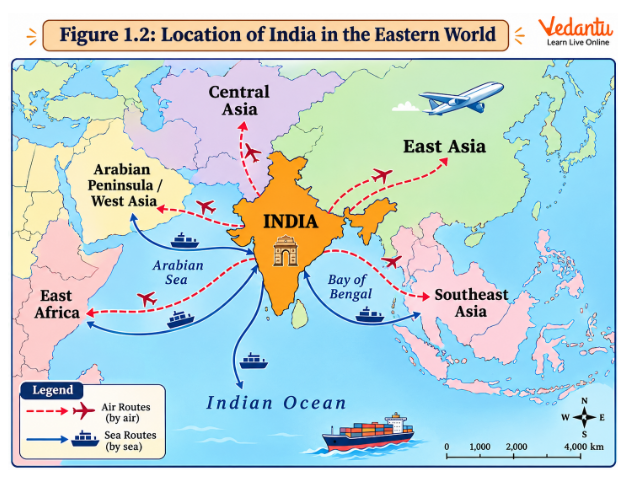
Peninsular India extends southward into the Indian Ocean.
The Arabian Sea lies to its west, while the Bay of Bengal lies to its east.
This location provides important geographical connections with neighbouring regions.
9. Important Maps in Class 11 Geography Chapter 1
Map-based learning is an important part of India - Location.
Map Practice: Locate the Arabian Sea, Bay of Bengal, Indian Ocean, Lakshadweep, Andaman and Nicobar Islands, Tropic of Cancer and India's neighbouring countries on a current outline map.
The supplied textbook map is from an older edition, so use an updated political map when studying present-day administrative boundaries.
Important Topics Covered in Class 11 Geography Chapter 1 India - Location
The following table summarises the concepts students should focus on while preparing from the Class 11 Geography Chapter 1 notes India Location.
Why are Class 11 Geography Chapter 1 India - Location Notes Important?
Vedantu's Class 11 Geography India Physical Environment Chapter 1 notes help students understand India's geographical location through clear explanations, tables and maps.
These notes make it easier to remember important geographical facts, understand the relationship between latitude and climate, and explain how India's location influences its connections with other regions.
How to Prepare Class 11 Geography Chapter 1 India - Location with Vedantu?
Students can use these Class 11 Geography Chapter 1 India Location short notes to review important facts and practise geographical reasoning.
Learn the coordinates accurately: Remember the latitudinal and longitudinal extent of mainland India and distinguish it from the southern extent, including islands.
Practise time calculations: Understand why 1° of longitude corresponds to four minutes and how India's nearly 30° longitudinal spread creates a two-hour difference.
Use maps regularly: Identify the Tropic of Cancer, neighbouring countries, surrounding seas and island groups.
Compare geographical distances: Explain why India's north-south distance is greater than its east-west distance despite similar angular extents.
Prepare short explanations: Practise answering questions about the standard meridian, the Indian subcontinent and the importance of the coastline.
Check your understanding: Use Vedantu's Class 11 Geography notes and important questions to practise both factual and reasoning-based answers.
Preparation Tip: Do not memorise only the figures. Learn what they explain. For example, connect 82°30′ E with Indian Standard Time and the country's longitudinal extent with differences in local solar time.
Conclusion
Chapter 1, India - Location, explains how India's geographical position shapes its physical environment and connections with other regions. Understanding latitude, longitude, Indian Standard Time, geographical size, neighbouring countries and maritime location provides a strong foundation for later chapters.
Students can use Vedantu's chapter notes, maps and solved practice questions to strengthen their understanding and prepare for Class 11 Geography examinations.
CBSE Class 11 Geography Chapter 1 Study Materials
CBSE Class 11 Geography Other Books Notes and Study Resources
CBSE Class 11 Geography India: Physical Environment Chapter-wise Notes
Other Important Study Materials for CBSE Class 11 Geography
FAQs on CBSE Class 11 Geography India: Physical Environment Chapter 1 India - Location Notes 2026-27
1. What are the main topics covered in Class 11 Geography Chapter 1 India - Location notes?
The notes cover India's latitudinal and longitudinal extent, geographical size, Indian Standard Time, physical diversity, coastline, island groups and neighbouring countries. They also explain India's location in Asia and its maritime connections.
2. What is the latitudinal and longitudinal extent of India?
Mainland India extends from approximately 8°4′ N to 37°6′ N latitude and 68°7′ E to 97°25′ E longitude. Including its islands, India's territory extends farther south to approximately 6°45′ N.
3. Why is 82°30′ E selected as the Standard Meridian of India?
India uses 82°30′ E as its standard meridian to maintain a common official time across the country. Indian Standard Time is 5 hours and 30 minutes ahead of Greenwich Mean Time.
4. Why is India's north-south distance greater than its east-west distance?
India's north-south distance is approximately 3,214 km, while its east-west distance is around 2,933 km. This happens because lines of longitude converge towards the poles, while the distance represented by one degree of latitude remains nearly constant.
5. Where can I find notes for Class 11 Geography Chapter 1 India Location?
Vedantu provides chapter-wise Geography notes explaining India's geographical extent, standard meridian, physical diversity and neighbouring countries. Students can study the topic-wise explanations and use the accompanying PDF for preparation.
6. How can I use the Class 11 Geography India Physical Environment Chapter 1 notes PDF?
Begin with the location and size tables, then study the explanations of latitude, longitude and Indian Standard Time. Use the maps to identify neighbouring countries, islands and surrounding seas. Finally, practise explaining geographical relationships in your own words.
7. How does India's location influence its climate and natural vegetation?
Southern India lies within tropical latitudes, while northern India extends into subtropical latitudes. Along with relief and other geographical factors, this latitudinal spread contributes to differences in climate, soil and natural vegetation.
8. What is the importance of India's location in the Indian Ocean?
India's peninsular landmass extends into the Indian Ocean, with the Arabian Sea to the west and the Bay of Bengal to the east. This location provides maritime connections with neighbouring countries and other regions of Asia and Africa.
9. Are Class 11 Geography Chapter 1 India Location short notes enough for exam preparation?
Short notes are useful for reviewing key facts, definitions and geographical relationships. Students should also study the textbook maps, practise numerical questions involving longitude and prepare descriptive answers to strengthen their understanding.
10. How can I use the Class 11 Geography India Physical Environment Chapter 1 notes PDF for map-based questions?
Use the notes alongside Figures 1.1 and 1.2 of the textbook. Practise identifying India's geographical extent, surrounding seas, neighbouring countries and island groups. Use an updated political map for present-day administrative boundaries.