




What is a reflex arc?
Answer
 Verified
577.8k+ views
Hint: Sensory, motor, and relay neurons are the three main types of neuron.
In a reflex action, these many types of neurons operate together. A reflex action is an automatic (involuntary) and quick reaction to a stimulus that protects the body from potentially dangerous situations like touching something hot. Many species' existence depends on their ability to react quickly. This typical process is followed by a reflex action, which does not involve the conscious section of the brain. This is why there is such a quick response.
Complete answer:
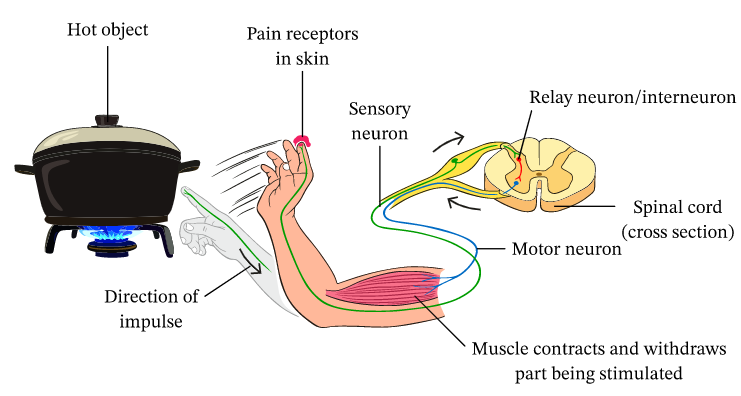
The reflex arc is the neural pathway that reflex activity follows. For example when we inadvertently touch something hot, we experience the reaction arc. The receptor detects the change in temperature first. The electrical impulses are then delivered to the relay neuron in the spinal cord. Sensory neurons bridge the gap between motor neurons and sensory neurons. The motor neuron sends electrical impulses to an effector. The effector generates a response.
The reflex arc is a sort of neural circuit that starts with a sensory neuron at a receptor and finishes with a motor neuron at an effector (for example, a pain receptor in the fingertip) (e.g., a skeletal muscle).
Most sensory neurons in vertebrates synapse in the spinal cord rather than passing directly into the brain. This enables faster reflex actions by engaging spinal motor neurons without having to wait for messages to go to the brain.
Receptors, sensory neurons, interneurons, motor neurons, and muscles are the five primary components of most reflex arcs. Interneurons are not used by all reflexes. Some do not employ interneurons and connect sensory neurons directly to motor neurons.
Note:
The autonomic reflex arc, which affects inner organs, and the somatic reflex arc, which affects muscles, are the two types of reflex arcs. Monosynaptic reflex arcs are those that have only two neurons, one sensory neuron, and one motor neuron.
The presence of a single chemical synapse is referred to as monosynaptic. Brief stimulation of the muscle spindle causes the agonist or effector muscle to contract in peripheral muscle reflexes (patellar reflex, achilles reflex).
In a reflex action, these many types of neurons operate together. A reflex action is an automatic (involuntary) and quick reaction to a stimulus that protects the body from potentially dangerous situations like touching something hot. Many species' existence depends on their ability to react quickly. This typical process is followed by a reflex action, which does not involve the conscious section of the brain. This is why there is such a quick response.
Complete answer:
The reflex arc is the neural pathway that reflex activity follows. For example when we inadvertently touch something hot, we experience the reaction arc. The receptor detects the change in temperature first. The electrical impulses are then delivered to the relay neuron in the spinal cord. Sensory neurons bridge the gap between motor neurons and sensory neurons. The motor neuron sends electrical impulses to an effector. The effector generates a response.
The reflex arc is a sort of neural circuit that starts with a sensory neuron at a receptor and finishes with a motor neuron at an effector (for example, a pain receptor in the fingertip) (e.g., a skeletal muscle).
Most sensory neurons in vertebrates synapse in the spinal cord rather than passing directly into the brain. This enables faster reflex actions by engaging spinal motor neurons without having to wait for messages to go to the brain.
Receptors, sensory neurons, interneurons, motor neurons, and muscles are the five primary components of most reflex arcs. Interneurons are not used by all reflexes. Some do not employ interneurons and connect sensory neurons directly to motor neurons.
Note:
The autonomic reflex arc, which affects inner organs, and the somatic reflex arc, which affects muscles, are the two types of reflex arcs. Monosynaptic reflex arcs are those that have only two neurons, one sensory neuron, and one motor neuron.
The presence of a single chemical synapse is referred to as monosynaptic. Brief stimulation of the muscle spindle causes the agonist or effector muscle to contract in peripheral muscle reflexes (patellar reflex, achilles reflex).
Recently Updated Pages
A Paragraph on Pollution in about 100-150 Words

Write any three differences between metals and nonmetals class 10 social science CBSE
Amit standing on a horizontal plane finds a bird flying class 10 maths CBSE
Two circles of radii 5 cm and 3 cm intersect at two class 10 maths CBSE
Solve the following i John and Jivanti together have class 10 maths CBSE
What is the relation between orthocenter circumcentre class 10 maths CBSE
Trending doubts
Explain the Treaty of Vienna of 1815 class 10 social science CBSE
10 examples of evaporation in daily life with explanations
What is the full form of POSCO class 10 social science CBSE
Make a sketch of the human nerve cell What function class 10 biology CBSE
The uses of bleaching powder are A It is used bleaching class 10 chemistry CBSE
GST is a direct or indirect tax?