




What are porins?
Answer
 Verified
535.8k+ views
Hint: These are proteins that form pores in membranes. These help in the transport of various substances and molecules across the membrane. They create ion channels which help in the movement of substance.
Complete answer:
Porins are beta-barrel proteins that cross cellular membranes and act as a pore, through which molecules can diffuse. They allow huge molecules up to the size of protein to pass through the membrane. They help in the facilitated transport of small size protein molecules.
-Porins act as channels that are specific to different types of molecules.
-They are present in the outer membrane of gram-negative bacteria and some gram-positive bacteria, the outer membrane of mitochondria and chloroplast.
-Porins are made up of beta-sheets linked together by beta turns and long loops of amino acids.
-Depending on the size of the porin, the interior of the protein may either be filled with water or have a stopper segment.
-There are two types of porins that transport different materials – general and selective porins.
-General porins have no substrate preference, it can be anion or cation.
-Selective porins are smaller than general porins and have specificities to chemical species.
-The channels are found in the cell envelope and help facilitate solute transfer in archaea.
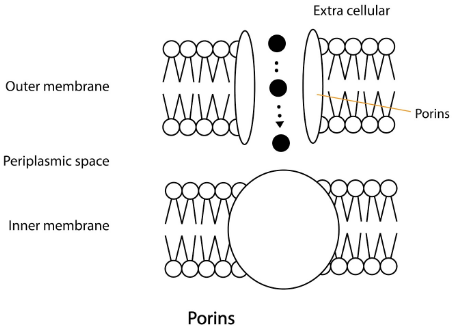
Note:
There is another structure of porin called aquaporins which are protein molecules embedded in the cell membrane which allow the flow of water molecules. They are present in the cell membrane of plant and animal cells and form water selective channels to allow water to pass freely across the membrane.
Complete answer:
Porins are beta-barrel proteins that cross cellular membranes and act as a pore, through which molecules can diffuse. They allow huge molecules up to the size of protein to pass through the membrane. They help in the facilitated transport of small size protein molecules.
-Porins act as channels that are specific to different types of molecules.
-They are present in the outer membrane of gram-negative bacteria and some gram-positive bacteria, the outer membrane of mitochondria and chloroplast.
-Porins are made up of beta-sheets linked together by beta turns and long loops of amino acids.
-Depending on the size of the porin, the interior of the protein may either be filled with water or have a stopper segment.
-There are two types of porins that transport different materials – general and selective porins.
-General porins have no substrate preference, it can be anion or cation.
-Selective porins are smaller than general porins and have specificities to chemical species.
-The channels are found in the cell envelope and help facilitate solute transfer in archaea.
Note:
There is another structure of porin called aquaporins which are protein molecules embedded in the cell membrane which allow the flow of water molecules. They are present in the cell membrane of plant and animal cells and form water selective channels to allow water to pass freely across the membrane.
Recently Updated Pages
Master Class 11 Computer Science: Engaging Questions & Answers for Success

Master Class 11 Business Studies: Engaging Questions & Answers for Success
Master Class 11 Economics: Engaging Questions & Answers for Success
Master Class 11 English: Engaging Questions & Answers for Success
Master Class 11 Maths: Engaging Questions & Answers for Success
Master Class 11 Biology: Engaging Questions & Answers for Success
Trending doubts
One Metric ton is equal to kg A 10000 B 1000 C 100 class 11 physics CBSE
There are 720 permutations of the digits 1 2 3 4 5 class 11 maths CBSE
Discuss the various forms of bacteria class 11 biology CBSE
Draw a diagram of a plant cell and label at least eight class 11 biology CBSE
State the laws of reflection of light
10 examples of friction in our daily life