




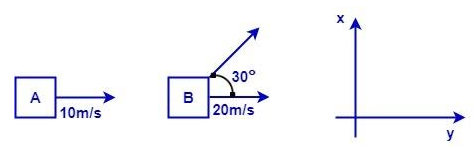
Two objects A and B are moving along the directions as shown in the figure. Find the magnitude and direction of the relative velocity of B w.r.t. A.
Answer
 Verified
564.6k+ views
Hint Relative velocity of B w.r.t. A is given by:
$\Rightarrow \overrightarrow{{{v}_{BA}}}=\overrightarrow{{{v}_{B}}}-\overrightarrow{{{v}_{A}}} $
Magnitude of this relative velocity is $ \left| \overrightarrow{{{v}_{BA}}} \right| $
Direction of this relative velocity is given by the angle $ \alpha $ which is calculated by:
$\Rightarrow \tan \alpha =\frac{{{v}_{B{{A}_{y}}}}}{{{v}_{B{{A}_{x}}}}} $
Where $ {{v}_{B{{A}_{y}}}} $ and $ {{v}_{B{{A}_{x}}}} $ are the y and x components of $ \overrightarrow{{{v}_{BA}}} $ .
Complete step by step solution
$ \begin{align}
&\Rightarrow \overrightarrow{{{v}_{A}}}=10\widehat{i} \\
&\Rightarrow \text{Here taking the components of velocity of B;} \\
&\Rightarrow \overrightarrow{{{v}_{B}}}=20\cos 30{}^\circ \widehat{i}+20\sin 30{}^\circ \widehat{j} \\
&\Rightarrow10\sqrt{3}\widehat{i}+10\widehat{j} \\
\end{align} $
Relative velocity of B w.r.t. A is
$ \begin{align}
&\Rightarrow \overrightarrow{{{v}_{BA}}}=\overrightarrow{{{v}_{B}}}-\overrightarrow{{{v}_{A}}} \\
&\Rightarrow =10\sqrt{3}\widehat{i}+10\widehat{j}-10\sqrt{3}\widehat{i} \\
&\Rightarrow =10\left( \sqrt{3}-1 \right)\widehat{i}+10\widehat{j} \\
\end{align} $
$ \begin{align}
& Now \\
&\Rightarrow \left| \overrightarrow{{{v}_{BA}}} \right|=10\sqrt{{{\left( \sqrt{3}-1 \right)}^{2}}+{{1}^{2}}} \\
&\Rightarrow10\sqrt{3+1-2\sqrt{3}+1} \\
&\Rightarrow \left| \overrightarrow{{{v}_{BA}}} \right|=10\sqrt{5-2\sqrt{3}}m{{s}^{-1}} \\
& \text{For direction;} \\
&\Rightarrow \tan \alpha =\frac{10}{10\left( \sqrt{3}-1 \right)} \\
&\Rightarrow \tan \alpha =\frac{1}{\sqrt{3}-1} \\
&\Rightarrow \alpha ={{\tan }^{-1}}\left( \frac{1}{\sqrt{3}-1} \right) \\
\end{align} $ .
Note
Alternate method:
Velocity of B w.r.t. A:
$\Rightarrow \overrightarrow{{{v}_{BA}}}=\overrightarrow{{{v}_{B}}}+\left( -\overrightarrow{{{v}_{A}}} \right) $
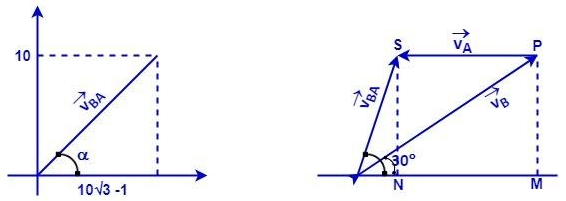
From the figure;
$ \begin{align}
&\Rightarrow NS=MP=20\sin 30{}^\circ \\
&\Rightarrow NS=10 \\
& and \\
&\Rightarrow ON=OM-NM \\
&\Rightarrow ON=20\cos 30{}^\circ -10 \\
&\Rightarrow ON=10\left( \sqrt{3}-1 \right) \\
&\Rightarrow \left| \overrightarrow{{{v}_{BA}}} \right|=\sqrt{O{{N}^{2}}+N{{S}^{2}}} \\
&\Rightarrow \left| \overrightarrow{{{v}_{BA}}} \right|=10\sqrt{{{\left( \sqrt{3}-1 \right)}^{2}}+{{1}^{2}}} \\
&\Rightarrow \left| \overrightarrow{{{v}_{BA}}} \right|=10\sqrt{5-2\sqrt{3}}m{{s}^{-1}} \\
\end{align} $
$ \begin{align}
& \text{For direction;} \\
&\Rightarrow \text{tan }\alpha =\frac{NS}{ON} \\
&\Rightarrow \tan \alpha =\frac{10}{10\left( \sqrt{3}-1 \right)} \\
&\Rightarrow \tan \alpha =\frac{1}{\sqrt{3}-1} \\
&\Rightarrow \alpha ={{\tan }^{-1}}\left( \frac{1}{\sqrt{3}-1} \right) \\
\end{align} $ .
$\Rightarrow \overrightarrow{{{v}_{BA}}}=\overrightarrow{{{v}_{B}}}-\overrightarrow{{{v}_{A}}} $
Magnitude of this relative velocity is $ \left| \overrightarrow{{{v}_{BA}}} \right| $
Direction of this relative velocity is given by the angle $ \alpha $ which is calculated by:
$\Rightarrow \tan \alpha =\frac{{{v}_{B{{A}_{y}}}}}{{{v}_{B{{A}_{x}}}}} $
Where $ {{v}_{B{{A}_{y}}}} $ and $ {{v}_{B{{A}_{x}}}} $ are the y and x components of $ \overrightarrow{{{v}_{BA}}} $ .
Complete step by step solution
$ \begin{align}
&\Rightarrow \overrightarrow{{{v}_{A}}}=10\widehat{i} \\
&\Rightarrow \text{Here taking the components of velocity of B;} \\
&\Rightarrow \overrightarrow{{{v}_{B}}}=20\cos 30{}^\circ \widehat{i}+20\sin 30{}^\circ \widehat{j} \\
&\Rightarrow10\sqrt{3}\widehat{i}+10\widehat{j} \\
\end{align} $
Relative velocity of B w.r.t. A is
$ \begin{align}
&\Rightarrow \overrightarrow{{{v}_{BA}}}=\overrightarrow{{{v}_{B}}}-\overrightarrow{{{v}_{A}}} \\
&\Rightarrow =10\sqrt{3}\widehat{i}+10\widehat{j}-10\sqrt{3}\widehat{i} \\
&\Rightarrow =10\left( \sqrt{3}-1 \right)\widehat{i}+10\widehat{j} \\
\end{align} $
$ \begin{align}
& Now \\
&\Rightarrow \left| \overrightarrow{{{v}_{BA}}} \right|=10\sqrt{{{\left( \sqrt{3}-1 \right)}^{2}}+{{1}^{2}}} \\
&\Rightarrow10\sqrt{3+1-2\sqrt{3}+1} \\
&\Rightarrow \left| \overrightarrow{{{v}_{BA}}} \right|=10\sqrt{5-2\sqrt{3}}m{{s}^{-1}} \\
& \text{For direction;} \\
&\Rightarrow \tan \alpha =\frac{10}{10\left( \sqrt{3}-1 \right)} \\
&\Rightarrow \tan \alpha =\frac{1}{\sqrt{3}-1} \\
&\Rightarrow \alpha ={{\tan }^{-1}}\left( \frac{1}{\sqrt{3}-1} \right) \\
\end{align} $ .
Note
Alternate method:
Velocity of B w.r.t. A:
$\Rightarrow \overrightarrow{{{v}_{BA}}}=\overrightarrow{{{v}_{B}}}+\left( -\overrightarrow{{{v}_{A}}} \right) $
From the figure;
$ \begin{align}
&\Rightarrow NS=MP=20\sin 30{}^\circ \\
&\Rightarrow NS=10 \\
& and \\
&\Rightarrow ON=OM-NM \\
&\Rightarrow ON=20\cos 30{}^\circ -10 \\
&\Rightarrow ON=10\left( \sqrt{3}-1 \right) \\
&\Rightarrow \left| \overrightarrow{{{v}_{BA}}} \right|=\sqrt{O{{N}^{2}}+N{{S}^{2}}} \\
&\Rightarrow \left| \overrightarrow{{{v}_{BA}}} \right|=10\sqrt{{{\left( \sqrt{3}-1 \right)}^{2}}+{{1}^{2}}} \\
&\Rightarrow \left| \overrightarrow{{{v}_{BA}}} \right|=10\sqrt{5-2\sqrt{3}}m{{s}^{-1}} \\
\end{align} $
$ \begin{align}
& \text{For direction;} \\
&\Rightarrow \text{tan }\alpha =\frac{NS}{ON} \\
&\Rightarrow \tan \alpha =\frac{10}{10\left( \sqrt{3}-1 \right)} \\
&\Rightarrow \tan \alpha =\frac{1}{\sqrt{3}-1} \\
&\Rightarrow \alpha ={{\tan }^{-1}}\left( \frac{1}{\sqrt{3}-1} \right) \\
\end{align} $ .
Recently Updated Pages
Master Class 11 Computer Science: Engaging Questions & Answers for Success

Master Class 11 Business Studies: Engaging Questions & Answers for Success
Master Class 11 Economics: Engaging Questions & Answers for Success
Master Class 11 English: Engaging Questions & Answers for Success
Master Class 11 Maths: Engaging Questions & Answers for Success
Master Class 11 Biology: Engaging Questions & Answers for Success
Trending doubts
One Metric ton is equal to kg A 10000 B 1000 C 100 class 11 physics CBSE
There are 720 permutations of the digits 1 2 3 4 5 class 11 maths CBSE
Discuss the various forms of bacteria class 11 biology CBSE
Draw a diagram of a plant cell and label at least eight class 11 biology CBSE
State the laws of reflection of light
Explain zero factorial class 11 maths CBSE