




How do you decide whether the relation \[{{x}^{2}}+{{y}^{2}}=16\] defines a function?
Answer
 Verified
557.1k+ views
Hint: Draw the graph of the circle \[{{x}^{2}}+{{y}^{2}}=16\]. Now, draw a line vertical to the x – axis passing through the circle. If this vertical line passes through two points on the circle which have different y – coordinates then the given relation will not be a function.
Complete answer:
Here, we have been provided with the relation \[{{x}^{2}}+{{y}^{2}}=16\] and we are asked to check if it is a function or not.
Now, a relation can only be a function if for no value of x there are more than one value of y. To check if a relation is a function or not we have many methods but the graphical method is one of the easiest methods. In this method first we draw the graph of the given relation, then we draw vertical lines parallel to y – axis. If any one of these vertical lines cuts the graph at more than one point then the relation is not considered as a function.
Now, let us come to our question. We have the relation \[{{x}^{2}}+{{y}^{2}}=16\] which can be written as \[{{x}^{2}}+{{y}^{2}}={{4}^{2}}\]. Clearly, this equation denotes a circle having radius 4 units, so let us draw this circle on the graph.
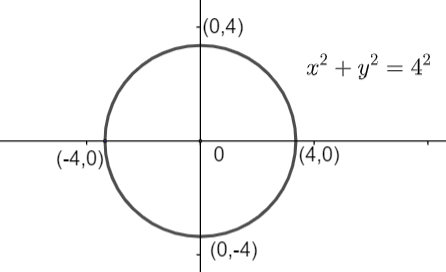
Let us draw some vertical lines on the graph of the above circle. So, it will look like: -
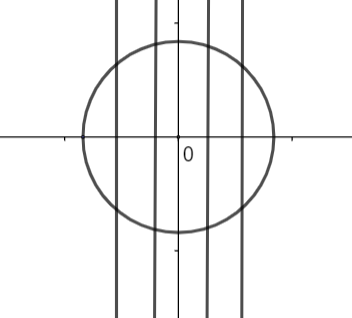
As we can see that there are many lines which are cutting the circle at more than one point, that is they are cutting the circle at two points. So, for a single value of x there are two values of y.
Hence, we can conclude that the relation \[{{x}^{2}}+{{y}^{2}}=16\] is not a function.
Note: One may note that if we have a relation in which we have one value of y for more than one value of x then the relation will be considered as a function. That is called a many – one function. You must remember the vertical line test that we have used to solve the question. Remember the basic differences between a ‘relation’ and a ‘function’ to solve the above question.
Complete answer:
Here, we have been provided with the relation \[{{x}^{2}}+{{y}^{2}}=16\] and we are asked to check if it is a function or not.
Now, a relation can only be a function if for no value of x there are more than one value of y. To check if a relation is a function or not we have many methods but the graphical method is one of the easiest methods. In this method first we draw the graph of the given relation, then we draw vertical lines parallel to y – axis. If any one of these vertical lines cuts the graph at more than one point then the relation is not considered as a function.
Now, let us come to our question. We have the relation \[{{x}^{2}}+{{y}^{2}}=16\] which can be written as \[{{x}^{2}}+{{y}^{2}}={{4}^{2}}\]. Clearly, this equation denotes a circle having radius 4 units, so let us draw this circle on the graph.
Let us draw some vertical lines on the graph of the above circle. So, it will look like: -
As we can see that there are many lines which are cutting the circle at more than one point, that is they are cutting the circle at two points. So, for a single value of x there are two values of y.
Hence, we can conclude that the relation \[{{x}^{2}}+{{y}^{2}}=16\] is not a function.
Note: One may note that if we have a relation in which we have one value of y for more than one value of x then the relation will be considered as a function. That is called a many – one function. You must remember the vertical line test that we have used to solve the question. Remember the basic differences between a ‘relation’ and a ‘function’ to solve the above question.
Recently Updated Pages
Master Class 11 Computer Science: Engaging Questions & Answers for Success

Master Class 11 Business Studies: Engaging Questions & Answers for Success
Master Class 11 Economics: Engaging Questions & Answers for Success
Master Class 11 English: Engaging Questions & Answers for Success
Master Class 11 Maths: Engaging Questions & Answers for Success
Master Class 11 Biology: Engaging Questions & Answers for Success
Trending doubts
One Metric ton is equal to kg A 10000 B 1000 C 100 class 11 physics CBSE
There are 720 permutations of the digits 1 2 3 4 5 class 11 maths CBSE
Discuss the various forms of bacteria class 11 biology CBSE
Draw a diagram of a plant cell and label at least eight class 11 biology CBSE
State the laws of reflection of light
Explain zero factorial class 11 maths CBSE