



How to Write Stepwise NCERT Answers for Chapter 7 The Cleanest Village?
NCERT Textbook Pages 96-97 – Daisy and Lou Go Shopping
Sapan dada asks … other method to calculate.
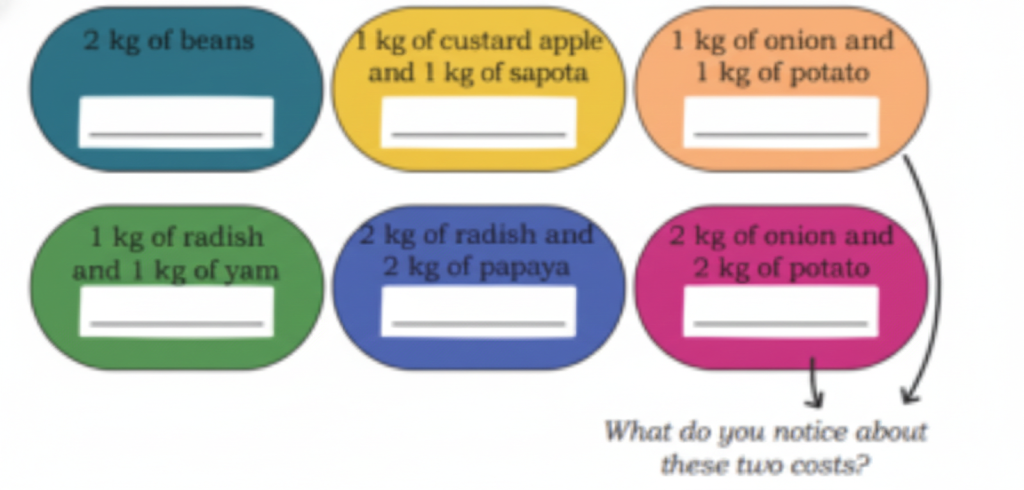
Solution:
The cost of 1 kg of beans is ₹95.
So, the cost of 2 kg of beans is calculated as:
₹95 + ₹95 = ₹190
The cost of 1 kg of custard apple is ₹45 and the cost of 1 kg of sapota is ₹70.
So, the total cost of 1 kg of custard apple and 1 kg of sapota is:
₹45 + ₹70 = ₹115
The cost of 1 kg of onion is ₹32 and the cost of 1 kg of potato is ₹37.
So, the total cost of 1 kg of onion and 1 kg of potato is:
₹32 + ₹37 = ₹69
The cost of 1 kg of radish is ₹23 and the cost of 1 kg of yam is ₹45.
So, the total cost of 1 kg of radish and 1 kg of yam is:
₹23 + ₹45 = ₹68
The cost of 2 kg of radish is:
₹23 + ₹23 = ₹46
The cost of 1 kg of papaya is ₹65, so the cost of 2 kg of papaya is:
₹65 + ₹65 = ₹130
Therefore, the total cost of 2 kg of radish and 2 kg of papaya is:
₹46 + ₹130 = ₹176
The cost of 2 kg of onion is:
₹32 + ₹32 = ₹64
The cost of 2 kg of potato is:
₹37 + ₹37 = ₹74
So, the total cost of 2 kg of onion and 2 kg of potato is:
₹64 + ₹74 = ₹138
What do you notice about these two costs?
1 kg of onion and 1 kg of potato
2 kg of onion and 2 kg of potato
Solution:
Since
₹163 = ₹45 + ₹95 + ₹23
and also
₹163 = ₹70 + ₹70 + ₹23
One possible set of items is 1 kg of custard apple, 1 kg of beans, and 1 kg of radish.
Another possible set is 2 kg of sapota and 1 kg of radish.
She could also have bought 1 kg of beans, 1 kg of yam, and 1 kg of radish.
These are some of the different combinations that add up to ₹163.
NCERT Textbook Pages 97-98
Udaya didi runs … some tricky questions.
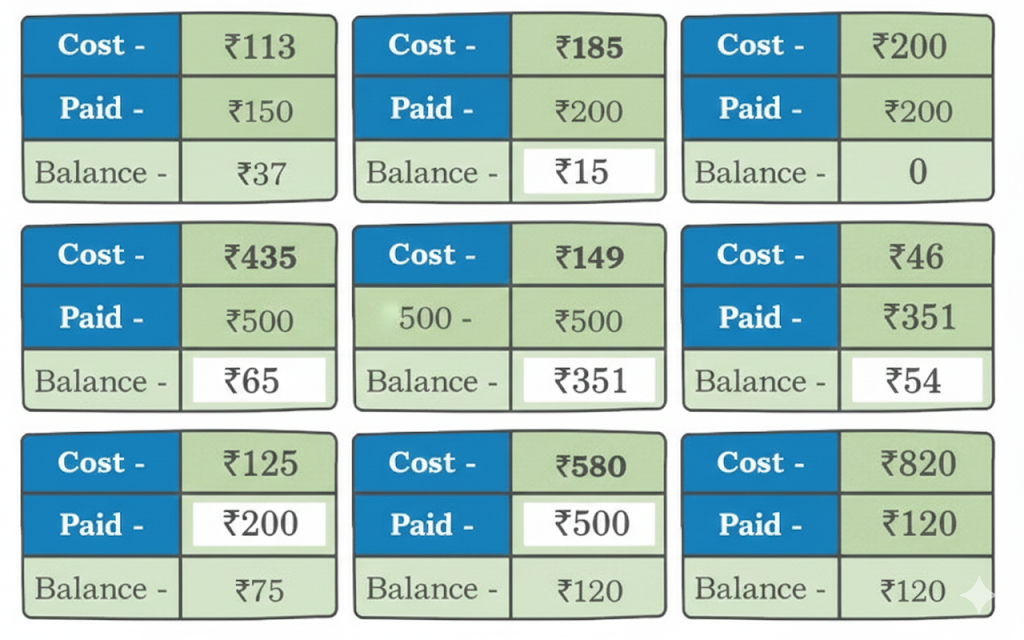
Help them find the missing numbers in each of the following. Use a number line, play money or any other way to find the balances.
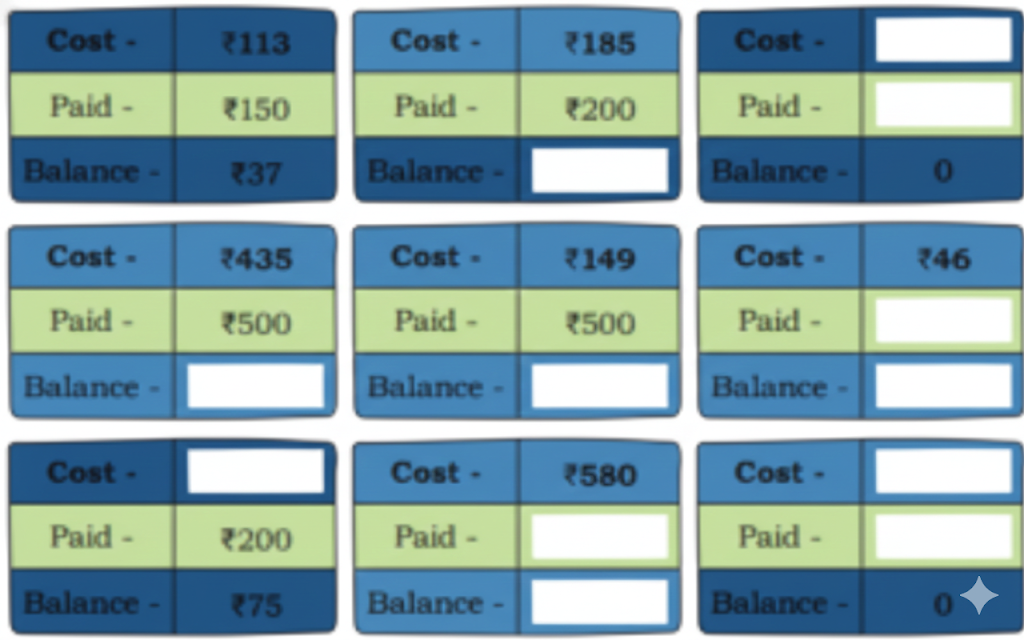
Solution:
Lou and Daisy buy … to buy the bananas?
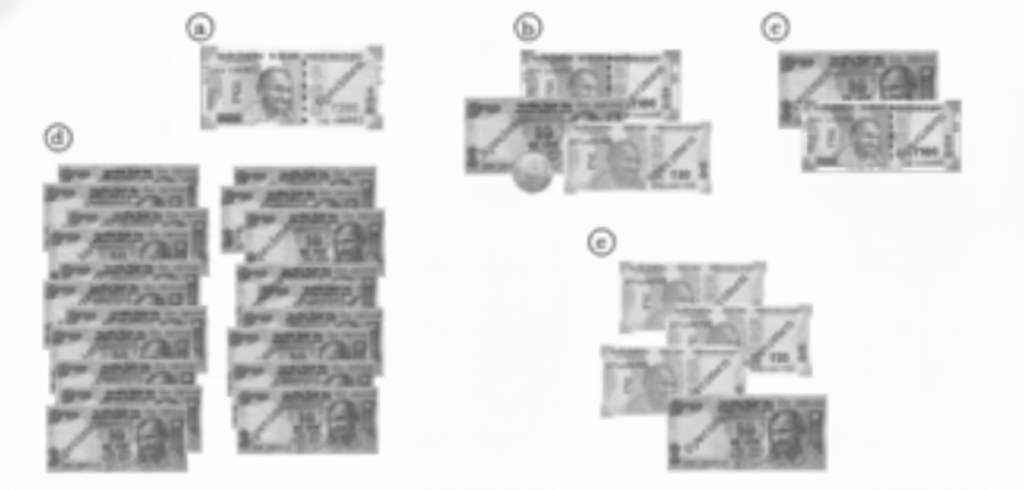
Solution:
The price of 1 kg of bananas is ₹55.
So, the cost of 3 kg of bananas is calculated as:
₹55 + ₹55 + ₹55 = ₹165
Therefore, Lou and Daisy will select option (b) to buy the bananas.
NCERT Textbook Page 99 A Strange Puzzle!
Four naughty kids … Neela a ₹ 500.
What is the balance that they each got?
Solution:
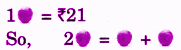
The cost of 1 orange is ₹21.
So, the cost of 2 oranges is:
₹21 + ₹21 = ₹42
Krishna paid ₹50 for 2 oranges.
Since he paid more than the total cost, his balance is:
₹50 − ₹42 = ₹8
Sudama paid ₹100 for 2 oranges.
So, his balance is:
₹100 − ₹42 = ₹58
Mala paid ₹200 for 2 oranges.
Her balance is:
₹200 − ₹42 = ₹158
Neela paid ₹500 for 2 oranges.
So, her balance is:
₹500 − ₹42 = ₹458
NCERT Textbook Page 100 – Let Us Play
Place the numbers 1-6 in the blanks in such a way that the sum on each side of the triangle is 9. No numbers should be repeated.
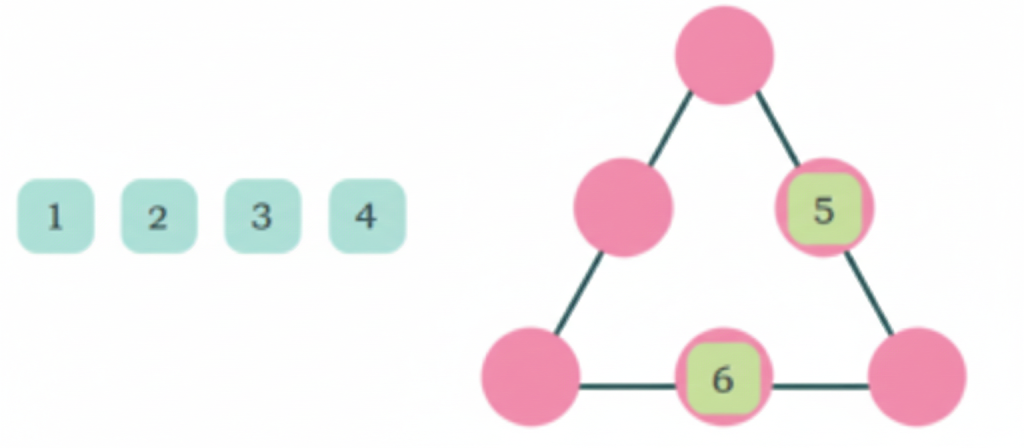
Solution:
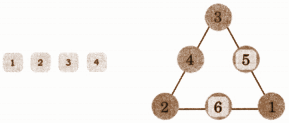
1 + 6 + 2 = 2 + 4+ 3 = 3 + 5 + 1 = 9
Use the same numbers 1-6 and make the sum 10 on each side of the triangle.
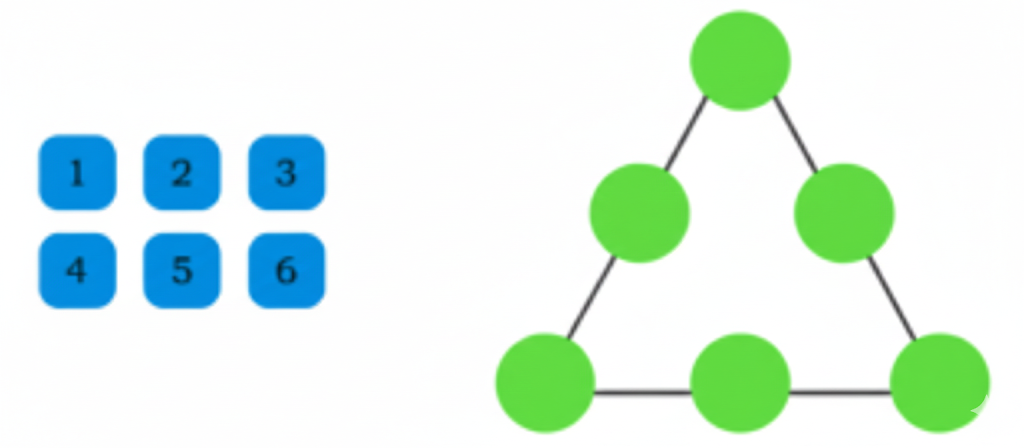
Solution:
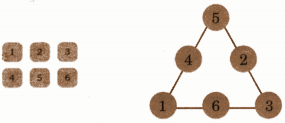
1 + 4 + 5 = 5 + 2 + 3 = 3 + 6 + 1 = 10
What other sums can you make with these 6 numbers?
Solution:
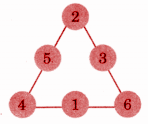
4 + 5 + 2 = 2 + 3 + 6 = 4 + 1 + 6 = 11
Thus the other sum we can make using these numbers is 11.
Can you make 12 on each side? Can you make 13?
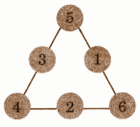
Solution:
4 + 3 + 5 = 12
5 + 1 + 6 = 12
6 + 2 + 4 = 12
All three sides add up to 12. However, it is not possible to get a total of 13 on each side of the triangle using the numbers 1 to 6 without repeating any number.
In a magic triangle, each side must have the same total. To find the largest possible side sum, we place the highest numbers—6, 5, and 4—at the three corners. Their sum is:
6 + 5 + 4 = 15
Since each corner number is counted in two sides, the total contribution from the corner numbers is:
15 × 2 = 30
The remaining middle numbers are 1, 2, and 3, whose total is:
1 + 2 + 3 = 6
So, the total of all numbers used in the three sides is:
30 + 6 = 36
Because this total is shared equally by the three sides, the maximum possible sum on each side is:
36 ÷ 3 = 12
Therefore, it is impossible to form a magic triangle with a side sum of 13 using the numbers 1 to 6 without repeating any number.
NCERT Textbook Pages 101-104 Add Up
Daisy and Lou leave … the same village.
Daisy and Lou ate one large piece of pusaw for ₹ 38. They liked it a lot and bought another small piece for ₹ 16. How much did they spend on pusaw?
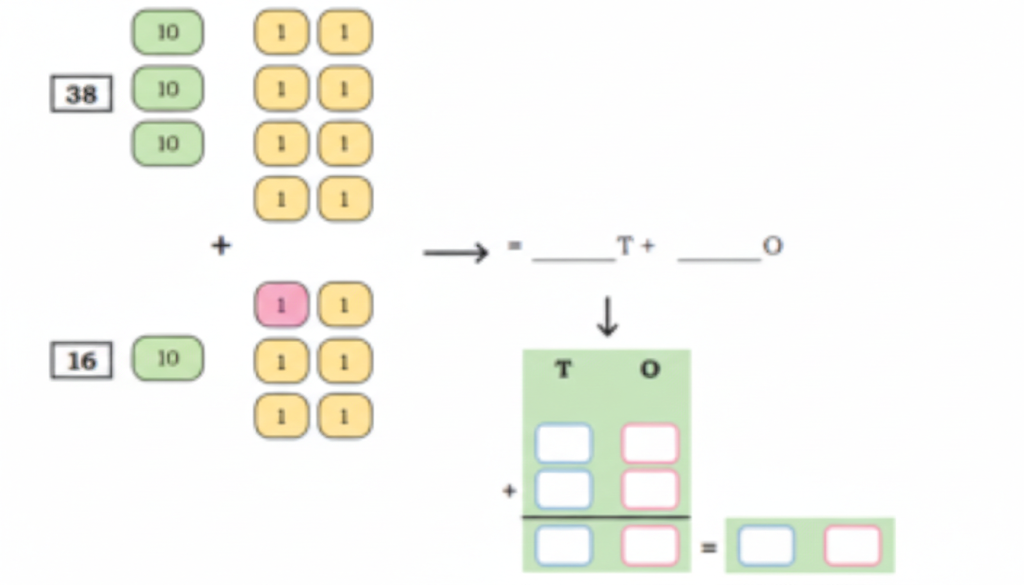
Solution:
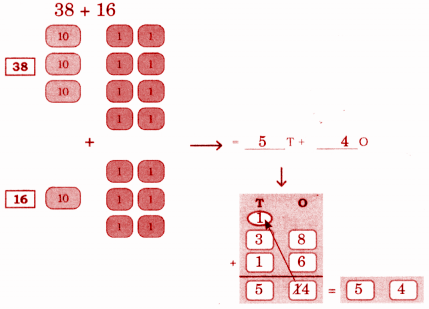
Thus, Daisy and Lou spents ₹ 54.
Daisy and Lou had collected ₹ 185 in their piggy bank. Their mother gave them M25 more for the trip. How much money did they take for the trip?
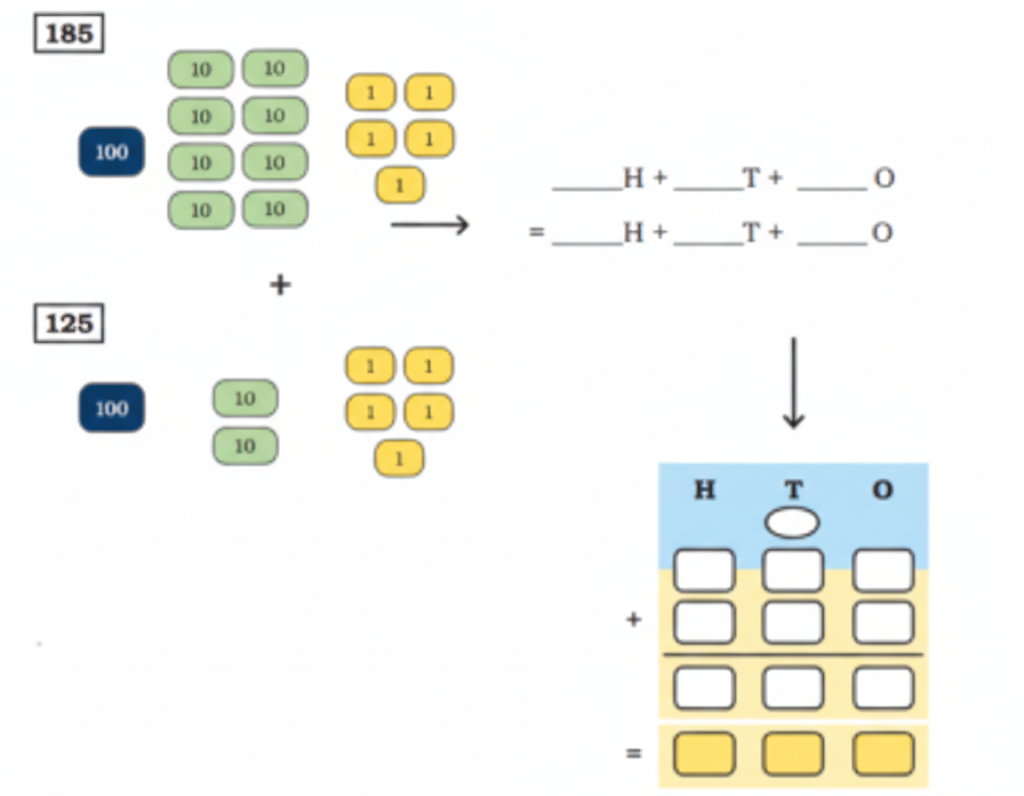
Daisy and Lou took ₹______ for the trip.
Solution:
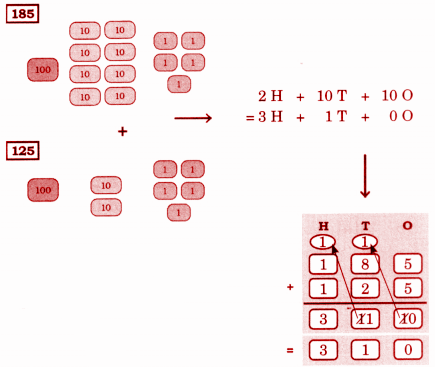
Daisy and Lou took ₹ 310 for the trip.
NCERT Textbook Page 105 – Let Us Do
Question 1.
In Kalakshitij, a school of performing arts, the following number of students are learning to sing and play the tabla. Estimate and then find the total students.
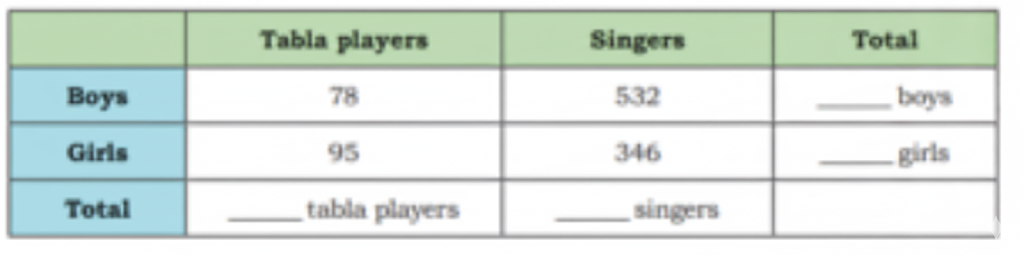
15 more girls join the music school and they want to learn to play the tabla. How many girls play tabla now?
Solution:
The number of girls who play the tabla is 95.
Since 15 more girls want to learn it, the new total becomes:
95 + 15 = 110 girls.
Question 2.
Add by aligning the numbers in columns in your notebook.
(a) 32 + 47
Solution:
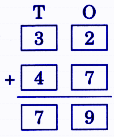
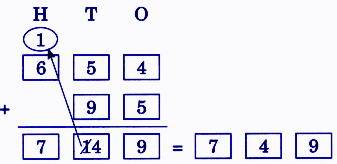
(b) 654 + 95
Solution:
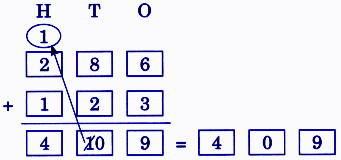
(c) 286 + 123
Solution:
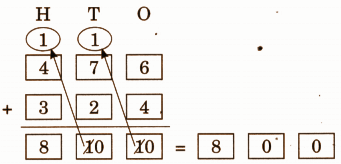
(d) 476 + 324
Solution:
(e) 700 + 289
Solution:
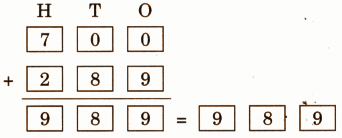
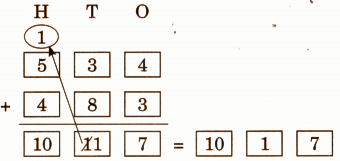
(f) 534 + 483
Solution:
Question 3.
Preeti’s school has 423 children. Her school has 178 children less than her cousin’s school. How many children study in Preeti’s cousin’s school?
Solution:
Preeti’s cousin’s school has 178 more students than Preeti’s school.
So, the total number of students in Preeti’s cousin’s school is:
423 + 178 = 601 students.
NCERT Textbook Pages 108-109 – Let Us Solve
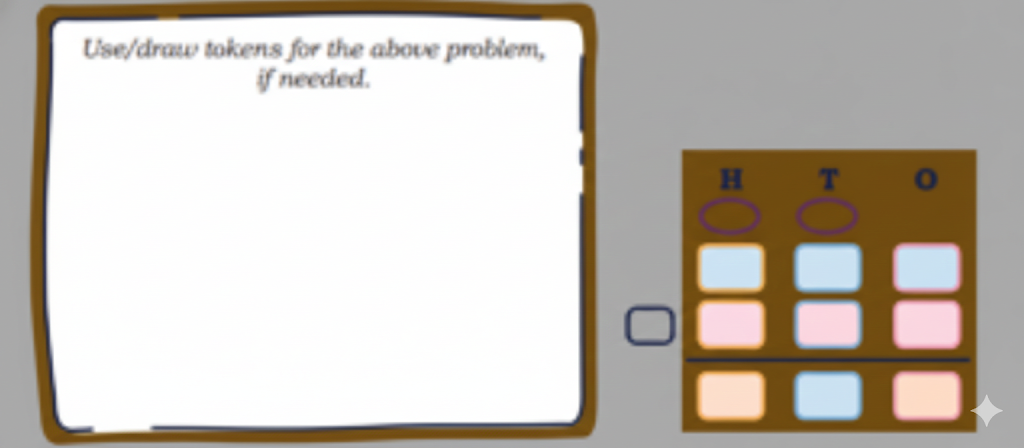
Ram Chacha got 264 mangoes from his mango tree last year. This year he has got 527 mangoes. How many more mangoes did he get this year?
Solution:
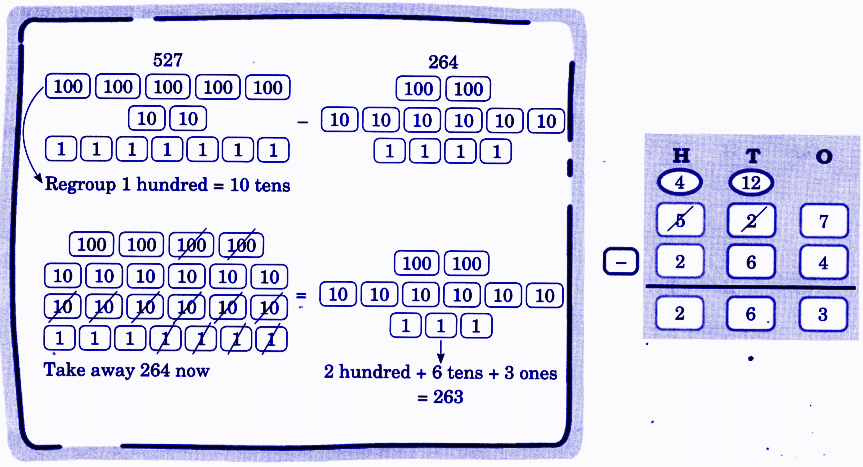
So, Ram Chacha received 263 more mangoes this year than he did last year.
Question 4.
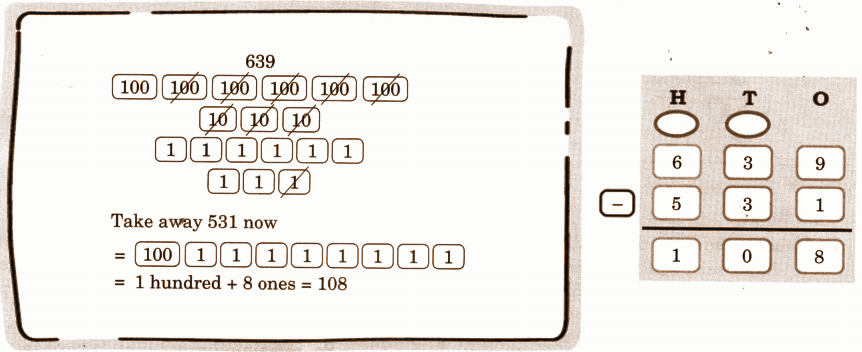
During the festival of dolls (Gombe Habba in Dussehra), Ranganna made 639 dolls. He was able to sell 531 dolls. How many dolls are left with him?
Solution:
No. of dolls left = 639 – 531 = 108.
Question 5.
Subtract by aligning the numbers in columns in your notebook.
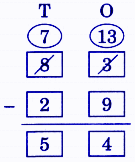
(a) 83 -29
Solution:
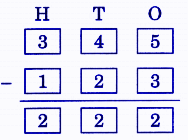
(b) 345 – 123
Solution:
(c) 763 – 437
Solution:
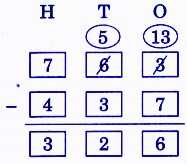
(d) 803 – 350
Solution:
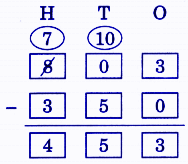
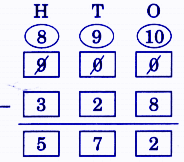
(e) 900 – 328
Solution:
NCERT Textbook Pages 109-111 – Let Us Solve
Question 1.
These books are in the community library of Wakanda village. Children borrow these books to read during their vacation.
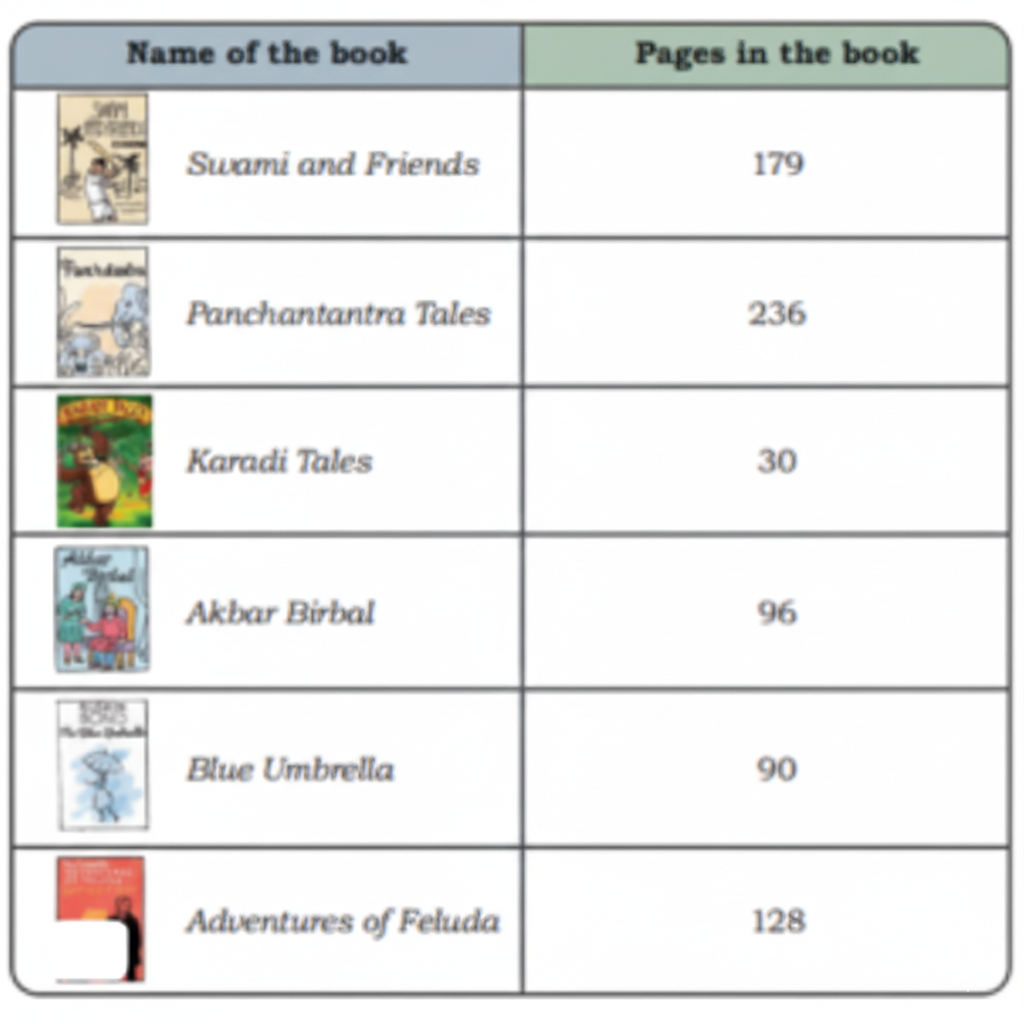
(а) Rami read Panchatantra Tales during the summer vacation. Kesu read Akbar Birbal, Karadi Tales and Blue Umbrella. Who do you think read more? How many more pages?
(b) Sumi has read 23 pages of Adventures of Feluda. How many more pages are left to complete the book?
(c) Jaggu decides to read all the books listed here during his vacation. He has finished reading Swami and Friends, Akbar
Birbal and 50 pages of Feluda in 4 weeks. How many more pages does he have to read to finish reading all the books?
Solution: (a) Rami read Panchatantra Tales, which has 236 pages.
Kesu read Akbar Birbal, Karadi Tales, and The Blue Umbrella.
So, the total number of pages Kesu read is:
96 + 30 + 90 = 216
Since 236 is more than 216, Rami read more pages.
Therefore, Rami read 20 pages more than Kesu.
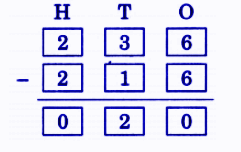
(b) Sumi has read 23 pages so far.
The book Adventures of Feluda has a total of 128 pages.
So, the number of pages she still needs to read is:
128 − 23 = 105 pages.
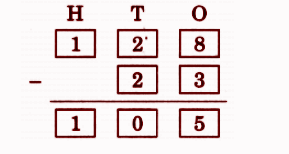
(c) The total number of pages in all the books is:
179 + 236 + 30 + 96 + 90 + 128 = 759 pages
Jaggu has already read:
Swami and Friends = 179 pages
Akbar Birbal = 96 pages
50 pages of Adventures of Feluda
So, the total pages Jaggu has read so far are:
179 + 96 + 50 = 325 pages
Therefore, the number of pages still left for Jaggu to complete all the books is:
759 − 325 = 434 pages
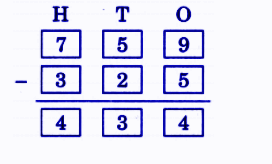
Question 2.
A daily train between Delhi and Aligarh travels a distance of 131 km. Look at the picture below and answer the questions that follow.
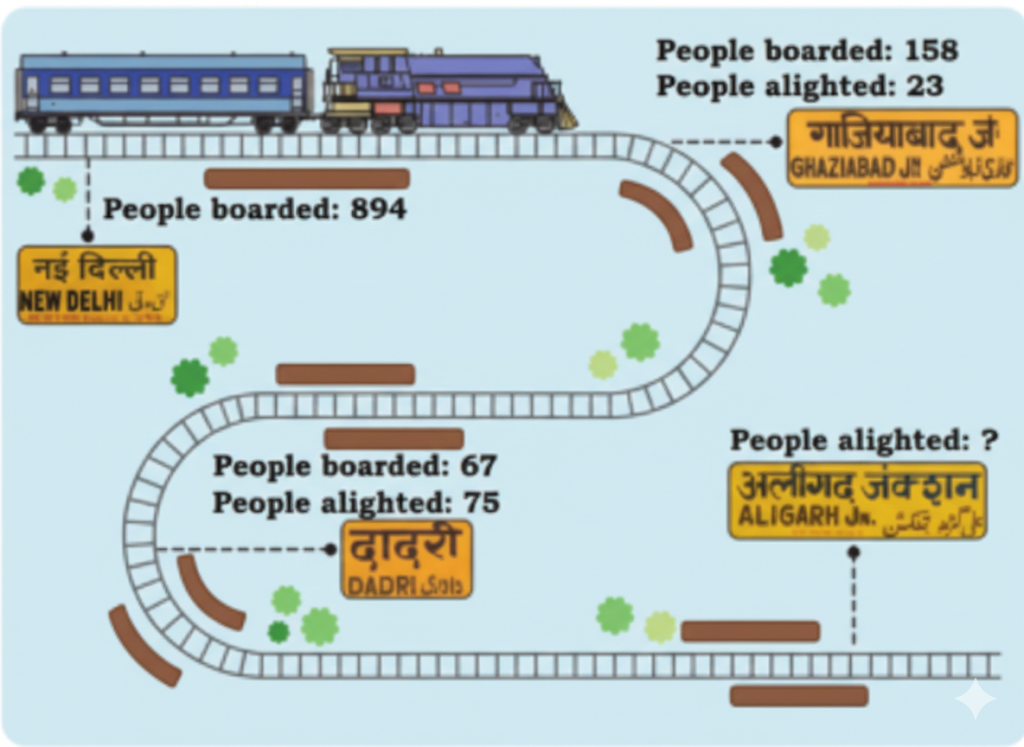
(a) How many passengers are there on the train when it leaves Dadri?
(b) Find the number of people who got off the train at Aligarh.
(c) Were there more people on the train in New Delhi or in Aligarh? How much more/less?
(d) How many people travelled altogether by the train?
Solution:
(a) People boarded train at Delhi = 894
People boarded train at Ghaziabad = 158
Total passengers at Ghaziabad after boarding train = 894 + 158 = 1052
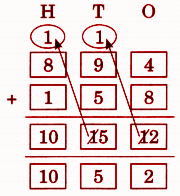
Passengers left in train at Ghaziabad after alighted train = 1052 – 23 = 1029
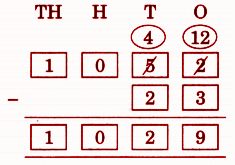
Total passengers in train after boarding at Dadri = 1029 + 67 = 1096
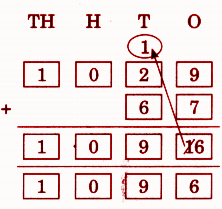
Passengers in train after alighted at Dadri = 1096 – 75 = 1021
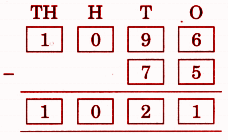
So, passengers in train when it leaves Dadri = 1021.
(b) Since, Aligrah is the last station of the journey.
So, Number of people who got off the train at Aligarh = Number of people in train when it leaves Dadri = 1021
(c) Number of people of New Delhi = 894
Number of people at Aligarh = 1021
So, at Aligarh there were more people in train than at New Delhi.
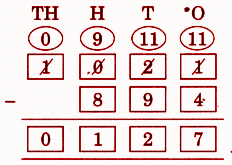
So, 127 more people at Aligarh than at New Delhi.
(d) Total people travelled altogether by the train = 894 + 158 + 67 = 1119.
NCERT Textbook Pages 111-112 – Let Us Solve
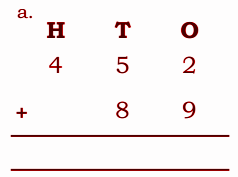
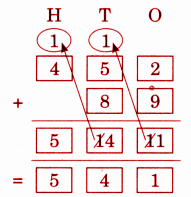
Solution:
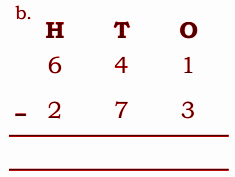
Solution:
(c) Find quick ways of solving. Think about some of the strategies you learnt in grade 3.
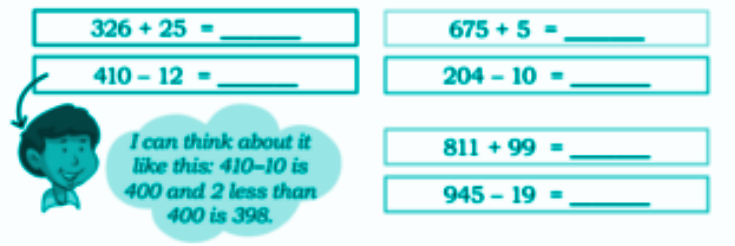
Solution:
326 + 25 = 325 + 25 + 1 = 350 + 1 = 351
410 – 12 = 410 – 10 – 2 = 400 – 2 = 398
675 + 5 = 670 + 5 + 5 = 680
204 – 10 = 200 – 10 + 4 = 190 + 4 = 194
811 + 99 = 800 + 10 + 1 + 100 – 1 = 910
945 – 19 = 940 + 5 – 20 + 1 = 926
(d) Solve by aligning the numbers in columns in your notebook.
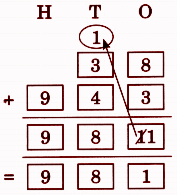
1. 38 + 943
Solution:
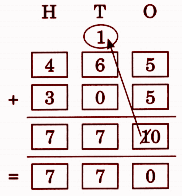
2. 465 + 305
Solution:
3. 435 + 462
Solution:
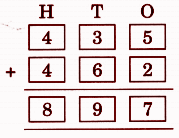
4. 764 – 657
Solution:
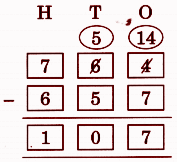
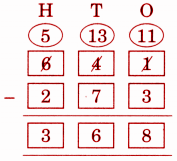
5. 518 – 209
Solution:
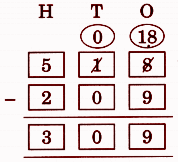
6. 879 – 53
Solution:
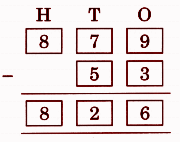
(e) Find two numbers such that their sum is 856. Find another two numbers such that
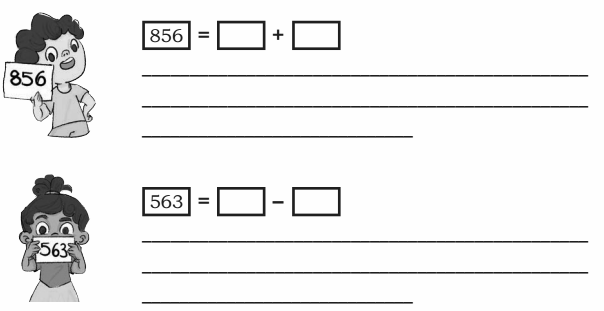
Solution:
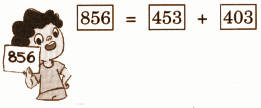
Ravi bought a book which has 453 pages. Seema bought a book which has 403 pages.
How many total pages in books bought by Ravi and Seema? ‘
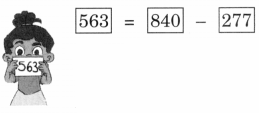
Ishita made 840 toys last year and this year, she made 277 toys only. How many less toy did she made this year?
NCERT Textbook Pages 112-113 Number Pair Hunt
Here is a grid of… 185 are number pairs in this grid.
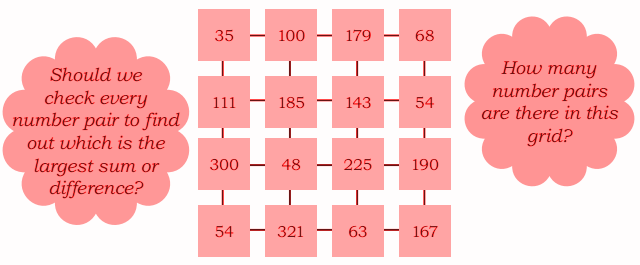
1. Find the number pair whose sum is the greatest.
2. Find the number pair whose sum is the smallest.
3. Find the number pair whose difference is the greatest.
4. Find the number pair whose difference is the smallest.
Solution:
Since each number pair contains different numbers, their sums and differences will also be different. So, we must check every pair to find the required values.
The number pairs in the given grid are:
(35, 100), (100, 179), (179, 68), (111, 185), (185, 143), (143, 54), (300, 48), (48, 225), (225, 190), (54, 321),
(321, 63), (63, 167), (35, 111), (111, 300), (300, 54), (100, 185), (185, 48), (48, 321), (179, 143), (143, 225),
(225, 63), (68, 54), (54, 190), (190, 167)
So, the total number of pairs in the grid is 24.
Results:
The pair with the greatest sum is (225, 190), because
225 + 190 = 415The pair with the smallest sum is (68, 54), because
68 + 54 = 122The pair with the greatest difference is (48, 321), because
321 − 48 = 273The pair with the smallest difference is (68, 54), because
68 − 54 = 14
NCERT Textbook Page 113 The Missing Digits
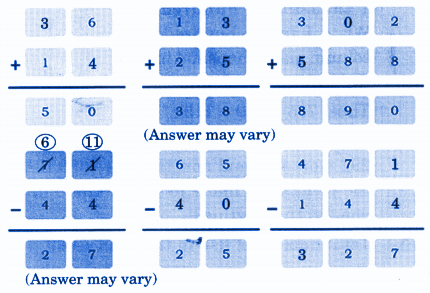
Fill the missing digits below to make it a correct statement.
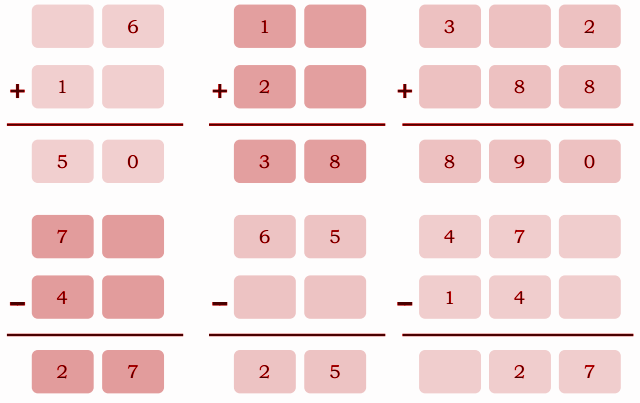
Solution:
NCERT Textbook Page 114 Let Us Do
Question 1.
Add
(a) 23 + 489
Solution:
\[ \begin{array}{r} \phantom{+}23\\ +\,489\\ \hline 512 \end{array} \]
(b) 105 + 295
Solution:
\[ \begin{array}{r} \phantom{+}105\\ +\,295\\ \hline 400 \end{array} \]
(c) 630 + 56
Solution:
\[ \begin{array}{r} \phantom{+}630\\ +\,\,56\\ \hline 686 \end{array} \]
(d) 35 + 99
Solution:
\[ \begin{array}{r} \phantom{+}35\\ +\,99\\ \hline 134 \end{array} \]
(e) 409 + 387
Solution:
\[ \begin{array}{r} \phantom{+}409\\ +\,387\\ \hline 796 \end{array} \]
(f) 67 + 76
Solution:
\[ \begin{array}{r} \phantom{+}67\\ +\,76\\ \hline 143 \end{array} \]
(g) 580 + 207
Solution:
\[ \begin{array}{r} \phantom{+}580\\ +\,207\\ \hline 787 \end{array} \]
(h) 333 + 666
Solution:
\[ \begin{array}{r} \phantom{+}333\\ +\,666\\ \hline 999 \end{array} \]
(i) 826 + 268
Solution:
\[ \begin{array}{r} \phantom{+}826\\ +\,268\\ \hline 1094 \end{array} \]
Question 2.
Subtract.
(a) 300 – 45
Solution:
\[ \begin{array}{r} \phantom{-}300\\ -\,\,45\\ \hline 255 \end{array} \]
(b) 962 – 268
Solution:
\[ \begin{array}{r} \phantom{-}962\\ -\,268\\ \hline 694 \end{array} \]
(c) 706 – 209
Solution:
\[ \begin{array}{r} \phantom{-}706\\ -\,209\\ \hline 497 \end{array} \]
(d) 842 – 387
Solution:
\[ \begin{array}{r} \phantom{-}842\\ -\,387\\ \hline 455 \end{array} \]
(e) 674 – 76
Solution:
\[ \begin{array}{r} \phantom{-}674\\ -\,\,76\\ \hline 598 \end{array} \]
(f) 754 – 409
Solution:
\[ \begin{array}{r} \phantom{-}754\\ -\,409\\ \hline 345 \end{array} \]
(g) 403 — 245
Solution:
\[ \begin{array}{r} \phantom{-}403\\ -\,245\\ \hline 158 \end{array} \]
(h) 333 + 666
Solution:
\[ \begin{array}{r} \phantom{+}333\\ +\,666\\ \hline 999 \end{array} \]
(i) 826 + 268
Solution:
\[ \begin{array}{r} \phantom{+}826\\ +\,268\\ \hline 1094 \end{array} \]
Question 2.
Subtract.
(a) 300 – 45
Solution:
\[ \begin{array}{r} \phantom{-}300\\ -\,\,45\\ \hline 255 \end{array} \]
(b) 962 – 268
Solution:
\[ \begin{array}{r} \phantom{-}962\\ -\,268\\ \hline 694 \end{array} \]
(c) 706 – 209
Solution:
\[ \begin{array}{r} \phantom{-}706\\ -\,209\\ \hline 497 \end{array} \]
(d) 842 – 387
Solution:
\[ \begin{array}{r} \phantom{-}842\\ -\,387\\ \hline 455 \end{array} \]
(e) 674 – 76
Solution:
\[ \begin{array}{r} \phantom{-}674\\ -\,\,76\\ \hline 598 \end{array} \]
(f) 754 – 409
Solution:
\[ \begin{array}{r} \phantom{-}754\\ -\,409\\ \hline 345 \end{array} \]
(g) 403 — 245
Solution:
\[ \begin{array}{r} \phantom{-}403\\ -\,245\\ \hline 158 \end{array} \]
(h) 546 — 538
Solution:
\[ \begin{array}{r} \phantom{-}600\\ -\,384\\ \hline 216 \end{array} \]
NCERT Solutions for Class 4 Maths Chapter 7 The Cleanest Village (2026-27)
In Class 4 Maths Chapter 7, children explore The Cleanest Village while practicing real-life sums on money, shopping and travel. Our NCERT Solutions Class 4 Maths Chapter 7 (2026-27) explain each story-based question in simple, stepwise methods.
These NCERT Solutions for Class 4 Maths help you master addition and subtraction through fields, markets and school trips to Mawlynnong. Well-structured answers build confidence, reduce careless mistakes and make problem-solving faster for school exams and class tests.
Revise the entire chapter regularly with our chapter-wise NCERT solutions. Focus on price lists, change from money, and word problems to strengthen calculation skills and improve your overall performance in Class 4 Maths for the 2026-27 session.
FAQs on NCERT Solutions For Class 4 Maths Chapter 7 The Cleanest Village - 2026-27 Free PDF Download (Sign-in Required)
1. What are NCERT Solutions for Class 4 Maths Chapter 7: The Cleanest Village?
NCERT Solutions for Class 4 Maths Chapter 7: The Cleanest Village provide clear, stepwise answers to all the textbook questions, helping students understand concepts and score full marks in CBSE exams.
Key features include:
- Exercise-wise, stepwise answers matching the latest NCERT syllabus
- Exam-focused solutions with important definitions, diagrams, and explanations
- Free PDF download for offline study
- Helps build strong problem-solving and presentation skills for CBSE 2026–27
2. How can I score full marks in Class 4 Maths Chapter 7 The Cleanest Village?
To score full marks in Class 4 Maths Chapter 7 The Cleanest Village, follow these steps:
- Write stepwise answers with clear working for each part
- Use definitions and neat diagrams when required
- Practice all exercise questions and examples using NCERT Solutions
- Use key mathematical terms as given in the textbook
- Revise important formulae, map labels, and concepts before the exam
3. Which topics from The Cleanest Village are most important for CBSE exams?
The most important topics for CBSE Class 4 Maths Chapter 7: The Cleanest Village include:
- Understanding of cleanliness and sanitation using practical data
- Reading and labelling maps or diagrams based on the village
- Solving numerical and word problems related to data in the chapter
- Key definitions and conceptual questions given in the textbook
4. Is it necessary to include diagrams or definitions in my answers for Chapter 7?
Yes, including diagrams and correct definitions is important for scoring full marks in CBSE exams.
- Draw neat, well-labelled diagrams if the question asks for it
- Write textbook definitions for key terms like cleanliness, sanitation, waste management, etc.
- This matches CBSE marking schemes and boosts your exam score
5. How should I structure long answers for Class 4 Maths Chapter 7 to get better marks?
To score better marks with long answers in Class 4 Maths Chapter 7:
- Start with an introduction stating the main concept or definition
- Break the answer into logical steps or points
- Use bullet points or numbering for clarity
- Include diagrams or examples if relevant
- Conclude with a summary line
6. Where can I download the free PDF for Class 4 Maths Chapter 7 NCERT Solutions?
You can download the NCERT Solutions Class 4 Maths Chapter 7 The Cleanest Village PDF from trusted educational websites. Look for a clearly labelled download button for the latest 2026–27 syllabus.
Benefits of downloading the PDF:
- Easy offline study and quick revision
- Stepwise solutions for all exercises
- Useful for homework and exam prep
7. How do I prepare maps or diagrams for Class 4 Maths Chapter 7?
Prepare diagrams and map labelling for Chapter 7 by:
- Using a scale and pencil for clean diagrams
- Labelling key parts as per textbook examples
- Following NCERT conventions for neatness and correct placement
- Practising with previous year questions or sample papers
8. Are NCERT Solutions enough for Class 4 Maths exams?
Yes, NCERT Solutions are usually enough for Class 4 Maths exams if all chapter questions and exercises are thoroughly practised.
- Covers all important concepts from the CBSE 2026–27 syllabus
- Develops answer-writing and stepwise problem-solving skills
- For more practice, revise with sample papers and important questions
9. What are some common mistakes to avoid in Class 4 Maths Chapter 7 exams?
Avoid these common mistakes during your Class 4 Maths Chapter 7 exam:
- Skipping steps in calculation or explanations
- Not using correct units or labels in diagrams
- Leaving diagrams unlabelled or messy
- Missing key definitions or keywords asked in the questions
10. How do NCERT Solutions for Class 4 Maths Chapter 7 help with CBSE 2026–27 exams?
NCERT Solutions for Class 4 Maths Chapter 7 help with CBSE 2026–27 exams by:
- Providing accurate, CBSE-aligned answers for all exercises
- Teaching students how to structure answers stepwise, as required in exams
- Ensuring understanding of concepts through clear explanations and diagrams
- Offering downloadable PDF resources for quick revision and offline use
11. How do I use the revision planner and quick notes for Chapter 7?
Use the revision planner and quick notes for Chapter 7 by:
- Following a 1-day, 3-day, or 7-day revision plan as outlined in your NCERT solutions PDF
- Reviewing all key definitions, formulae, and diagrams regularly
- Solving all textbook exercises and sample questions within your revision schedule
12. How should I present my answers to get step marks in CBSE evaluation?
To get step marks in CBSE exams for Class 4 Maths Chapter 7, always:
- Show each calculation or reasoning step clearly
- Number or bullet each step to match the marking scheme
- Use correct mathematical symbols and terms
- Include neat diagrams or maps when required
- Underline keywords or important terms if possible
