








How to Solve Year 5 Multiplication Problems Step by Step
Let's say you have two bicycles and they look the exact same. You go to the store to fill up the air in the tires. The service boy asks you a simple question 'how many tires do you want me to fill the air in?' To figure that out we're gonna use multiplication.
Multiplication is the method of determining the product of two or more numbers in mathematics. It is a basic arithmetic operation that is frequently used in everyday life. When we need to combine groups of equal size, we employ multiplication. In this article, we'll learn more about year 5 multiplication.
What is Multiplication?
Multiplication is a mathematical operation that conveys the idea of adding the same number over and over again. The factors are the numbers that are multiplied, and the result obtained after multiplying two or more numbers is known as the product of those numbers. Multiplication is a method of making repeated additions of the same number easier.
Question: If there are 3 boxes of chocolates and each box has 6 chocolates, find the total number of chocolates.
Sol: Let’s solve this question by addition.
6 + 6 + 6 = 18 chocolates.
It would take longer to add the numbers every time to get the answer. But multiplication makes it easier. Also, it will be easier when we have larger numbers to work upon.
If we use multiplication to solve the same problem, we will multiply the no of boxes with the no of chocolates in each box. So, when we multiply 3 × 6, we will get the total number of chocolates, that is 3 × 6 = 18 chocolates. Here, we have to understand that we get the same answer in less time. That’s the reason why multiplication is also known as repeated addition.

Example of Repeated Addition
Read some more examples of multiplication below:
Multiplication of 3 and 4 = 3 x 4 = 12
Multiplication of 4 by 5= 4 x 5 = 20
Multiplication of 5 by 6 = 6 x 5 = 30
Multiplication of 10 x 5 = 50
Multiplication of 7 by 9 = 7 x 9 = 63
Multiplication Symbol
We have different symbols in mathematics for multiplication. In the example problem given above, we learnt about the multiplication of two numbers 3 and 6. If we look at the solution, (3 × 6 = 18), we will understand that the symbol (×) will connect the two numbers and give us the final answer. Apart from the symbol that is used which is called as cross symbol (×), multiplication also uses midline dot operator (⋅), as well as the asterisk sign (*). Refer to the image given below.
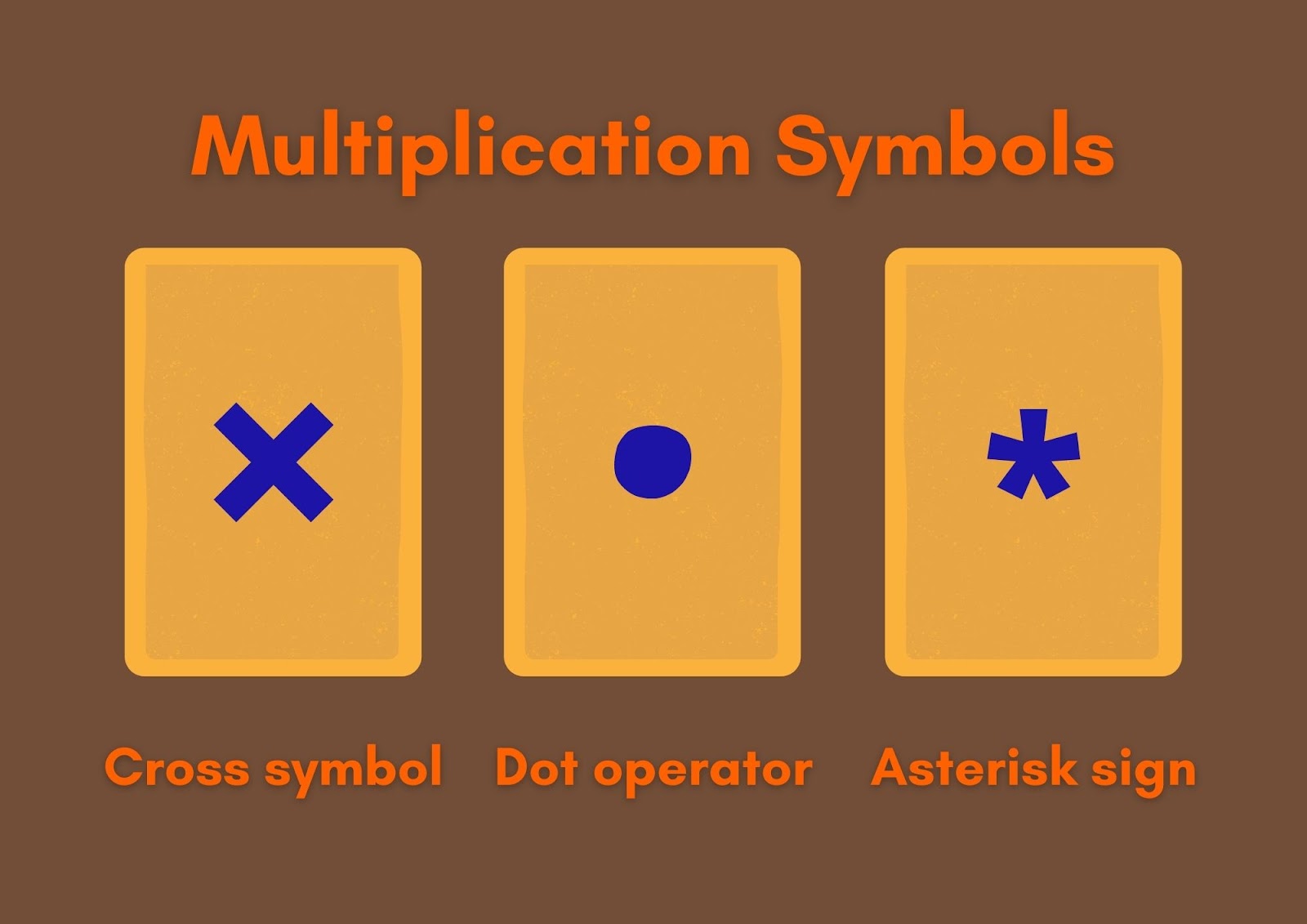
Multiplication Symbol
Multiplication Formula
The multiplication formula can be expressed as,
Multiplicand × Multiplier = Product
Here,
Multiplicand is the first number (factor).
Multiplier is the second number (factor).
Product is the final answer after multiplying both multiplicand and multiplier.
Multiplication symbol is '×' (this connects the entire expression)
Let’s understand this with the help of an example. Refer to the image below:

Multiplication Formula with Example
Using this basic concept of multiplication we can solve any number of multiplication problems.
How to Solve Multiplication Problems?
Single-digit numbers can be multiplied easily using multiplication tables, but larger numbers are split into columns using their individual place values, such as ones, tens, hundreds, thousands, and so on. Multiplication problems can be divided into two types:
1. Multiplication Without Regrouping: When multiplying two numbers without regrouping, you're working with smaller numbers that don't require a carry-over to the next higher place value. It's the basic level that can help a student understand the basics of multiplication before moving on to more advanced problems like regrouping.
2. Multiplication with Regrouping: When multiplying more than two numbers with regrouping, we are involved with numbers of a 2-digit product. Here, we must carry over to the next higher place value.
Multiplication Using Number Lines
In year 5 multiplication we also learn about Multiplication on a number line which refers to using a number line to perform multiplication on a given set of numbers. A number line is a line that shows numbers in a straight line. As discussed earlier, multiplication is also referred to as repeated addition. To do multiplication on a number line, we start at zero and move to the right side for the given number of times. Refer to the image below for a good understanding of Multiplication on a number line.
Example: Multiply 3 × 3 using a number line.
Sol: Observe the number line to see the multiplication of 3 × 3 = 9. We will start from 0 and move to the right side of the number line. We will form 3 groups of 3 equal intervals. Which will give us the answer as 9.

Multiplication Using a Number Line
The above number line shows 3 times 3 is 9. The same solution can also be written as 3 + 3 + 3 = 9. But, the multiplication statement is given as, 3 × 3 = 9.
Remember:
Any number which is multiplied by 0 is 0.
Any number multiplied by 1 stays the same.
When a number is multiplied by two we are doubling the number.
Conclusion
Multiplication is a method of calculating the product of two or more numbers in mathematics. It's one of the most basic arithmetic operations we use on a daily basis. Multiplication of two numbers is also known as the repeated addition of one number with respect to another.
FAQs on Year 5 Multiplication Explained with Strategies and Practice
1. What is multiplication in Year 5 Maths?
Multiplication in Year 5 Maths is the process of finding the total when a number is added repeatedly a certain number of times. It is written using the × symbol and involves a multiplicand and a multiplier.
- Example: 6 × 4 = 24
- This means 6 groups of 4, or 4 + 4 + 4 + 4 + 4 + 4
- The answer is called the product
2. How do you multiply a 2-digit number by a 2-digit number?
To multiply two 2-digit numbers, use the long multiplication method and multiply each digit carefully.
- Example: 23 × 14
- Step 1: 23 × 4 = 92
- Step 2: 23 × 10 = 230
- Step 3: Add them: 92 + 230 = 322
3. What are the key multiplication properties in Year 5?
The main multiplication properties in Year 5 are the commutative, associative, and distributive properties.
- Commutative: 4 × 7 = 7 × 4
- Associative: (2 × 3) × 5 = 2 × (3 × 5)
- Distributive: 6 × (10 + 3) = (6 × 10) + (6 × 3)
4. How do you multiply by 10, 100, and 1,000?
To multiply by 10, 100, or 1,000, shift the digits to the left according to the number of zeros.
- × 10 → move digits one place left
- × 100 → move digits two places left
- × 1,000 → move digits three places left
5. What is the grid method in multiplication?
The grid method is a visual way to multiply numbers by splitting them into place values.
- Example: 34 × 6
- Split 34 into 30 and 4
- 30 × 6 = 180
- 4 × 6 = 24
- Add: 180 + 24 = 204
6. How do you solve word problems involving multiplication?
To solve multiplication word problems, identify equal groups and multiply the numbers given.
- Step 1: Find how many groups there are
- Step 2: Find how many in each group
- Step 3: Multiply
7. What is the difference between multiplication and repeated addition?
Multiplication is a faster method of repeated addition using a single calculation.
- Repeated addition: 5 + 5 + 5 + 5
- Multiplication: 4 × 5
- Both equal 20
8. How do you check if a multiplication answer is correct?
You can check a multiplication answer by using the inverse operation, which is division.
- Example: 36 × 7 = 252
- Check: 252 ÷ 7 = 36
9. What are common mistakes in Year 5 multiplication?
Common mistakes in Year 5 multiplication include place value errors and forgetting to carry digits.
- Misaligning numbers in long multiplication
- Forgetting to add the zero when multiplying by tens
- Incorrect times table facts
10. Why is learning times tables important for Year 5 multiplication?
Knowing times tables up to 12 × 12 is essential because it makes long multiplication faster and more accurate.
- Helps with mental maths
- Supports written methods
- Improves speed in exams and problem-solving
