








Why Zero Is the Smallest Whole Number with Definition and Examples
Numbers are the most basic form of counting which is used to count everything. It can be used in simple ways like counting the number of apples you have, or for more complex math problems like calculating how many seconds there are in a year. Zero is a number that falls at the beginning of the number line and had been used since ancient times as a placeholder or just to distinguish from other numbers. But what types of whole numbers are there? Which is the smallest whole number? These are points we will cover below, in detail.
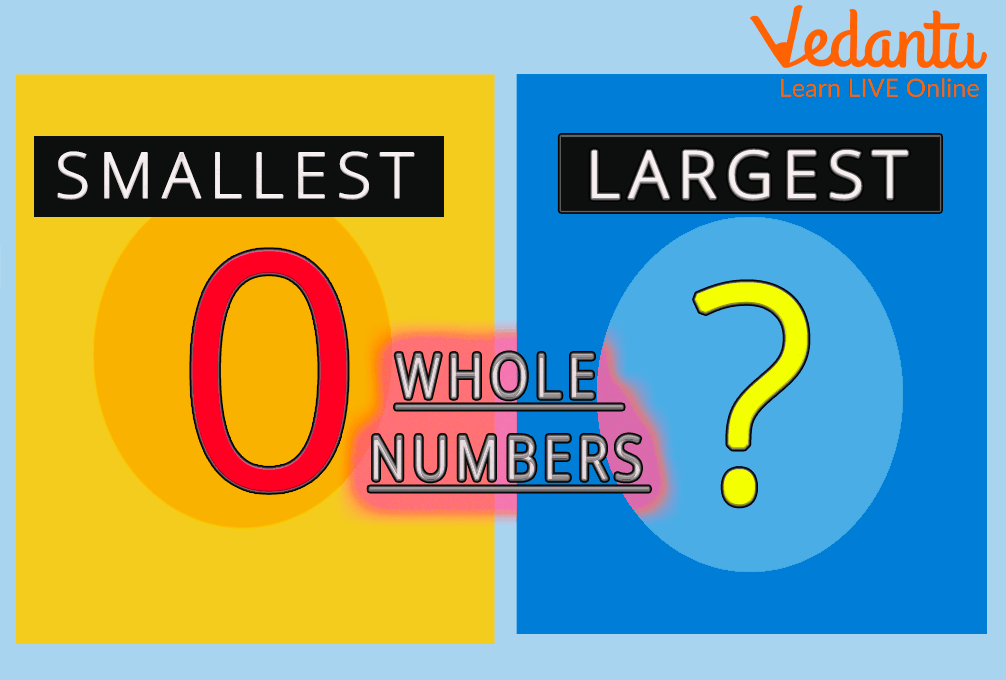
Smallest Whole Numbers
What are Whole Numbers?
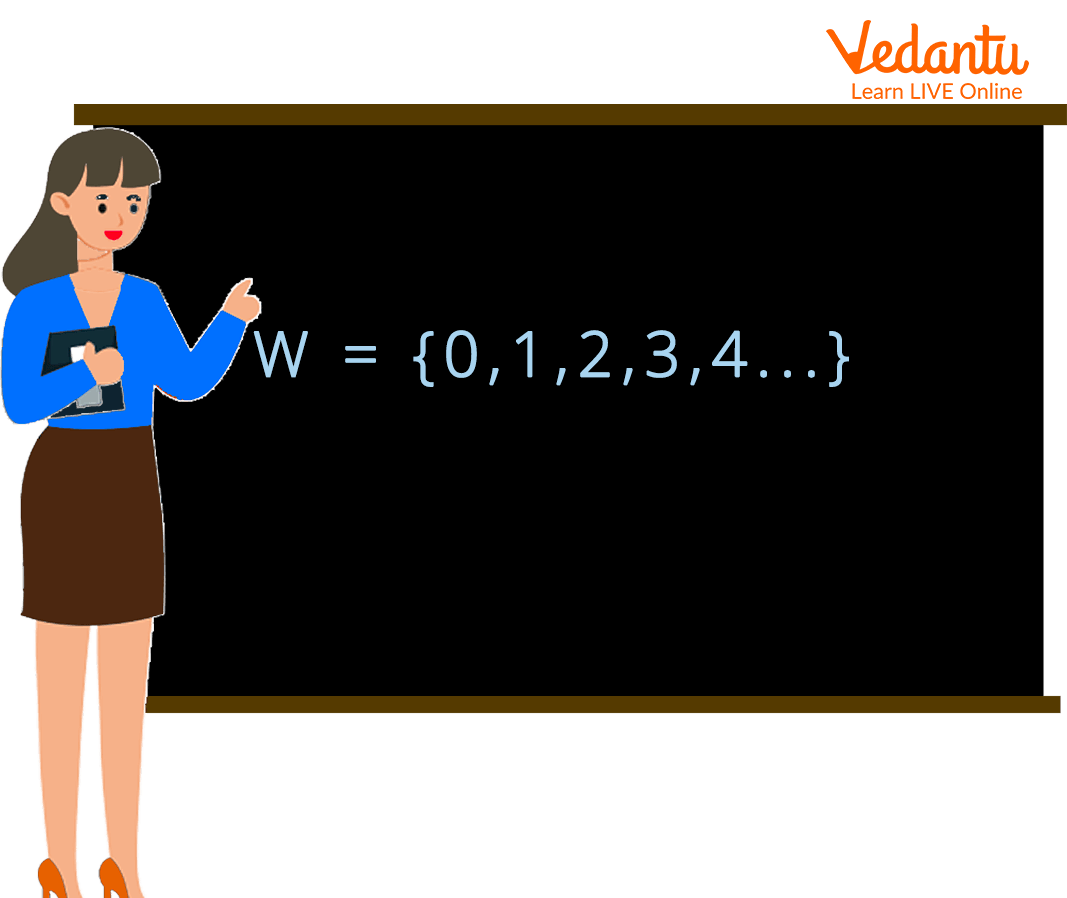
Whole Numbers
The set of natural numbers and the number 0 are collectively referred to as whole numbers. The mathematical set of whole numbers is 0 through 9 and is represented by the letter W.
W = {0, 1, 2, 3, 4, …}
To better understand whole numbers, consider the following information:
Whole numbers make up all natural numbers.
There are only whole numbers when counting.
Zero and all positive integers are whole numbers.
Counting of Whole Numbers
Numbers that are used to count things and have some value are called counting numbers. Natural numbers in general are all counting numbers. Therefore, all whole numbers, including zero, are counting numbers.
Whole Number Properties
Whole Number Properties
The product of two whole numbers is always a whole number that can be added to or multiplied by itself. There are three primary properties of whole numbers that are derived from the fundamental operations of addition, subtraction, multiplication, and division.
They are as follows:
Commutative Property: Even if the order of the numbers is reversed, the sum and product of whole numbers are the same.
$a+b=b+a$
$a \times b=b \times a$
For addition and multiplication, the commutativity property holds true.
Associative Property: The associative property states that the sum or product is unaffected by the order in which the whole numbers are added together or multiplied.
$a+(b+c)=(a+b)+c$
$a \times(b \times c)=(a \times b) \times c$
Distributive Property: The distributive property is the distribution of a whole number's multiplication over its sum or difference with other whole numbers. When the distributive property is applied, the problem is easier to solve.
$a \times(b+c)=(a \times b)+(a \times c)$
Types of Whole Numbers
Whole Numbers
Different names are given to different types of whole numbers.
Natural Numbers
Whole Numbers
Integers
Natural Numbers
A natural number is a whole number starting at 1 and going up:
1,2,3,4,5,6,7,8,9,10….
Counting numbers is another name for natural numbers. They are the numbers you would apply to count things. The smallest natural number is 1.
Whole Numbers
Although any number without a fraction is a whole number, we also refer to the whole numbers starting at 0 as whole numbers:
0,1,2,3,4,5,6,7,8,9,….
Integers
An integer is a whole number. An integer may be positive, negative, or zero:
-5,-4,-3,-2,-1,0,1,2,3,4,5,..
Least Whole Number

Least Whole Number
Whole numbers begin with 0, which is the smallest whole number (from the definition of whole numbers). Therefore, Zero is the smallest whole number.
Zero is used as a placeholder even though it has no value. Therefore, zero is a number that can neither be positive nor negative.
Difference Between Natural and Whole Numbers
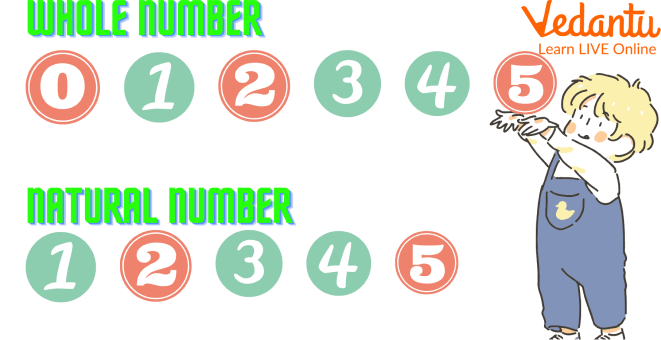
Comparing Numbers
Following are the difference between natural and whole numbers:
We can easily assume from these differences that every whole number other than 0 is a natural number. We can assume that a subset of whole numbers is the set of natural numbers.
Solved Examples
Learning from Examples
Example 1: Solve 10 × (5 + 10) using the distributive property.
Ans: Distributive property of multiplication over the addition of whole numbers is:
x × (y + z) = (x × y) + (x × z)
10 × (5 + 10) = (10 × 5) + (10 × 10)
= 50 + 100
= 150
Therefore, 10 × (5 + 10) = 150
However, we can show several examples of whole numbers using the properties of the whole numbers.
Example 2: Make three different additions to the numbers. List the used property.
25 + 36 + 15
Ans: 25 + 36 + 15
Step I: 25 + (36 + 15) = 25 + 51 = 76
Step II: (25 + 36) + 15 = 61 + 15 = 76
Step III: (25 + 15) + 36 = 40 + 36 = 76
Here, we have used associative property.
Practice Time

Lets Solve
1. Find the product of 6 × (40 + 2).
(Ans: 252)
2. How many whole numbers are there between 22 and 35?
(Ans: 12)
3. Write whole numbers between 12 and 25.
(Ans: 13, 14, 15, 16, 17, 18, 19, 20, 21, 22, 23, 24)
Summary
In mathematics, any number that is not a fraction with a whole part is considered to be a whole number. Integers, rationals, and irrational numbers are all examples of whole numbers, while natural numbers are the subset of whole numbers which are either positive or zero. Whole numbers can be classified into two broad categories: natural and whole numbers. Natural numbers, also called counting numbers, are the set of integers starting at 1 and containing zero and every integer divisible by it. All other integers are called the non-zero natural number in contrast to "natural" ones.
FAQs on What Is the Smallest Whole Number in Mathematics
1. What is the smallest whole number?
The smallest whole number is 0. Whole numbers include all non-negative integers starting from 0 and continuing as 1, 2, 3, and so on.
- Whole numbers: 0, 1, 2, 3, 4, ...
- They do not include negative numbers or fractions.
- Since counting begins at 0 in whole numbers, 0 is the smallest.
2. Why is 0 the smallest whole number?
The number 0 is the smallest whole number because whole numbers start at 0 and include only non-negative integers.
- Whole numbers are defined as 0, 1, 2, 3, ...
- Negative numbers like −1 or −2 are not included.
- Since there is no whole number less than 0, it is the smallest.
3. Is 1 the smallest whole number?
No, 1 is not the smallest whole number because 0 comes before 1 in the set of whole numbers.
- Whole numbers: 0, 1, 2, 3, ...
- Since 0 is included, it is smaller than 1.
- Therefore, 1 is the smallest natural number (in many definitions), but not the smallest whole number.
4. Are whole numbers and natural numbers the same?
Whole numbers and natural numbers are not exactly the same because whole numbers include 0, while natural numbers sometimes start from 1.
- Whole numbers: 0, 1, 2, 3, ...
- Natural numbers (common definition): 1, 2, 3, ...
- The key difference is the inclusion of 0.
5. Can whole numbers be negative?
No, whole numbers cannot be negative because they include only zero and positive integers.
- Whole numbers: 0, 1, 2, 3, ...
- Negative numbers like −1, −5 are integers but not whole numbers.
- This is why 0 remains the smallest whole number.
6. What are examples of whole numbers?
Examples of whole numbers are 0, 1, 2, 3, 10, and 100.
- They are non-negative integers.
- They do not include fractions like 1/2.
- They do not include decimals like 2.5.
7. Is zero a whole number?
Yes, 0 is a whole number because whole numbers are defined as non-negative integers starting from zero.
- Set of whole numbers: 0, 1, 2, 3, ...
- Zero represents no quantity but is still a valid number.
- It is the smallest element in the set of whole numbers.
8. What is the difference between whole numbers and integers?
The main difference is that integers include negative numbers, while whole numbers do not.
- Whole numbers: 0, 1, 2, 3, ...
- Integers: ..., −3, −2, −1, 0, 1, 2, 3, ...
- All whole numbers are integers, but not all integers are whole numbers.
9. Is there a largest whole number?
No, there is no largest whole number because whole numbers continue infinitely.
- After any whole number n, the next number is n + 1.
- This process never ends.
- Therefore, the set of whole numbers is infinite.
10. How are whole numbers used in real life?
Whole numbers are used to count objects and represent quantities that are not negative or fractional.
- Counting students in a class: 25 students.
- Number of books on a shelf: 12 books.
- Scoring points in a game: 0, 10, 20 points.
