








Definition of Attributes in Math with Examples and How to Identify Them
Maths involves accurate noticing of the traits or properties of a shape or an object at hand. These traits and properties of a particular object or shape are called its attributes.
Attributes, thus, become very important for mathematical study as well as for any mathematical calculation.
What are attributes in Maths? We will learn this more clearly in this content. Here we will be discussing the attributes that should be considered in Maths.
What do You Mean by Attributes?
‘Attributes’ in the study of Mathematics means the traits and properties of a particular object. Let us consider an example to explain more precisely.
Examples
Suppose we have a simple Mathematics calculation, where we need to find out the sum of numbers. In this scenario, first, we will look at the type of addition required, if it is a three-block addition or a two-block, or simple one-block addition. Then we will check for any decimal places, after these analyses we proceed on with the sum. This checking of the number of blocks in addition or the form of a number in the question is the attributes of the particular sum.
Let us simplify even further, from the following diagram, observe the properties of both the books -

Two books - Yellow and Blue
The properties of the books can be:
The shape of the book is rectangular.
The colours of the book are yellow and blue.
We will check the page count in the book.
The length and width of both the books will also be checked.
We will take note of the weight of the book as well.
Thus these are the attributes of the books which can be used for calculation of the area covered by the book or other such mathematical calculations.
Attributes of Geometrical Shape
Since Geometry is another branch of Mathematics, the attributes of the geometric shapes work well. Moreover, the attributes of a geometric shape define the characteristics of that particular shape in terms of our imaginary vision which are required to be dealt with mathematically.
In the following diagram, we have the shape of a square:
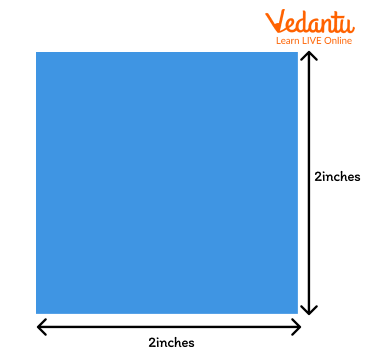
A square with sides 2 inches
Now, there are two types of attributes - Visual Attributes and Mathematical Attributes. Visual attributes are those attributes that are perceived via vision simply. While mathematical attributes are those attributes that are required in mathematical calculations.
The visual attributes of the square in the above diagram are:
The shape has 4 sides and 4 vertices.
All the sides of the square are equal.
The opposite sides of the square are also parallel in nature.
Now, let us look at the Mathematical attributes of the square in the above diagram:
The sides of the square measure 2 inches each.
The angles which are present on two adjacent sides sum up to 90 degrees.
Attributes Help us Identify the Type of Triangles
Attributes help us in identifying many shapes and objects. Similarly, these attributes also help us in identifying the type of triangles too. Did you know? There are three types of triangles:
Right Angle Triangle
Equilateral Triangle
Scalene Triangle
In a right-angled triangle, one of the angles is 90 degrees. In an equilateral triangle, all the sides are of equal measurement. While, in a scalene triangle, one of the angles is more than 90 degrees.
So, these attributes and properties of triangles differentiate each other and make them unique.
Did You Know?
The famous star constellation after the Zodiac signs is founded by the means of attributes.
Many computer programming languages and coding involve the usage of functions and attributes.
In this study, we have gained knowledge about the importance of attributes in Maths. In elementary schools, the kids learn and initiate visual observation priorly to any complicated calculations. Visual attributes are indeed the first step in learning the attributes. They visualize the mathematical operators, symbols, and numbers. Thus, we see attributes are involved in Maths right from elementary school. So, the students must be made aware of this gradually.
FAQs on What Are Attributes in Mathematics
1. What are attributes in mathematics?
In mathematics, attributes are qualitative characteristics or properties of objects that cannot be measured numerically but can be classified into categories. In data handling and statistics, attributes describe qualities such as gender, color, literacy, or pass/fail status. For example:
- Eye color (brown, blue, green)
- Marital status (single, married)
- Result (pass or fail)
2. What is the difference between attributes and variables?
The main difference is that attributes are qualitative while variables are quantitative.
- Attributes: Describe qualities (e.g., gender, literacy, blood group).
- Variables: Represent measurable quantities (e.g., height, weight, marks).
3. What are examples of attributes in statistics?
Examples of attributes in statistics are characteristics that describe quality rather than quantity. Common examples include:
- Gender (male/female)
- Religion
- Employment status (employed/unemployed)
- Literacy (literate/illiterate)
- Blood group (A, B, AB, O)
4. What are dichotomous attributes?
A dichotomous attribute is an attribute that has only two possible categories. It divides data into exactly two groups. Examples include:
- Pass / Fail
- Male / Female
- Literate / Illiterate
5. What are manifold attributes?
A manifold attribute is an attribute that has more than two categories. Unlike dichotomous attributes, it allows multiple classifications. Examples include:
- Blood group (A, B, AB, O)
- Religion (Hindu, Muslim, Christian, etc.)
- Education level (primary, secondary, higher)
6. How are attributes represented in statistics?
Attributes are represented using class frequencies and contingency tables in statistics. They are commonly shown as:
- Frequency tables (number of individuals in each category)
- Cross-tabulation tables (comparison of two or more attributes)
7. What is meant by classification of attributes?
The classification of attributes means grouping data according to shared qualitative characteristics. This can be done in two main ways:
- Simple classification: Based on one attribute (e.g., gender).
- Multiple classification: Based on two or more attributes (e.g., gender and literacy).
8. What is the association of attributes?
The association of attributes measures the relationship between two or more qualitative characteristics. It examines whether the presence of one attribute is related to another. For example:
- Is literacy related to employment?
- Is smoking associated with lung disease?
9. What is the difference between positive and negative attributes?
In the theory of attributes, positive attributes indicate the presence of a characteristic, while negative attributes indicate its absence. For example:
- A = literate (positive attribute)
- Ā = illiterate (negative attribute)
10. Why are attributes important in statistics?
Attributes are important because they help analyze qualitative data that cannot be measured numerically. They are useful for:
- Classifying populations
- Studying social and economic characteristics
- Finding relationships between qualitative traits
