








What is a Vulgar Fraction with Definition and Solved Examples
Do you know another name for a common fraction? A fraction in which the numerator and denominator are both integers. Vulgar fractions are simply two integers placed above and below a fraction bar (the numerator and denominator). A vulgar fraction, also known as a common fraction or fraction, is a fraction written in the conventional form, with one integer number written above the next and a line between them.
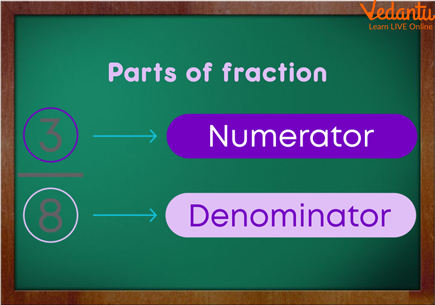
The Numerator and The Denominator
What are Numerators and Denominators?
The numerator predicts the total number of selected equal fractions. Whereas the denominator demonstrates the whole number of equal parts. A circular wheel is distributed into six equal sections. This situation can be represented as a $\dfrac{5}{6}$ fraction, the numerator 5 represents the number of the equivalent shaded portion taken out from the set of 6 equal amounts, and the denominator 6 means that 6 equal parts make up a whole unit.
Vulgar Fractions Facts
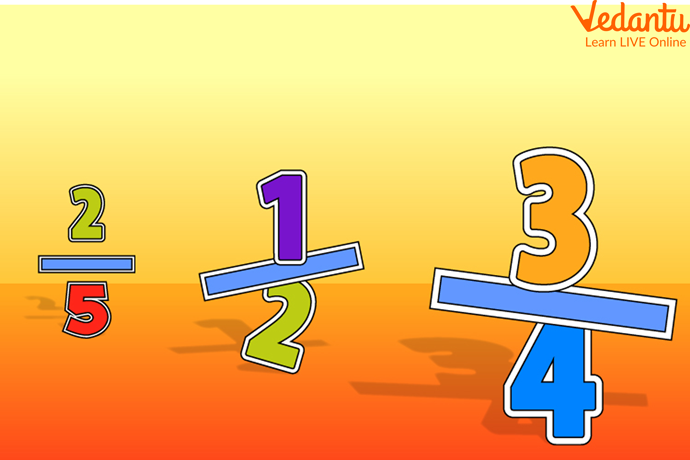
Examples of The Vulgar Fraction
If the numerator and denominator are multiplied or divided by the same number, the value of a vulgar fraction remains the same.
A fraction can be lowered only when the numerator and denominator share the exact divisors.
The fractions can be added by adding their numerators if their denominators are the same; to subtract them, take the numerator of the subtrahend and divide it by the numerator of the minuend; to multiply two fractions by fractions, multiply the numerators for the product's numerator and the denominators for the product's denominator.
Fraction
Finally, multiply the integer by the reciprocal of the particle to divide it by the fraction. The denominator cannot contain 0; it should be noted. Since denominators are also divisors, no integer may be split by 0, and the same rule applies to irrational numbers. Therefore, the denominator must be rationalised.
What is an Improper Fraction?

Improper Fraction
When the numerator is less than the denominator, the fraction is less than one and is referred to as a proper fraction. For example, $\dfrac{1}{2}$ and $\dfrac{5}{11}$ are correct fractions. If the numerator equals the denominator, the fraction is equal to unity, such as $\dfrac{7}{7}$. If the $\dfrac{200}{100}$ numerator is greater than the denominator, the fraction is more significant $\overline{100}$. The fraction is known as an improper fraction.
Converting Decimal to Vulgar Fraction
In the denominator, put 1 under the decimal point and annex with it as many zeros as is the number of digits after the decimal point. Then, remove the decimal point and reduce the fraction to the lowest terms.
Solved Examples on Vulgar Fraction
Q1. Express 0.18 as a Vulgar Fraction.
Ans: x = 0.18
Multiply both aspects by 10 (Since the number of digits without a bar is 1)
10x = 1.8
$10 x=1.88 .... . .(\text { i) }$
$10 \times 10 x=1.88 \ldots . . \times 10$ (Since number of digits having bars is 1
$100 x=18.8 \ldots . . \ldots \text { (ii) }$
Subtracting (i) from (ii)
$100 x-10 x=18.8-1.8$
$90 x=17$
$x=\dfrac{17}{90}$
Therefore, the vulgar fraction $=\dfrac{17}{90}$
Summary
A vulgar fraction, also known as a common fraction or fraction, is a fraction written in the conventional form, with one integer number written above the next and a line between them. Examples of vulgar fractions include 1/2, 5/11, and 200/100. A vulgar fraction is a part of unity or several equal parts of unity. A vulgar fraction is one that is based on ordinary or everyday arithmetic, as opposed to these highfalutin decimal things, which were originally called decimal fractions. It specifically refers to one in which two whole numbers (the numerator and denominator) are placed above and below a horizontal line. Neither part can be zero.
FAQs on Understanding Vulgar Fractions in Mathematics
1. What is a vulgar fraction in maths?
A vulgar fraction is a fraction written in the form a/b, where a and b are integers and b ≠ 0. It represents a part of a whole.
- a is called the numerator (top number).
- b is called the denominator (bottom number).
- Example: 3/4 means 3 parts out of 4 equal parts.
2. What is the difference between a vulgar fraction and a decimal?
The main difference is that a vulgar fraction is written as a/b, while a decimal is written using a decimal point.
- Vulgar fraction example: 1/2
- Decimal form: 0.5
- Fractions show exact ratios, while decimals may be terminating or recurring.
3. How do you convert a vulgar fraction to a decimal?
To convert a vulgar fraction to a decimal, divide the numerator by the denominator.
- Step 1: Take the numerator.
- Step 2: Divide it by the denominator.
- Example: 3/4 = 3 ÷ 4 = 0.75.
4. How do you simplify a vulgar fraction?
To simplify a vulgar fraction, divide both the numerator and denominator by their highest common factor (HCF).
- Example: Simplify 8/12.
- HCF of 8 and 12 is 4.
- 8 ÷ 4 = 2 and 12 ÷ 4 = 3.
- Simplified fraction = 2/3.
5. What are the types of vulgar fractions?
The main types of vulgar fractions are proper, improper, and mixed fractions.
- Proper fraction: Numerator less than denominator (e.g., 3/5).
- Improper fraction: Numerator greater than or equal to denominator (e.g., 7/4).
- Mixed fraction: A whole number and a fraction together (e.g., 1 3/4).
6. How do you convert an improper vulgar fraction to a mixed number?
To convert an improper fraction to a mixed number, divide the numerator by the denominator.
- Example: Convert 7/3.
- 7 ÷ 3 = 2 remainder 1.
- Write as 2 1/3.
7. How do you add two vulgar fractions?
To add two vulgar fractions, first make the denominators the same, then add the numerators.
- Example: 1/4 + 1/6.
- LCM of 4 and 6 is 12.
- 1/4 = 3/12 and 1/6 = 2/12.
- Sum = 3/12 + 2/12 = 5/12.
8. How do you multiply vulgar fractions?
To multiply vulgar fractions, multiply the numerators together and the denominators together.
- Formula: (a/b) × (c/d) = (ac)/(bd).
- Example: 2/3 × 4/5 = (2×4)/(3×5) = 8/15.
9. What is the reciprocal of a vulgar fraction?
The reciprocal of a vulgar fraction is obtained by swapping its numerator and denominator.
- If the fraction is a/b, its reciprocal is b/a.
- Example: The reciprocal of 3/5 is 5/3.
10. Why is it called a vulgar fraction?
It is called a vulgar fraction because the word “vulgar” originally meant “common” or “ordinary.”
- It distinguishes common fractions from decimals and complex fractions.
- The term does not mean rude; it simply means common fraction.
