








What Is a Hundredth in Maths Definition Place Value and How to Write It
What is a Hundredth?
Let us assume that you have 100 friends in your colony and one day, you receive a cash prize of Rs. 100 after clearing Maths olympiad. The next day, all of your friends appear in your room and ask for their share. So, now a dilemma is how to solve this issue and divide equal share among all of your friends. Now, what you do is take 1/100 of the share and give it to each of your friends. So, here 100 Rs is what you have and then dividing it by 100, i.e., 100/100 = 1. Now, Rs. 1 is that you gave to your first friend, and subsequently, you gave this 100 times, which means each of your 100 friends gets Re. 1.
A question arises: what does 1/100 mean here? Well, 1/100 is the hundredth, and in this article, we will study how to divide any number into 100 equal parts. Now, let us proceed with solved examples on the concept of the hundredth.
Example of Hundredth in Maths
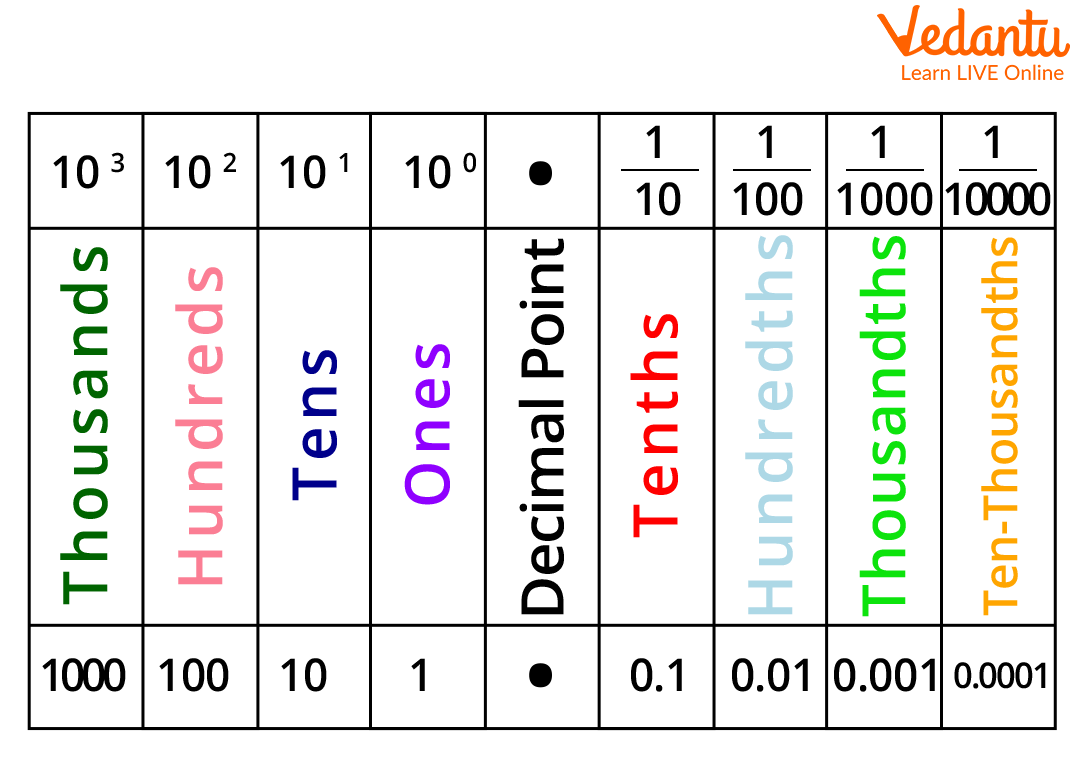
Let us consider a big number 3456.872 and find the place value of each digit to determine where the position of the hundredth falls.
Here, we have the following place values:
6 has a place value of ones, so 6 x 1 = 6.
4 has a place value of tens, so 4 x 100 = 400.
5 has a place value of hundreds, so 5 x 100 = 500.
Similarly, 3 has a place value of thousands, so 3 x 1000 = 3000.
Now, going to the digits right after the decimal, we have the following place values:
8 has a place value of the tenth of 8, so 8/10th or 0.8.
7 has a place value of hundredth of 7, so 7/100th or 0.07.
2 has a place value of thousandth of 2, i.e., 2/1000th or 0.002.
So, here you can notice the place value of 7 corresponding to the hundredth is 7/100th or 0.07.
Now, let us take another example to understand this concept a bit more. So, we have a number 2465.235. Now, let us solve this:
5 has a place value of ones, so 5 x 1 = 5.
6 has a place value of tens, so 6 x 10 = 60.
4 has a place value of hundreds, so 4 x 100 = 400.
Similarly, 2 has a place value of thousands, so 2 x 1000 = 2000.
Now, going to the digits right after the decimal, we have the following place values:
2 has a place value of the tenth of 2, so 2/10th or 0.2.
3 has a place value of hundredth of 3, so 3/100th, i.e., 0.03.
5 has a place value of thousandth of 5, i.e., 5/1000th or 0.005.
So, here you can notice the place value of 3 corresponding to the hundredth is 3/100th or 0.03.
This is how we understand the position of the hundredth in a given number with the help of the place value concept.
FAQs on Hundredth in Maths Explained with Place Value and Examples
1. What is a hundredth in maths?
A hundredth is one part out of 100 equal parts of a whole, written as 1/100 or 0.01. It represents a small fraction of a whole divided into 100 equal sections.
- Fraction form: 1/100
- Decimal form: 0.01
- Percentage form: 1%
2. How do you write one hundredth as a decimal?
One hundredth written as a decimal is 0.01. In the place value system, the second digit to the right of the decimal point represents hundredths.
- 0.1 = one tenth
- 0.01 = one hundredth
- 0.001 = one thousandth
3. What place value is the hundredth place?
The hundredth place is the second digit to the right of the decimal point. It shows how many hundredths are in a number.
- Example: In 3.47, the digit 4 is in the tenths place.
- The digit 7 is in the hundredths place.
4. How do you convert a fraction to hundredths?
To convert a fraction to hundredths, make the denominator 100 or convert it into a decimal with two decimal places. This is done by multiplying the numerator and denominator by the same number.
- Example: Convert 3/4 to hundredths.
- Step 1: Multiply numerator and denominator by 25.
- 3 × 25 = 75 and 4 × 25 = 100
- Result: 3/4 = 75/100 = 0.75
5. How do you round a number to the nearest hundredth?
To round to the nearest hundredth, look at the digit in the thousandths place (third digit after the decimal). If it is 5 or more, round the hundredths digit up; otherwise, keep it the same.
- Example: Round 2.346 to the nearest hundredth.
- The thousandths digit is 6.
- Since 6 ≥ 5, round 4 up to 5.
- Final answer: 2.35
6. What is the difference between tenths and hundredths?
The difference between tenths and hundredths is their place value, where tenths represent 1 out of 10 and hundredths represent 1 out of 100. Hundredths are ten times smaller than tenths.
- 1 tenth = 0.1
- 1 hundredth = 0.01
- 0.1 = 10 hundredths
7. How many hundredths are in one whole?
There are 100 hundredths in one whole. Since one hundredth equals 1/100, adding 100 of them makes 1.
- 1 hundredth = 1/100
- 100 × 1/100 = 1
8. Can you give an example of a hundredth in real life?
A real-life example of a hundredth is money, where 1 cent is one hundredth of a dollar. In decimal form, 1 cent is written as $0.01.
- $1 = 100 cents
- 1 cent = 1/100 of a dollar
- Decimal form: 0.01
9. How do you add and subtract hundredths?
To add or subtract hundredths, line up the decimal points and operate as with whole numbers. Make sure each number has two decimal places if working with hundredths.
- Example: 0.25 + 0.37
- Add: 25 hundredths + 37 hundredths = 62 hundredths
- Result: 0.62
10. Why are hundredths important in maths?
Hundredths are important in maths because they allow precise representation of decimal numbers and measurements. They are widely used in percentages, money, data, and calculations.
- Percentages: 1% = 1/100
- Money: $0.01 = one hundredth of a dollar
- Measurements: 2.34 m includes 4 hundredths
