

Courses
Courses for Kids
Free study material
Offline Centres
More
Store Icon
Store

Table of 7 Times Table with Chart and Practice Questions

ffImage
banner

How to Learn and Memorize the Table of 7 with Solved Examples

From the number of colours in a rainbow to the number of days in a week, to the number of continents in the world, all account to 7. As the number 7 is often used in the real world, learning and memorising the multiplication table of 7 at an early age is highly important. It will help students to solve problems of multiplication, division, and the fraction of large numbers with speed and accuracy. 


The multiplication table of 7 is also known as Table of 7 which contains a list of numbers that are the result of the multiplication of 7 with other natural numbers (1 and above). As 7 is a unit digit number, the table of 7 is considered as a building block for other multiplication tables.
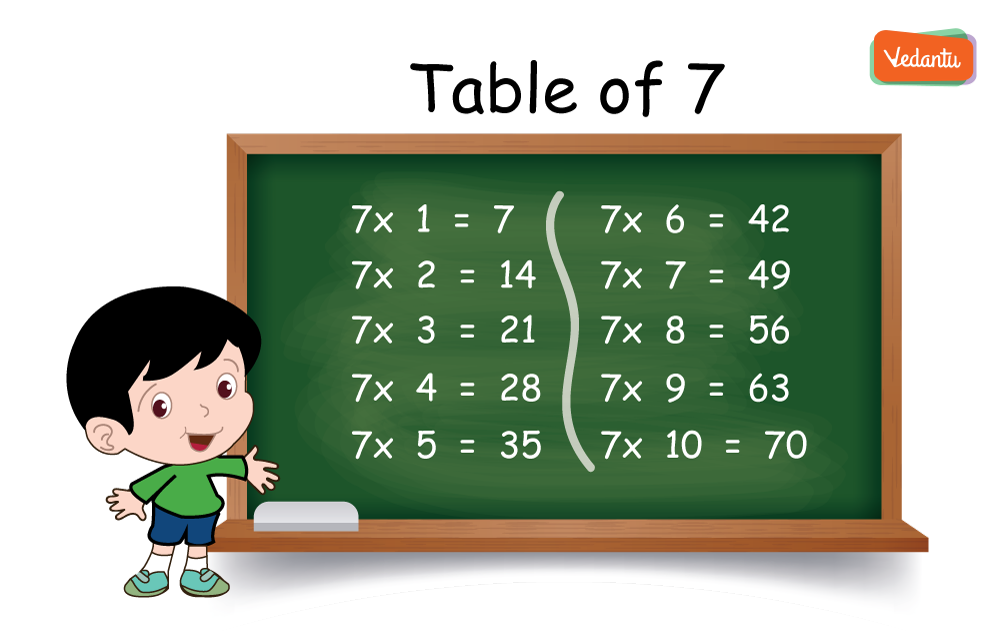

Table of 7

Table Chart of 7 from 1 to 10

The multiplication table of 7 or Table of 7 basically includes the multiples of 7. The Table of 7 is provided below:

7 × 1 = 7

7 × 6 = 42

7 × 2 = 14

7 × 7 = 49

7 × 3 = 21

7 × 8 = 56

7 × 4 = 28

7 × 9 = 63

7 × 5 = 35

7 × 10 = 70


Tips and Tricks to Memorise Table of 7

Below are some of the tips and tricks for fast learning multiplication table of 7.

  • The fast and easiest way to memorise the table chart of 7 is to read out loud (because you are more likely to memorise information when you read out loud) and repeat the same until you have achieved a stage where you can see the numbers 7, 14, 21, 28, 35, 42, 49, 56, 63, and 70 in that order by closing your eyes.

  • Another best way to remember the multiplication table of 7 is simply to apply the skip counting method. To skip count, we have to keep adding the same number to the previous number. For example, starting at 0, the next number will be 0 + 7 = 7, then 7 + 7 = 14, then 14 + 7 = 21, then 21 + 7 = 28, and then 35, 42, 49, 56, 63, and so on. 


How to Solve Questions Based on Table 7?

In this section, we have provided a few questions that can appear in the form of word problems, multiple-choice, or numericals.


Word Problems on Table 7 with Practice Questions

1. Andrew works 2 days a week. How many days does he work in 7 weeks?

Solution:

Andrew works 2 days a week.

In 7 weeks, he works 2 times 7.

Now, from the 7 times table, 2 × 7 = 14 days.

Hence, Andrew works 14 days in 7 weeks.


2. What is the value of 7 times 7 plus 7 times 6?

Solution: 

As we know, from the table,

  • 7 times 7 = 7 x 7 = 49

  • 7 times 6 = 7 x 6 = 42

Therefore,

7 times 7 plus 7 times 6

= 7 x 7 + 7 x 6

= 49 + 42

= 91


Practice Questions

  • Rahul bought 6 pens for Rs. 7 each. What is the total amount Rahul spent on pens?

  • What is the value of 7 times 8 plus 91?


MCQs on Table 7 with Practice Questions

1. What is the value of 7 times 5 – 8?

  1. 54

  2. 27

  3. 35

  4. 42

Solution: (b)

7 times 5 – 8

= 7 x 5 - 8

= 35 - 8

= 27


Practice Question

1. In each box, there are 7 eggs. How many in 9 boxes of eggs?

  1. 56

  2. 42

  3. 63

  4. 49

Answer: 63


Table Chart of 7 from 11 to 20

To master the Table of 7, it is important that you remember the Table of 7 from 11 to 20. It will also help the students while solving problems that involve higher multiples of 7. Refer to the image given below, the same is provided in the PDF form, which can be easily downloaded and printed.


7 × 11 = 77

7 × 16 = 112

7 × 12 = 84

7 × 17 = 119

7 × 13 = 91

7 × 18 = 126

7 × 14 = 98

7 × 19 = 133

7 ×15 = 105

7 × 20 = 140


For Parent/Teacher: How to Read the Table to Your Kid?

A kid can easily remember his/her name due to the repetition of the name multiple times throughout the day. So, it is a good habit to read the table to your kid on a regular basis. It can become a new rhyme/song that you repeat in the morning or play on your devices. Read the table in front of your kid and ask them to repeat after you. You can also hang a Table of 7 in a place that your child can see often so that they can take a glance at the table while crossing that place.


  • Seven ones are seven

  • Seven twos are fourteen

  • Seven threes are twenty-one

  • Seven fours are twenty-eight

  • Seven fives are thirty-five

  • Seven sixes are forty-two

  • Seven sevens are forty-nine

  • Seven eighths are fifty-six

  • Seven nines are sixty-three

  • Seven tens are seventy


Conclusion

Considering the importance of Table of 7, we have provided the PDF containing Multiplication Table up to 20. To access the PDF, students can click on 'Download PDF' and use it whenever they need it. This will help students in keeping the table of 7 at their fingertips and improve their efficiency at Mathematical calculations.


Remember the trick to mastering the multiplication table is repetition and regular practice.

FAQs on Table of 7 Times Table with Chart and Practice Questions

1. What is the table of 7?

The table of 7 is the list of multiples of 7 obtained by multiplying 7 by whole numbers. It helps in quick multiplication and division calculations.

  • 7 × 1 = 7
  • 7 × 2 = 14
  • 7 × 3 = 21
  • 7 × 4 = 28
  • 7 × 5 = 35
  • 7 × 6 = 42
  • 7 × 7 = 49
  • 7 × 8 = 56
  • 7 × 9 = 63
  • 7 × 10 = 70
These are the first ten multiples of 7.

2. How do you learn the table of 7 easily?

You can learn the 7 times table easily by repeated addition and pattern recognition. Follow these steps:

  • Add 7 repeatedly: 7, 14, 21, 28, 35...
  • Notice the pattern in the ones place: 7, 4, 1, 8, 5, 2, 9, 6, 3, 0.
  • Practice writing and reciting the table daily.
  • Use skip counting by 7s to improve speed.
Regular practice strengthens multiplication skills.

3. What are the first 20 multiples in the table of 7?

The first 20 multiples of 7 are numbers obtained from 7 × 1 to 7 × 20.

  • 7, 14, 21, 28, 35, 42, 49, 56, 63, 70
  • 77, 84, 91, 98, 105, 112, 119, 126, 133, 140
Each number increases by 7 from the previous one.

4. What is 7 multiplied by 12?

The value of 7 multiplied by 12 is 84. You can calculate it as:

  • 7 × 12 = 7 × (10 + 2)
  • = (7 × 10) + (7 × 2)
  • = 70 + 14
  • = 84
This uses the distributive property of multiplication.

5. What is the pattern in the table of 7?

The pattern in the multiplication table of 7 increases by 7 each time. Important patterns include:

  • Each number is 7 more than the previous one.
  • The ones digits follow a repeating cycle: 7, 4, 1, 8, 5, 2, 9, 6, 3, 0.
  • Every 5th multiple ends in 5 or 0 (35, 70).
Recognizing patterns helps in quick recall.

6. How do you use the table of 7 in division?

You use the table of 7 in division by finding which multiple of 7 matches the given number. For example:

  • Divide 63 ÷ 7
  • Since 7 × 9 = 63
  • Therefore, 63 ÷ 7 = 9
This method makes division faster and easier.

7. Why is learning the table of 7 important?

Learning the 7 times table is important because it improves speed and accuracy in multiplication and division. It is useful in:

  • Solving word problems
  • Finding factors and multiples
  • Working with fractions and ratios
  • Mental maths calculations
Strong multiplication skills build a foundation for advanced maths topics.

8. What is 7 times 15?

The value of 7 times 15 is 105. You can calculate it as:

  • 7 × 15 = 7 × (10 + 5)
  • = (7 × 10) + (7 × 5)
  • = 70 + 35
  • = 105
This method simplifies larger multiplication problems.

9. How can I practice the table of 7?

You can practice the table of 7 by solving multiplication and division exercises daily. Effective methods include:

  • Writing the table from memory
  • Using flashcards for quick recall
  • Solving fill-in-the-blank questions (7 × __ = 49)
  • Practicing word problems involving multiples of 7
Consistent revision improves retention.

10. What are some real-life examples of the table of 7?

The table of 7 is used in real life for counting and grouping items in sets of seven. Examples include:

  • Days in weeks: 7 days × 4 weeks = 28 days
  • Buying 7 pencils in 6 boxes: 7 × 6 = 42 pencils
  • Calculating weekly wages for 7 days of work

Multiplication tables help solve everyday maths problems quickly.