
Courses
Courses for Kids
Free study material
Offline Centres
More
Store Icon
Store

Table of 11 with Simple Patterns and Practice Examples

ffImage
banner

How to Learn and Practice the Table of 11 with Tricks and Solved Examples

Multiplication, addition, and subtraction are some of the fundamental arithmetic operations that are taught to kids at an early age. Before looking into the multiplication table of 11, we must look into what is a multiplication table?


Multiplication is the process of adding something more than once. The use of a multiplication table or times table is a simple approach to accomplish day-to-day computations. A multiplication table is defined as a collection of a number's multiples. By multiplying the provided integer by whole numbers, we may get the multiplication table.


Multiplication is one of the fundamental mathematical processes that students are taught from a young age. A multiplication chart is a table that displays the results of multiplying two integers together.
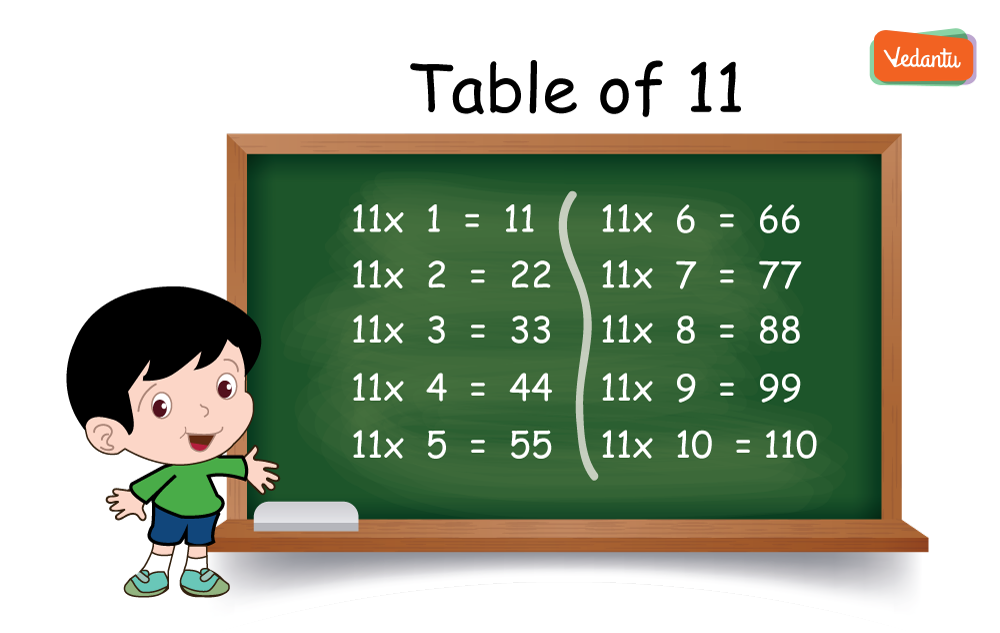

Table of 11

Table Chart of 11 from 1 to 10

Let us look at the multiplication table of 11.

11 × 1 = 11

11 × 6 = 66

11 × 2 = 22

11 × 7 = 77

11 × 3 = 33

11 × 8 = 88

11 × 4 = 44

11 × 9 = 99

11 × 5 = 55

11 × 10 = 110


Tips and Tricks to Memorise the Table of 11

Let us look at some of the tips and tricks that can help kids in better memorising the table of 11.

  • The first nine multiples of eleven are simple to remember. When the number 11 is multiplied by any single-digit natural number, the result is written twice. 11 × 2 = 22, for example, where 2 is a natural number. As a result, we have the first nine multiples of 11.

  • There is a technique to calculate the 11 times table for two-digit numbers. When multiplying a two-digit number by 11, add the sum of the digits and position it between the two digits of the original two-digit number. For example, when 11 is multiplied by 16, the result is 176, in which the sum of 1 and 6, is 7. 7 is placed between 1 and 6.

  • Using the multiplication table of 10 to get the products of the 11 times table is a simple approach to do so. To begin, divide the number by ten. Then multiply the answer by the multiplier to get the multiple of 11. This can be understood by a simple example.

11 × 15.

Let's multiply it by 10. So, 10 × 15 = 150.

Add the multiplier to the answer. 150 + 15 = 165.

Therefore, 11 × 15 = 165.


Questions Based on Multiplication Table of 11

Let us look into some of the questions based on the multiplication table 11, solving these questions would help kids to understand the concepts of the multiplication table.


Word Problems of Table 11

Question 1: Shreya on her birthday distributed 5 candies each to the kids in her class. There were 11 kids in the class. Find the total number of candies distributed by Shreya with the help of the multiplication table of 11.

Solution: 

As per the question, there were 11 kids, and she distributed 5 candies each to the kids.

Therefore, from the table of 11, 5 × 11= 55. 

Hence, 55 candies were distributed in total in the class.


Question 2: Rashmi bows 5 times in a row. If she bowed 11 times, how many times Rashmi must have bowed, calculated using the table of 11.

Solution: 

The number of times the girl bowed in a row = 5.

Therefore, using the table of 11, the total number of times she bowed is 11 times = 11 times 5 = 55

Hence, she has bowed 55 times in total.


MCQ Problem

Let us look into a simple multiple-choice question.

Question: What is 11 times 7?

  1. 77

  2. 22

  3. 78

Solution: The multiplication result of 11 × 7 = 77.

Hence, option A is the correct answer.


Number Problems Using the Multiplication Table of 11

Question 1: Evaluate 7 minus 6 plus 3 times 11 using the multiplication table of 11.

Solution: The mathematical representation of the problem is 7 minus 6 plus 3 times 11 = 7 - 6 + 3 × 11, upon solving it,

1 + 33 = 34

Hence, 7 minus 6 plus 3 times 11 is 34.


Question 2: Find the value of 4 plus 5 times 11.

Solution: Let us first represent the problem mathematically, 

4 plus 5 times 11 = 4 + 5 × 11 = 4 + 55 = 59

Hence, the value of 4 plus 5 times 11 is 59.


Practice Questions Using the Multiplication Table of 11

Question 1: Evaluate the number which when multiplied to 11 gives 33 with help of the multiplication table?

Answer: 3


Question 2: What is the value of 5 plus 5 times 11?

Answers: 60


Question 3: Using the multiplication table of 11, evaluate 10 minus 8 plus 7 times 11?

Answer: 79


The Table Chart of 11 from 11 to 20

A portion of the multiplication table of 11 is shown below, which includes the multiples of 11 from 11 to 20. Learning these multiples can help children answer Maths problems more effectively.


11 × 11 = 121

11 × 16 = 176

11 × 12 = 132

11 × 17 = 187

11 × 13 = 143

11 × 18 = 198

11 × 14 = 154

11 × 19 = 209

11 × 15 = 165

11 × 20 = 220


We hope to answer all the queries related to the multiplication table of 11. We also encourage students to thoroughly go through the multiplication tables of mathematics.


Learning these multiples can help children answer Maths problems more effectively.

FAQs on Table of 11 with Simple Patterns and Practice Examples

1. What is the table of 11?

The table of 11 is the multiplication table that shows the products of 11 with natural numbers. It lists multiples like 11 × 1, 11 × 2, 11 × 3, and so on.

  • 11 × 1 = 11
  • 11 × 2 = 22
  • 11 × 3 = 33
  • 11 × 4 = 44
  • 11 × 5 = 55
  • 11 × 10 = 110
Learning the 11 times table helps improve mental maths, multiplication skills, and quick calculations.

2. How do you write the table of 11 up to 20?

The table of 11 up to 20 is written by multiplying 11 with numbers from 1 to 20. Here are the products:

  • 11 × 6 = 66
  • 11 × 7 = 77
  • 11 × 8 = 88
  • 11 × 9 = 99
  • 11 × 10 = 110
  • 11 × 15 = 165
  • 11 × 20 = 220
You can continue multiplying 11 by each natural number to extend the table further.

3. What is the trick to learn the table of 11?

A simple trick to learn the 11 times table (up to 9) is to repeat the digit in the ones and tens place. For example:

  • 11 × 2 = 22
  • 11 × 3 = 33
  • 11 × 4 = 44
For two-digit numbers like 11 × 12, use this method:
  • Write the number: 12
  • Add its digits: 1 + 2 = 3
  • Place the sum in the middle → 132
So, 11 × 12 = 132.

4. What is 11 multiplied by 11?

The value of 11 multiplied by 11 is 121. You can calculate it as:

  • 11 × 11 = (10 × 11) + (1 × 11)
  • = 110 + 11
  • = 121
This is also a square number because 121 = 11².

5. How do you multiply a number by 11 quickly?

To multiply a two-digit number by 11 quickly, add the digits and place the sum in between them. Steps:

  • Example: 11 × 23
  • Add digits: 2 + 3 = 5
  • Place 5 in the middle → 253
So, 11 × 23 = 253. If the sum is greater than 9, carry over to the tens place.

6. Why does the table of 11 have repeated digits up to 9?

The table of 11 has repeated digits up to 9 because multiplying a single-digit number by 11 places the digit in both the tens and ones places. For example:

  • 11 × 4 = 44
  • 11 × 7 = 77
This pattern happens due to place value multiplication: 11 × n = (10 × n) + n, which results in repeating digits for n less than 10.

7. What are the first 10 multiples of 11?

The first 10 multiples of 11 are the products of 11 from 1 to 10. They are:

  • 11
  • 22
  • 33
  • 44
  • 55
  • 66
  • 77
  • 88
  • 99
  • 110
These numbers form the basic 11 times table used in arithmetic calculations.

8. How is the table of 11 useful in real life?

The table of 11 is useful for quick mental maths, counting money, and solving multiplication problems faster. It helps in:

  • Calculating totals like 11 items at ₹20 each
  • Finding repeated additions (11 + 11 + 11)
  • Solving algebraic expressions involving multiples of 11
Knowing the 11 multiplication table improves speed and accuracy in exams and daily calculations.

9. What is the pattern in the 11 times table?

The main pattern in the 11 times table is repeating digits up to 9 and increasing digit sums afterward. For example:

  • 11 × 5 = 55
  • 11 × 9 = 99
  • 11 × 10 = 110
  • 11 × 12 = 132
The digits of each product add up to multiples of 11 (e.g., 1 + 3 + 2 = 6, and 6 is related to 11 × 12 = 132 pattern logic).

10. Is 121 in the table of 11?

Yes, 121 is in the table of 11 because 121 = 11 × 11. It is the 11th multiple of 11 and also a perfect square. This confirms that 121 belongs to the 11 times table.
