









How To Use Subtraction Strategies In Grade 2 With Step By Step Examples
As we all know, subtraction is a mathematical operation that takes part away from another value. Here in this lesson, we will understand subtraction, types of subtraction models, subtraction by crossing out, and some solved examples on add and subtract for class 2. Subtraction is the series of taking away a number from another. It is a primary operation denoted by a subtraction symbol (-) and is the method of calculating the difference between two numbers. So, let’s further learn about it in this article by understanding more about it and solving some questions.
What is Subtraction?
Subtraction is used to find the difference between numbers. When we have a group of objects, and you take away a few objects, the group becomes smaller. Subtraction methods are many ways numbers can be subtracted. The method will depend on the problem. We will be going to study in the future.
E.g. you bought 10 balls for your friend, and your friend takes 7 balls. This can be written as 10-7=3 and is read as “ ten minus seven equals three.” Here, we performed the subtraction operation on two numbers 10 and 7 to get the difference of 3.

Subtraction
Types of Subtraction Models
Teaching all four models of subtraction-take-away, comparison, completion and whole/part/part--can better train elementary school children to think abstractly and relate their math knowledge to the real world.
Take-Away Model
The takeaway model is the most commonly taught subtraction model. It teaches children that taking away some objects from a set results in fewer objects in the set. To teach children the take-away model, set a particular number (e.g. 8) of objects (apples, oranges, blocks, etc.) in front of them and ask them to take away a small number (e.g. 3) of objects. Then ask them how many objects remain. In some exercises, children learn that subtracting objects from a set results in a smaller number (e.g. 8 -3 = 5 ).
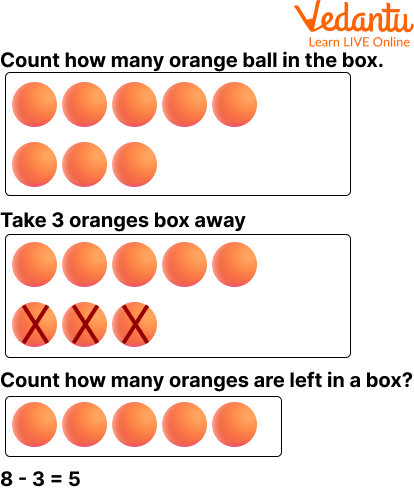
Take away model
Completion Subtraction
The completion subtraction model makes children understand algebra lessons since it forces children to manipulate variables in a basic subtraction equation. For example, a completion subtraction is “7 +? = 10.” Use the same blocks or orange balls you used in the takeaway model to teach children this concept. So here, if 3 balls are added to the 7 orange balls, then it will become 10.
So to get this three, we need to do the subtraction, i.e. 10 - 7 = 3.
Comparison Model
The comparison model of subtraction, which involves comparing two different numbers, is a little more challenging to visualise than the takeaway model. An example of comparison subtraction is “If Ram is 26 and Shyam is 36, how many years older is Shyan than Ram?” Since by using these types of problems, children understand concepts easily.
Whole/Part Model
The part model of subtraction involves categories of objects that need to be subcategorised: “I have five mangoes for sale. Three are green mangoes. How many aren’t green apples?”. In this way, we can categorise the objects and use this model.
How to Solve Subtraction by Crossing Out?
Crossing out is a memory game that models subtraction situations in a frame using crossing out (strike-through) and the matching equation without the difference. Subtract models subtraction situations in a frame using crossing out (strike-through) and the matching difference.
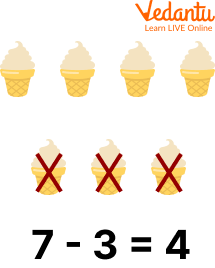
Subtraction by Crossing Out
Solved Examples on Add and Subtract for Class 2
Q.1. Find out the number of apples in the box. If the box contains 10 apples and 6 are removed, how many apples are left in the box?
Solution: Total number of apples in the box is 10.
Out of which, 6 apples are removed.
The number of apples left is given by,
10 -6 =4
Thus the number of apples left in the box is 4.
Q2. Newton catches 25 fish in a lake. He puts 13 fish back. How many fishes does he have now?
Solution: No. of fish caught are 25 fish.
No. of fish that were put back are 13 fish.
Fishes left are given by,
25 - 13 =12.
Thus the number of fish left is 12.
Q3. There are 39 birds in a tree. A loud noise scares 16 birds away, what number of birds are left in the tree?
Solution: There are 39 birds in a tree.
Out of which, 16 birds away from a tree.
Left birds are given by,
39 - 16 =23.
Thus the number of birds left in the tree is 23.
Practice Questions
Q.1. Mark had 10 blue marbles. Jim had 6 red marbles. What number of marbles do they have in total?
Ans: 16.
Q.2. There are 6 blue Marlins and 2 snappers in the pond. How many fish are there in total?
Ans: 4.
Q.3. Mary picked 11 cherries off the tree. Her brother Bill picked 8. How many cherries are left?
Ans: 3.
Summary
In this chapter, we have learned that subtraction is a mathematical operation that takes part away from another value. We also learnt about subtraction, types of subtraction methods, and how to solve subtraction by crossing out. When solving subtraction problems, the 1-digit number can be subtracted more easily, but for larger numbers, we need to split the numbers into columns using their respective values. By solving subtraction questions, we develop an understanding of methods and their applications, which will help us solve such difficult questions.
FAQs on Subtraction Strategies For Grade 2 Students
1. What are subtraction strategies for Grade 2?
Subtraction strategies for Grade 2 are simple methods that help students subtract numbers accurately and efficiently. These strategies build number sense and understanding of place value.
- Counting back – counting backwards on a number line.
- Using a number line – jumping back in steps.
- Break apart (place value) – subtracting tens and ones separately.
- Compensation – adjusting numbers to make subtraction easier.
- Fact families – using related addition and subtraction facts.
2. How do you teach subtraction using a number line in Grade 2?
To teach subtraction on a number line in Grade 2, students start at the larger number and jump backwards by the amount being subtracted.
- Example: Solve 15 − 7.
- Start at 15 on the number line.
- Jump back 7 steps.
- You land on 8.
3. What is the break apart strategy in subtraction?
The break apart strategy in subtraction means separating numbers into tens and ones before subtracting. This method uses place value understanding.
- Example: Solve 34 − 12.
- Break apart: 34 = 30 + 4 and 12 = 10 + 2.
- Subtract tens: 30 − 10 = 20.
- Subtract ones: 4 − 2 = 2.
- Add results: 20 + 2 = 22.
4. How do you subtract two-digit numbers without regrouping in Grade 2?
To subtract two-digit numbers without regrouping, subtract the ones first and then the tens. This works when the top digit is larger in both place values.
- Example: 46 − 23
- Ones: 6 − 3 = 3
- Tens: 40 − 20 = 20
- Final answer: 23
5. How do you subtract with regrouping in Grade 2?
To subtract with regrouping, you borrow 1 ten from the tens place and add it to the ones place. This is used when the top ones digit is smaller than the bottom one.
- Example: 42 − 18
- Regroup: 42 becomes 3 tens and 12 ones.
- Ones: 12 − 8 = 4
- Tens: 3 − 1 = 2
- Final answer: 24
6. What is the compensation strategy in subtraction?
The compensation strategy in subtraction means adjusting numbers to make them easier to subtract and then correcting the answer. It simplifies mental math.
- Example: 52 − 19
- Change 19 to 20 for easier subtraction.
- 52 − 20 = 32
- Add back 1 (because 19 is 1 less than 20).
- Final answer: 33.
7. How can fact families help with subtraction in Grade 2?
Fact families help with subtraction by showing the relationship between addition and subtraction facts using the same three numbers.
- Example numbers: 8, 5, and 3.
- 8 − 5 = 3
- 8 − 3 = 5
- 5 + 3 = 8
- 3 + 5 = 8
8. What is counting back in subtraction?
Counting back is a subtraction strategy where students count backwards from the larger number by the number being subtracted. It is often used for small numbers.
- Example: 13 − 4
- Start at 13.
- Count back: 12, 11, 10, 9.
- Final answer: 9.
9. What are common mistakes in Grade 2 subtraction?
Common mistakes in Grade 2 subtraction include place value errors and forgetting to regroup. These errors often happen when students rush.
- Subtracting the smaller digit from the larger without regrouping.
- Mixing up tens and ones columns.
- Forgetting to reduce the tens place after borrowing.
- Counting forward instead of backward.
10. Can you give a word problem example using subtraction strategies for Grade 2?
A subtraction word problem for Grade 2 asks students to find how many are left or how many more are needed. Subtraction strategies help solve it step by step.
- Example: Sara had 27 apples and gave away 9 apples.
- Equation: 27 − 9
- Use counting back or break apart.
- 27 − 9 = 18
