









How to Subtract Unlike Terms with Rules and Solved Examples
Have you ever thought about whether one can obtain a single result on the subtraction of two unlike terms or not? Subtraction is the process of removing a part of a given set of similar things to obtain the result. There will be no result from subtracting two non-similar things. Thus, it can be said that, unlike terms, never produce a single result when subtracted. These give a result as the difference between two, unlike terms. Let's read the article to learn further about the topic.
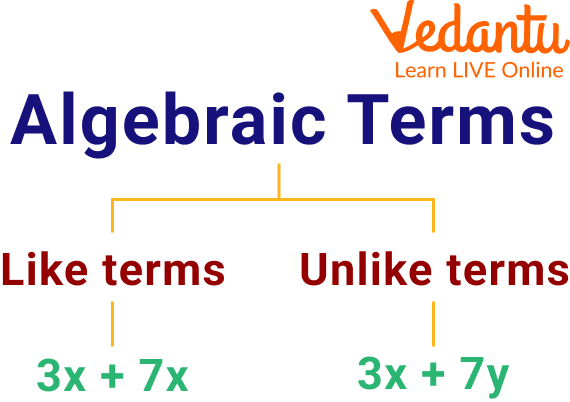
Algebraic Terms
Define Unlike Terms
Unlike terms are algebraic terms that have different variables. These can not be put up to the identical power of a number. For example, 7xy + 9x - z constitutes an, unlike term.
Subtraction of Two Positive Unlike Terms
To calculate the difference between two positive unlike terms, let us consider two positive numbers, say m and n, then subtract n from m, we must connect both the terms with a subtraction sign and express the result as m - n.
Subtraction of Positive and Negative Unlike Terms
If we take two numbers, one positive, say m and one negative, say -n. Then, subtract -n from m, by using a subtraction sign i.e. $[m-(-n)]$. The outcome thus obtained to discover the difference can be expressed in the form of m + n.
Subtraction of Negative and Positive Unlike Terms
Let us consider two numbers, one negative, say $-\mathrm{m}$, and the other positive, say $\mathrm{n}$. If we want to remove n from -m, we must connect them by using the subtraction symbol i.e. $[(-m)-n]$. The obtained result of the difference between two opposite sign terms can be expressed in the form of (-m-n).
Subtraction of Negative and Negative Unlike Terms
Assuming two negative numbers, say $-\mathrm{n}$ and $-\mathrm{m}$. Let us take the difference of $-\mathrm{n}$ from $-\mathrm{m}$, by using the subtraction symbol i.e. $[(-m)-(-n)]$. Here, the result of the difference between two negative numbers can be expressed in the form of -m+n.
Solved Examples
1. Subtract 7z from 4y.
We need to subtract the given two, unlike both positive terms. Thus applying the result m-n, where m = 4y and n = 7z.
4y-7z is the required answer obtained by subtracting two positives, unlike terms.
Q 2. Find the difference between -4 and -7mn
We need to find the difference between the given two unlike terms, which are both negative. Thus applying the result $-m+n$, where $m=4$ and $-n=7 \mathrm{mn}$.
$-4+7 \mathrm{mn}$ is the required answer obtained by subtracting two negatives, unlike terms.
Q 3. Subtract - 2b from 10a.
Ans: We need to subtract the given two, unlike terms, out of which one is positive while the other is negative. Thus applying the result m + n, where m = 10a and -n = 2b.
$10 a+2 b$ is the required answer obtained by subtracting one positive and one negative, unlike a term.
Practice Problems
Q 1. Find the difference between $11 \mathrm{pq}$ and $9 \mathrm{p}$.
Ans: $11 p q-9 p$
Q 2. Calculate the difference between $-9 p^2$ and $27 p$.
Ans: $\left(-9 p^2-27 p\right)$
Q 3. How much is $7 p+5 q$ greater than $3 q$?
Ans: $7 p+2 q$
Q 4. Find the difference between $13 x y$ and $-4 z$
Ans: $13 x y+4 z$
Summary
Subtraction is one of the most basic topics of mathematics which the students must learn to master the calculations. It serves as the foundation for various topics including data handling, mensuration, etc. Some children find it difficult to learn this topic due to the unavailability of a better understanding of the concepts. This article provides you with all the details regarding the subtraction of unlike terms, the subtraction of two positive, one positive, and other negative unlike terms, and the subtraction of two negative unlike terms. Hoping you learned and enjoyed reading it.
FAQs on Subtraction of Unlike Terms in Algebra
1. What is subtraction of unlike terms in algebra?
Subtraction of unlike terms means subtracting algebraic terms that do not have the same variables or powers, and they cannot be combined into a single term. In algebra, unlike terms have different variables or different exponents.
For example:
- 5x − 3y cannot be simplified further because x and y are different variables.
- 7a² − 4a cannot be combined because the powers of a are different.
2. How do you subtract unlike terms?
To subtract unlike terms, simply write them together with the subtraction sign because they cannot be combined. Follow these steps:
- Step 1: Identify whether the terms are unlike (different variables or powers).
- Step 2: Remove brackets if any.
- Step 3: Write the terms together with the minus sign.
3. Why can’t unlike terms be subtracted into one term?
Unlike terms cannot be subtracted into one term because they represent different algebraic quantities. In algebra, only like terms (same variables and same powers) can be combined.
For example:
- 3x and 5x can combine.
- 3x and 5y cannot combine because x ≠ y.
4. What is the difference between like terms and unlike terms?
The difference between like and unlike terms is that like terms have identical variables with the same exponents, while unlike terms do not.
- Like terms: 4x and 9x (same variable and power)
- Unlike terms: 4x and 9y (different variables)
- Unlike terms: 4x and 9x² (different powers)
5. Can you give an example of subtraction of unlike terms?
An example of subtraction of unlike terms is 8a − 3b, which cannot be simplified further. Since a and b are different variables, the terms are unlike.
Another example:
- 10x² − 5x → cannot combine because the powers differ.
6. What happens when you subtract unlike terms with brackets?
When subtracting unlike terms with brackets, first remove the brackets by changing the signs inside if necessary. After removing brackets, check if any terms are like terms.
Example:
- 5x − (2y + 3x)
- = 5x − 2y − 3x
- = 2x − 2y
7. Is 7x − 4x² an example of subtraction of unlike terms?
Yes, 7x − 4x² is an example of subtraction of unlike terms because the powers of x are different. The term 7x has power 1, while 4x² has power 2.
Since the exponents are not the same, the expression cannot be simplified further.
8. What are common mistakes when subtracting unlike terms?
A common mistake is trying to combine terms that are not alike. Students often ignore differences in variables or exponents.
Common errors include:
- Combining 3x and 2y to get 5xy (incorrect).
- Combining 6a and 4a² as 10a² (incorrect).
9. Can unlike terms ever become like terms?
Unlike terms can become like terms only after simplification if their variables and powers match. This usually happens after expanding brackets or simplifying expressions.
Example:
- 2x + (3x − 4y)
- = 2x + 3x − 4y
- = 5x − 4y
10. How do you know if terms are unlike in an algebraic expression?
You know terms are unlike if their variables or exponents are different. To check:
- Compare the variable letters.
- Compare the powers (exponents).
- Ensure both variable and exponent match exactly.
