








How to Subtract Decimals Using Place Value Method with Solved Examples
Decimal subtraction is like the standard deduction of entire numbers. We simply have to put the decimal numbers, one beneath the other, as per their place values alongside the decimal point. At times the two given numbers are unique. If necessary, we change the given decimal portions to like decimal divisions to make the deduction simpler. Two decimals are called like decimal portions on the off chance that they have an equivalent number of decimal spots.
How to Subtract Decimals or Point Subtraction
Taking away decimals with pulling together is equivalent to the refocusing that is finished in entire numbers. The accompanying advances make sense of the way to deduct decimals by refocusing. This is also termed as point subtraction.
Stage 1: After changing the numbers to like decimals, and putting the more modest number beneath the more noteworthy number, guarantee that the decimal focuses are adjusted and the digits are set in the comparing place esteem section.
Stage 2: Subtract the digits in every section exclusively, beginning from the right and move to the left.
Stage 3: If the number in the upper line is more modest than the number in the lower column, we acquire 1 from the digit to one side and add 10 to the ongoing digit. This step is known as refocusing.
Stage 4: Since 1 has been acquired, this number has decreased by 1. Change the number as needed and take it away.
For instance, let us take away the given numbers.
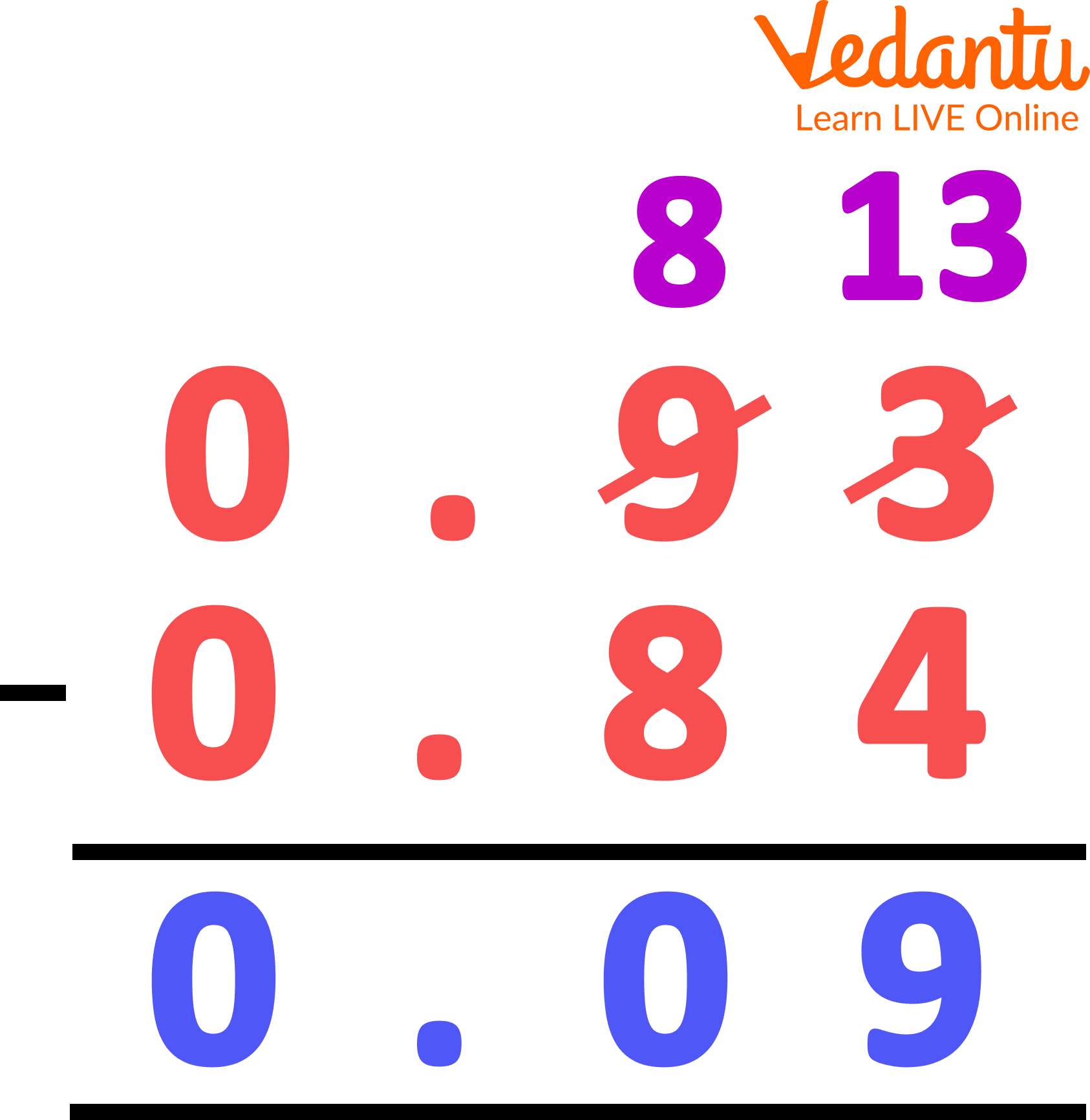
Model: Subtract 0.84 from 0.93.
Arrangement: Taking away decimals with refocusing
Subtraction of Decimal
In the above numbers 0.93 and 0.84, the digit 3 is more modest than 4 in the hundredths section, so we really want to acquire 1 from 9 to do the deduction. We want to diminish 1 from 9 since it has given 1 to the number to one side. Along these lines, 9 will become 8, and 3 will become 13. Presently, we take away 13 - 4 = 9 and 8 - 8 = 0.
At last, we place a decimal direct in the response to get 0.09.
Deducting Decimals with the Same Number of Decimal Places
Deducting decimals with a similar number of decimal spots is basic. We simply have to do the straightforward course of deduction and afterward place the decimal focuses as per the given numbers.
Rules for Subtracting Decimals
There are sure principles and steps which ought to be recalled while deducting decimals.
Following are the subtraction rules:
Change the given decimal parts to like decimals.
Compose the more modest number beneath the more prominent number so that the digits are put in the relating places and the decimal focuses are put in a similar vertical line.
Then, at that point, take away the numbers similarly as on account of entire numbers.
After the deduction, place the decimal point in accordance with the other decimal places. By applying the above stated subtraction rules, we can easily get our answer.
How to Subtract Decimals with Whole Numbers
To deduct decimal numbers from entire numbers, we place a decimal point in the entire number as per the quantity of digits (after the decimal) in the other number. Then, at that point, we add the expected number of zeros, so both the numbers have an equivalent length.
For instance, let us deduct 0.999 from 6.
Arrangement: Since there are three digits after the decimal in 0.999, we will put a decimal after 6 and add three zeros after it.

Subtracting From Whole Numbers
Solved Example
Let us deduct the given numbers:
Model: Subtract: 0.56 - 0.42.
Arrangement: Since these are like decimals, we will put them all together and do the customary deduction.
0.56 - 0.42 = 0.14
Summary
This article discussed decimals and subtractions in decimals. It is equivalent to refocusing that is completed in whole numbers to remove decimals by pulling them together. The supplementary developments clarify how to subtract decimals by focusing. The numbers are first cushioned with zero contingent on the most extreme digits present after the decimal for any of the numbers. The numbers are fixed up upward alongside one another. Finally, deduct the decimal numbers like whole numbers and spot the decimal point as needs are.
FAQs on Subtraction of Decimals Explained with Step by Step Method
1. What is subtraction of decimals?
Subtraction of decimals is the process of finding the difference between two decimal numbers by subtracting one from the other. It follows the same rules as whole number subtraction, with special attention to the decimal point alignment.
- Write the numbers vertically.
- Align the decimal points in the same column.
- Add zeros if needed to make equal decimal places.
- Subtract digit by digit from right to left.
2. How do you subtract decimals step by step?
To subtract decimals step by step, align the decimal points and subtract as you would with whole numbers.
- Step 1: Write the decimals vertically with decimal points aligned.
- Step 2: Add zeros to equalize decimal places if necessary.
- Step 3: Subtract from right to left, borrowing when required.
- Step 4: Place the decimal point directly below the aligned decimal points.
3. Do you have to line up the decimal points when subtracting decimals?
Yes, you must line up the decimal points when subtracting decimals to ensure correct place value subtraction. If decimal points are not aligned, digits from different place values (tenths, hundredths) may be incorrectly subtracted.
- Correct: 4.56 − 1.23
- Incorrect: 4.56 − 12.3
4. How do you subtract decimals with different decimal places?
To subtract decimals with different decimal places, add zeros to make the decimal lengths equal before subtracting. This does not change the value of the number.
- Example: 7.8 − 2.345
- Rewrite as: 7.800 − 2.345
- Subtract to get 5.455
5. What is an example of subtracting decimals?
An example of subtracting decimals is 9.63 − 4.28 = 5.35.
- Align decimal points: 9.63
- − 4.28
- Subtract hundredths: 3 − 8 (borrow)
- Complete subtraction to get 5.35
6. How do you subtract decimals with borrowing?
To subtract decimals with borrowing, borrow from the next left place value just like in whole numbers.
- Example: 6.02 − 3.47
- Rewrite as 6.02 − 3.47
- Borrow from tenths to subtract 2 − 7
- Continue subtracting
- Final answer: 2.55
7. What is the rule for subtracting decimals?
The main rule for subtracting decimals is to align decimal points and subtract place by place.
- Line up decimal points vertically.
- Add zeros if needed.
- Subtract from right to left.
- Bring down the decimal point in the answer.
8. Can you subtract decimals without adding zeros?
Yes, you can subtract decimals without physically writing zeros, but the place values must still be aligned mentally. Adding zeros simply makes the process clearer.
- Example: 4.5 − 2.34
- Think of 4.5 as 4.50
- Subtract to get 2.16
9. What are common mistakes when subtracting decimals?
Common mistakes when subtracting decimals include misaligning decimal points and ignoring place value.
- Not lining up decimal points correctly.
- Forgetting to add zeros when needed.
- Misplacing the decimal point in the answer.
- Errors in borrowing.
10. Where is subtraction of decimals used in real life?
Subtraction of decimals is used in real life for calculating money, measurements, and differences between quantities.
- Finding change after a purchase (₹10.00 − ₹6.75 = ₹3.25).
- Measuring length differences (5.5 m − 2.3 m = 3.2 m).
- Calculating weight differences or temperature changes.
