








What Is Skip Counting By 1 With Examples and Number Patterns
How to Skip Count by 1?
Skip counting is the method of counting forward by numbers like 1, 2, 3, and so on. In other words, by doing this, we skip over a particular number. For example, when we skip count by 3, we start from 0 and skip the next number to go to the third number, i.e., 3. Therefore, skip counting by 1 means skipping through 1.
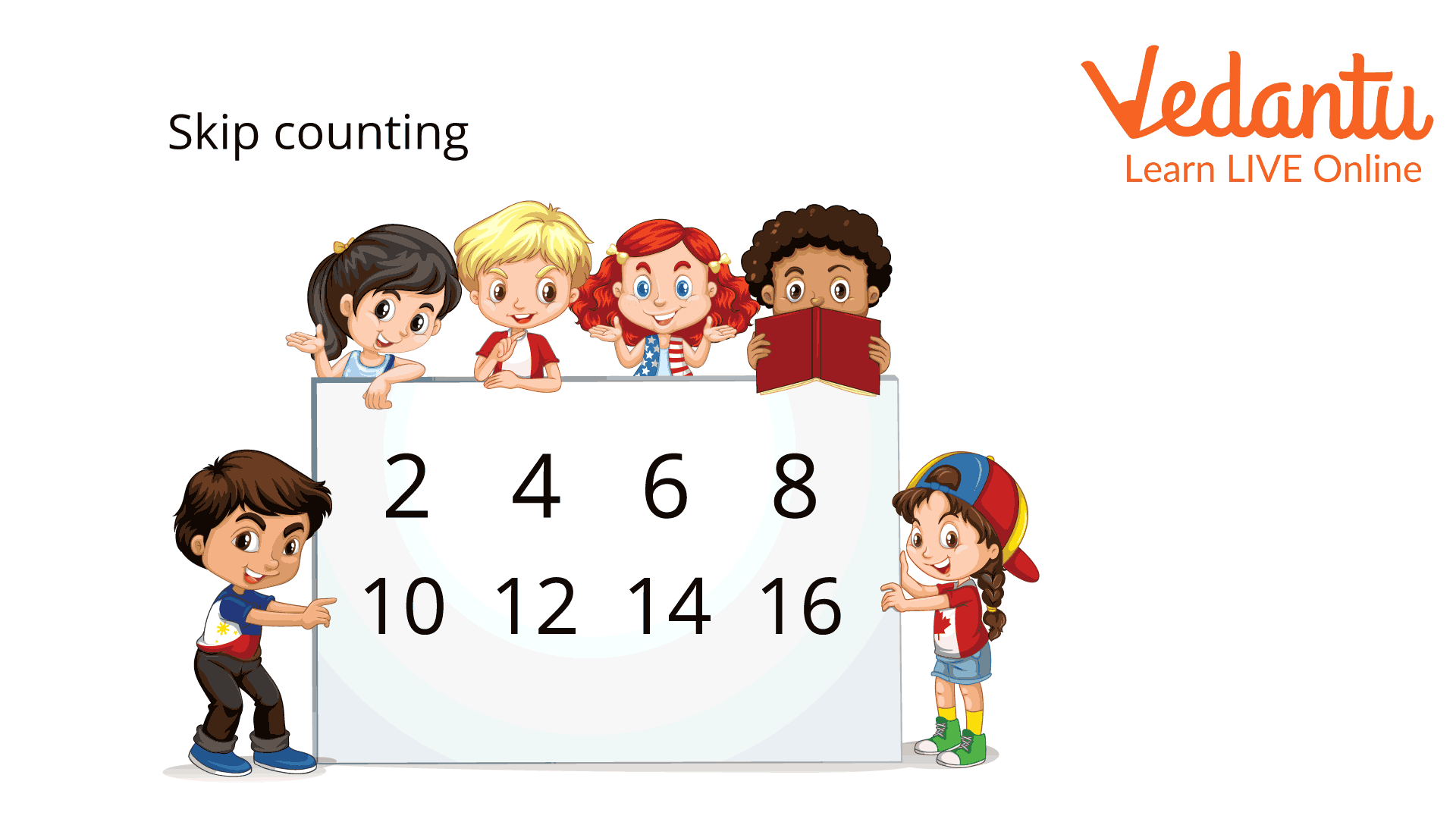
Skip counting
What is Skip Counting by 1?
Skip counting by 1, as explained above, means skipping through 1. If we start from 0, the next number will be 1 itself. If we continue, the next number will be 1, 2, 3, 4, 5, and so on, as shown in the image below.
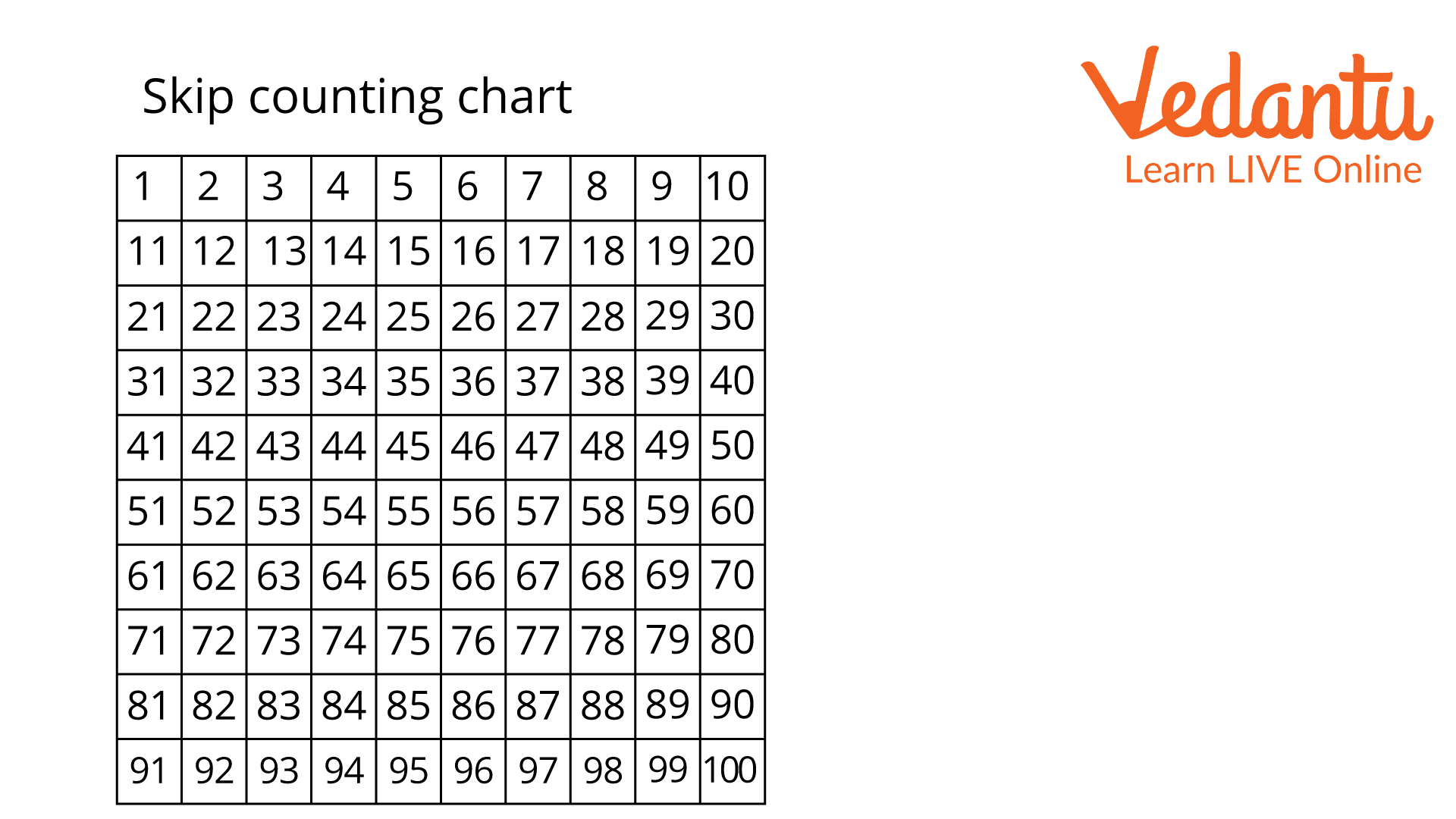
Skip counting by 1 chart
Skip counting is useful in multiplication tables because we can skip numbers to find the multiple of a number. For example, if you want to know the multiple of 6 in a multiplication table of 1, you can skip count by one 6 times. Thus, the result will be 6. We can use skip counting by 1 to 100 worksheets like the one given above for practice.
Types of Skip Counting
Skip counting has two types: forward skip counting and backward skip counting.
Forward Skip Counting
When we perform "forward skip counting," we count numbers in the forward direction. For example, if we had to perform forward skip counting by 1, and we began with 0, then the next number would be 1. If we continue forward counting, the number will be 1, 2, 3, 4, and so on.
Backwards Skip Counting
When we perform backwards skip counting, we count numbers in the backward direction. For example, if you skip count backwards by 1 starting from the number 9, the next number would be 8. If we continue skip-counting backward, the numbers will be 8, 7, 6, and so on.
Skip Counting by 1 Worksheet
1. Ravi has 20 marbles. How many times will he have to skip count by one?
Ans: Since the total number of marbles is 20, Ravi would have to skip count by 1, 20 times to get the total number of marbles. He can start by counting 1, 2, 3, 4,... 20.
2. Sneha has 10 candies. How many times will she need to perform a skip count by 1?
Ans: The total number of candies is 10. Sneha would need to skip count by 1, 10 times to get the total number of candies. She can skip count by counting 1, 2, 3, 4, 5, and so on, up to 10.
3. How many times will you need to skip count by 1 while climbing 15 stairs?
Ans: Since there are 15 stairs, while climbing the first one, you skip counting by 1. As you skip count by 1, the numbers will be 1, 2, 3, 4,... 15.
Conclusion
So, today you have learned about skip counting and skip counting by 1 type, i.e., forward and backward skip counting, with some examples. Now you can count anything easily by using this method. Following similar rules, you can skip counting higher numbers like 2 and 3.
FAQs on Skip Counting By 1 Explained for Early Learners
1. What is skip counting by 1?
Skip counting by 1 means counting forward by adding 1 each time to the previous number. It is the same as normal counting in order.
- Example: 1, 2, 3, 4, 5, 6...
- Each number increases by +1.
- It helps children understand number sequence and place value.
2. How do you skip count by 1?
To skip count by 1, start at any number and keep adding 1 repeatedly.
- Step 1: Choose a starting number (for example, 7).
- Step 2: Add 1 → 7 + 1 = 8.
- Step 3: Keep adding 1 → 9, 10, 11...
3. Is skip counting by 1 the same as regular counting?
Yes, skip counting by 1 is exactly the same as regular counting. When you count 1, 2, 3, 4, 5, you are adding 1 each time.
- There is no number skipped.
- The pattern increases by +1 at every step.
4. What is an example of skip counting by 1?
An example of skip counting by 1 is 5, 6, 7, 8, 9.
- Start at 5.
- Add 1 each time: 5 + 1 = 6, 6 + 1 = 7, and so on.
- This creates a simple increasing number pattern.
5. Why is skip counting by 1 important?
Skip counting by 1 is important because it builds the foundation for addition, number sense, and place value.
- Helps students understand number order.
- Prepares learners for skip counting by 2, 5, and 10.
- Supports early arithmetic skills.
6. Can you skip count by 1 starting from any number?
Yes, you can skip count by 1 starting from any whole number.
- Example starting at 12: 12, 13, 14, 15...
- Example starting at 25: 25, 26, 27, 28...
7. What number comes next when skip counting by 1?
The next number when skip counting by 1 is found by adding 1 to the given number.
- If the number is 9, the next number is 9 + 1 = 10.
- If the number is 34, the next number is 34 + 1 = 35.
8. How is skip counting by 1 related to addition?
Skip counting by 1 is repeated addition of 1.
- Each step adds 1 to the previous number.
- Example: 3 → 4 → 5 means 3 + 1 = 4 and 4 + 1 = 5.
9. Can you skip count by 1 backwards?
Yes, skip counting by 1 backwards means subtracting 1 each time.
- Example: 10, 9, 8, 7, 6...
- Each step decreases by −1.
10. What is the difference between skip counting by 1 and skip counting by 2?
The difference is that skip counting by 1 adds 1 each time, while skip counting by 2 adds 2 each time.
- By 1: 4, 5, 6, 7...
- By 2: 4, 6, 8, 10...
