








How to Simplify Numerical Expressions Using Order of Operations with Solved Examples
Simplifying expressions means rewriting the same algebraic expression with no like terms and in a compact manner. To simplify expressions, we combine all the like terms and solve all the given brackets, if any, and then in the simplified expression, we will be only left with unlike terms that cannot be reduced further.
In this article, we will learn a bunch of things. We will understand what numerical means in Maths and get to know more through numerical expression examples. We will learn the popular BODMAS rule that is used to simplify numerical expressions.
Numerical Expression Examples
A numerical expression consists of only numbers or integers. It includes basic mathematical operations such as addition, subtraction, multiplication, or division. Therefore, a numerical expression can be defined as a combination of numbers or integers and mathematical operators.
Example: k (16 - k) + 8 (16 - k), 9 (15 - k) = 145, etc.
What Does It Mean to Simplify Numerical Expressions?
Simplifying a numerical expression means solving it in the simplest way possible. Simplification refers to reducing complex expressions into simple Maths numerical that can be solved easily with basic arithmetics.
There are a bunch of things that you need to take care of while simplifying an expression such as the BODMAS rule, removing brackets, ordering from left to right, etc. Let us learn all of them, one by one.
Rule of BODMAS
The rule of BODMAS is one of the popular concepts in the field of algebra. The term BODMAS is an acronym. It stands for Brackets, Order, Division, Multiplication, Addition, and Subtraction. The acronym tells you the order in which you need to simplify the expression.
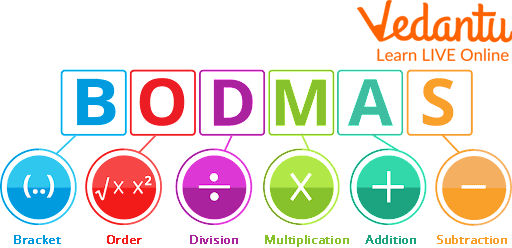
Full Form of BODMAS
Firstly, you need to resolve the brackets. The second preference is for orders or exponents. Then you have to do the division or multiplication in order from left to right, whichever comes first. Similarly, in the end, you must solve addition or subtraction, from left to right, whichever operation comes first.
Example: 5 x 8 - 12 ÷ 6 + 4\[^{2}\]
Ans: First of all we will solve the square of 4. i.e. 16.
= 5 x 8 - 12 ÷ 6 + 16
Now as per the BODMAS rule, first of all, the division will be done, then multiplication. So, the equation will become
= 40 - 2 + 16
Now the addition and subtraction will be done in the next step, which will give the result as:
= 56 - 2
= 54
Types of Brackets Used in Expressions
Generally, three types of brackets are used in a numerical expression and are very important while knowing how to simplify expressions.
The First Bracket is Parentheses, which is denoted by ( ).
The Second Bracket is the Curly Bracket, which is denoted by { }.
The third Bracket is the Square Bracket, which is denoted by $\left[ \right]$.
The rule in the bracket classification is that the operation in the first bracket needs to be performed first. Then the second bracket and finally, the third.
If you are confused with all these rules, you need not worry. We have got some solved examples for you to understand the concepts better.
Solved Examples
Go through these two solved examples to understand how the BODMAS rule is applied while simplifying the numerical expression calculator. Also, notice how the brackets are removed with priority. Below are some examples of numerical expressions with answers:
Example 1: $[8+\{6-(6 \div 2)\}] \times 4$
Ans: First of all-round brackets will be removed
$=[8+\{6-3\}] \times 4$
Then, curly brackets will be removed
$=[8+3] \times 4$
In the end, Square brackets will be removed
$=11 \times 4$ $=44$
Example 2: $12+[16-\{6+(4 \div 2)\}]$
Ans: First of all-round brackets will be removed
$=12+[16-\{6+2\}]$
Then, curly brackets will be removed
$=12+[16-8]$
In the end, Square brackets will be removed
$=12+8$
$=20$
Practice Questions
Simplify numerical expressions given below:
Q1. 15 × 3 - 15 ÷ 3
Ans: 40
Q2. $64-[\{48 \div 6\} \times 4]+8$
Ans: 40
Q3. $(9 \div 3) \times 7-5 \times 4$
Ans: 1
Q4. $22-\{8+(6 \div 2)\}$
Ans: 11
Summary
Firstly, we learned what numerical expressions are, with the help of some examples. The major focus of the article was on the important topic of simplification of numerical expressions for Class 5. We understood the types of brackets used in these expressions.
We also got to know about the BODMAS rule and learned how to use it to simplify complex expressions by going through some solved examples. If an expression is simplified without using the BODMAS rule, you might still get an answer but it will be incorrect. Therefore, it is necessary to follow the BODMAS rule carefully.
FAQs on Simplification of Numerical Expressions in Mathematics
1. What is simplification of numerical expressions?
Simplification of numerical expressions is the process of reducing a mathematical expression to its simplest form by performing operations correctly. It involves applying the order of operations (BODMAS/PEMDAS) to combine numbers using addition, subtraction, multiplication, division, exponents, or brackets. For example, in 8 + 2 × 3, we multiply first (2 × 3 = 6), then add: 8 + 6 = 14.
2. What is the order of operations in simplifying numerical expressions?
The order of operations is the rule that tells us the correct sequence to solve a numerical expression, commonly remembered as BODMAS or PEMDAS. It stands for:
- Brackets (or Parentheses)
- Orders (Powers and Roots)
- Division and Multiplication (left to right)
- Addition and Subtraction (left to right)
3. How do you simplify numerical expressions step by step?
To simplify a numerical expression, apply the order of operations step by step until only one number remains. Steps:
- Solve expressions inside brackets.
- Evaluate exponents or powers.
- Perform multiplication and division from left to right.
- Perform addition and subtraction from left to right.
4. Can you give an example of simplifying a numerical expression?
Yes, for example, simplify 5 + (6 − 2) × 3. First solve the bracket: 6 − 2 = 4. Then multiply: 4 × 3 = 12. Finally add: 5 + 12 = 17. The simplified value of the expression is 17.
5. Why is the order of operations important in numerical expressions?
The order of operations is important because it ensures everyone gets the same correct answer when simplifying numerical expressions. Without it, expressions like 6 + 2 × 3 could give different answers (either 24 or 12). Using BODMAS, we multiply first (2 × 3 = 6) and then add: 6 + 6 = 12, which is correct.
6. How do you simplify expressions with brackets and exponents?
To simplify expressions with brackets and exponents, solve brackets first and then evaluate powers before other operations. Example: (2 + 3)2 − 4. Step 1: 2 + 3 = 5. Step 2: 52 = 25. Step 3: 25 − 4 = 21. Always follow BODMAS for accurate results.
7. What are common mistakes when simplifying numerical expressions?
Common mistakes in simplifying numerical expressions include ignoring the order of operations and solving from left to right without priority rules. Typical errors:
- Adding before multiplying.
- Ignoring brackets.
- Misapplying exponents.
- Calculation errors in basic operations.
8. How do you simplify fractions in numerical expressions?
To simplify fractions in numerical expressions, perform division or reduce the fraction to its lowest terms before continuing other operations. Example: 1/2 + 3/4. Convert to a common denominator: 2/4 + 3/4 = 5/4 = 1 1/4. Always simplify fractions completely for the final answer.
9. What is the difference between simplifying and evaluating a numerical expression?
Simplifying and evaluating a numerical expression both mean reducing it to a single numerical value, but “simplifying” focuses on applying rules correctly, while “evaluating” emphasizes calculating the final answer. For example, simplifying 3 × (4 + 1) gives 3 × 5 = 15, and evaluating confirms the final result is 15.
10. How do you simplify expressions with multiple operations?
To simplify expressions with multiple operations, apply the order of operations (BODMAS/PEMDAS) carefully and work step by step. Example: 18 − 6 ÷ 3 + 2 × 4. Step 1: 6 ÷ 3 = 2. Step 2: 2 × 4 = 8. Step 3: 18 − 2 + 8 = 16 + 8 = 24. Always calculate multiplication and division before addition and subtraction.
