








How To Round Off Numbers To The Nearest Ten With Rules And Solved Examples
Rounding off a Number to The Nearest Tens
We have all come across instances when we failed to remember a number, date, or count simply because it was not very common or easy to recall. There are certain numbers that are easy to remember, anything in between will simply be confusing or difficult to recall.
For instance, the numbers ending with 5 or 0 are usually the ones that are remembered most easily. However, not always do we come across numbers or dates that end with 5 or 0. Therefore, to help us reach a number that ends in the desired digit, without changing the value by a lot, we use the method of rounding off to the nearest desired number. In this article, we will see how we can round a number off to the nearest tens.
What is Round off Meaning?
Rounding a number refers to the method of conversion of a particular number into a number that is easy to deal with or remember. The rounded number may not exactly be the same as the given number, but is generally very close to the given number or an approximation.
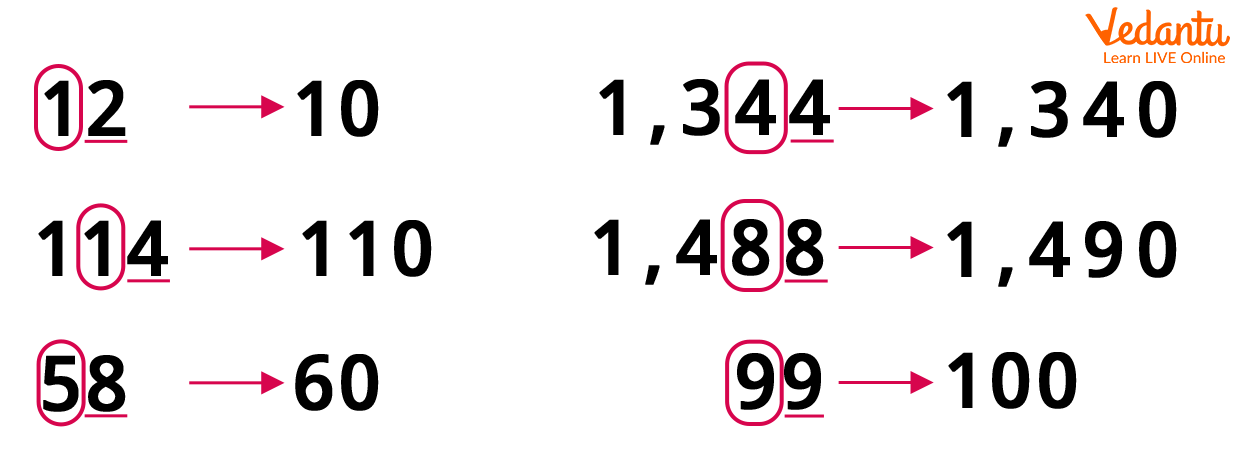
Rounding off means to estimate. Let us take an example to better understand the concept.
Example: Richard goes to the shop to buy vegetables. His total bill is ﹩98. So, he rounds off the amount to the nearest tens, which is ﹩100 and gives that to the shopkeeper. The shopkeeper easily returns the remaining ﹩2 to Richard and the deal is complete.
In the above scenario, Richard used the method of rounding off to make the calculation simpler for him and the shopkeeper. Let us now learn how this method works.
Steps for Rounding off to The Nearest Tens
Follow the given steps to be able to round off a number to the nearest tens:
Identify the number that needs to be rounded.
Mark the digit in the tens column of the number.
Check the digit in the one's column or the unit’s column, which is to the immediate right of the tens column.
If the digit in the one’s column is 1, 2, 3, or 4, then we shall round down the number to the nearest tens.
If the digit in the one’s column is 5 or greater, that is, 5, 6, 7, 8, or 9, then we shall round up the number to the nearest tens.
Finally, we write the one’s place digit as 0 and change the digit in the tens place accordingly.
Let us Understand This Better With an Example.
Consider the given number to be 87. As we have learned in the previous steps, we need to identify the unit's place or one’s place digit, which here is 7. Since 7 is greater than 5, we need to round the number ‘up’ to the nearest tens.
So, we need to change the one’s place digit to 0 and increase the tens place digit by 1, which gives us 90. Therefore, the required number obtained after rounding off 87 to the nearest tens is 90.

Conclusion
It is easy to forget numbers and counts when the one’s place digits are anything other than 0. To solve this problem, the process of rounding a number to the nearest tens is used. It helps ease the process of calculation and memorising. It is an important concept to learn and put to practical use. So do not skip this topic and try to practice these conversions as much as possible to be able to score good marks in your exams!
FAQs on Round Off To The Nearest Tens Explained Clearly
1. What does round off to the nearest tens mean?
Rounding off to the nearest tens means replacing a number with the closest multiple of 10. In this method, you look at the ones digit to decide whether to round up or down.
- If the ones digit is 0–4, round down.
- If the ones digit is 5–9, round up.
2. How do you round a number to the nearest tens?
To round a number to the nearest tens, check the ones digit and apply the rounding rule. Follow these steps:
- Step 1: Identify the ones digit.
- Step 2: If it is 5 or more, increase the tens digit by 1.
- Step 3: If it is less than 5, keep the tens digit the same.
- Step 4: Replace the ones digit with 0.
3. What is the rule for rounding to the nearest ten?
The rule for rounding to the nearest ten is to look at the ones place and compare it with 5.
- If the ones digit is 0, 1, 2, 3, or 4, round down.
- If the ones digit is 5, 6, 7, 8, or 9, round up.
4. Can you give an example of rounding to the nearest tens?
An example of rounding to the nearest tens is rounding 73 to 70. Since the ones digit in 73 is 3 (which is less than 5), we round down.
- 73 → ones digit = 3 → round down → 70
- 78 → ones digit = 8 → round up → 80
5. Why do we look at the ones digit when rounding to the nearest tens?
We look at the ones digit because it determines which multiple of 10 the number is closer to. The ones digit shows whether the number is nearer to the lower ten or the higher ten.
- If the ones digit is less than 5, the number is closer to the lower ten.
- If it is 5 or more, it is closer to the higher ten.
6. What happens if the ones digit is exactly 5 when rounding to the nearest ten?
If the ones digit is exactly 5, you round up to the next multiple of 10. This follows the standard rounding rule used in basic mathematics.
- 45 → round up → 50
- 75 → round up → 80
7. How do you round three-digit numbers to the nearest tens?
To round a three-digit number to the nearest tens, apply the same rule by checking the ones digit. The hundreds digit stays the same unless rounding causes a carry.
- Step 1: Look at the ones digit.
- Step 2: Apply the 5 rule.
- Step 3: Replace the ones digit with 0.
8. What is the difference between rounding to the nearest ten and rounding to the nearest hundred?
The difference is the place value you check: for nearest ten, check the ones digit; for nearest hundred, check the tens digit.
- Nearest ten: 67 → 70
- Nearest hundred: 167 → 200
9. How do you round negative numbers to the nearest tens?
To round negative numbers to the nearest tens, apply the same rounding rule based on the ones digit and move to the closest multiple of 10 on the number line.
- -34 → closer to -30 → -30
- -37 → closer to -40 → -40
10. What are common mistakes when rounding to the nearest tens?
A common mistake when rounding to the nearest tens is not checking the ones digit correctly. Students often round based on the tens digit instead of the ones digit.
- Forgetting that 5 always rounds up.
- Changing the tens digit incorrectly.
- Not replacing the ones digit with 0.
