








How to Represent Integers Fractions and Decimals on the Number Line with Steps and Examples
A straight line of numbers is shown visually as a number line. Here, the number line is useful for comparing integers on an endless line that extends on both sides i.e. horizontally or vertically, at equal intervals.
As we walk towards the right side of a horizontal number line, the numbers grow; as we move towards the left, the numbers drop. A number line is a line that has an endlessly long list of positive and negative integers on either side of a point called "zero" in the middle. A Maths student can use a number line as an example to solve addition and subtraction problems. We will understand here what every point on a number line represents.
What Is a Number Line?
A number line is a visual representation of numbers on a straight line drawn horizontally or vertically. When we write numbers on a number line, we can easily compare them and execute simple arithmetic operations on them. A number line's origin is defined as zero (0). The numbers to the left of 0 are all negative, whereas the numbers to the right of 0 are all positive. So, as we walk towards the right on a number line, the value of numbers increases. This signifies that the numbers on the right are more than those on the left. For instance, 3 comes after 1, hence 3 > 1.
Represent on a Number Line
The visual representation of numbers on a straight line is known as a number line. A straight line is divided into several segments, each with a unit separation. We can quickly distinguish between two numbers and do comparisons between them by expressing them on a number line. It can alternatively be described as a line with numerals marked at regular intervals. It demonstrates elementary mathematical procedures with ease.
The Steps to Represent on a Number Line are as Follows:
Make a clean line.
Put a zero at the very leftmost spot.
Place a point just to the right of zero. Indicate 1, 2, 3, etc. These marks must be spaced evenly apart.
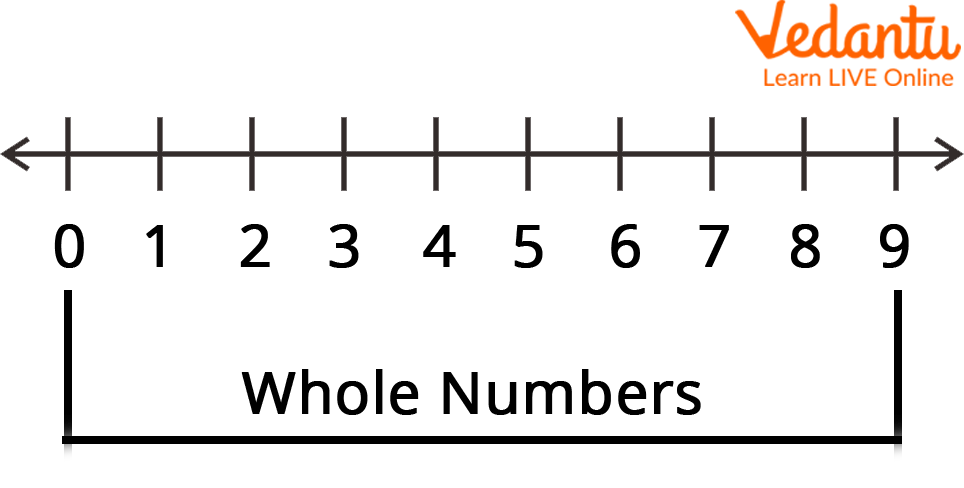
Whole Number from 0 to 9 on Number Line
Every Point on a Number Line Represents a Number
Each point on a number line represents a specific number i.e. a unique real number. It can represent any real number, including natural and whole numbers. Recall that the natural number is the collection of all counting numbers, i.e., 1, 2, 3, 4, 5, 6, etc., but the whole number is a collection of numbers that contains all counting numbers, i.e., 1, 2, 3, 4, 5, 6, etc., as well as "zero (0)." Real numbers, "such as natural numbers, whole numbers, integers, rational numbers, and irrational numbers," are compared by using the number line.
Solved Examples
Q 1. Put x greater than 5 on a number line.
Ans: We will use the steps listed below to represent x > 5 on a number line:
Draw a number line, mark 0, and then draw equal distances to the right and left, as shown below.
The value of x in the inequality x > 5 is bigger than 5. Consequently, we must go to the right of 5.
Draw a black empty circle as indicated in the figure. Shade the line to the right side until it reaches the arrow. Since a blank circle indicates that a point is not included, the circle at point 5 will be left unfilled. This indicates that x is not equal to and is greater than 5.
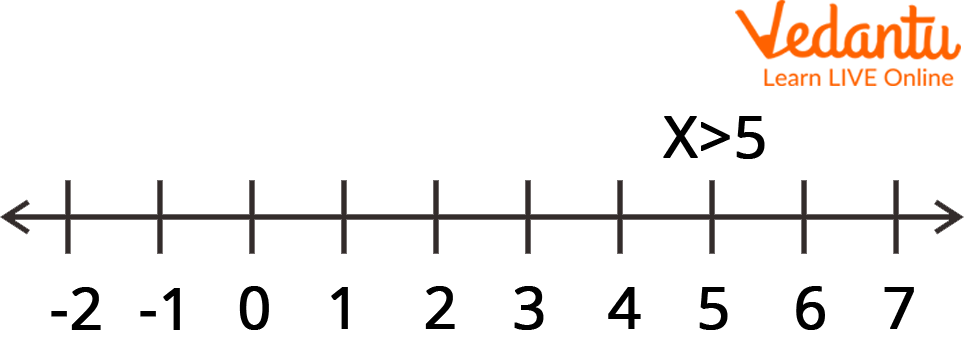
Number Line
Practice Questions
Q 1. Put x greater than or equal to 8 on a number line.
Q 2. Put x in fraction i.e. $\dfrac{7}{5}$ on a number line.
Summary
The horizontal straight lines in Mathematics known as number lines are where integers are arranged in equal intervals. A number line can be used to represent every number in a sequence. Here, the endpoints of this number line go forever. Integers are arranged on a number line.
A number line is exactly what it sounds like—a horizontal, straight line with numbers spaced evenly apart throughout its length. Since it's not a ruler, the distance between each number is irrelevant; instead, the numbers on the line specify how it should be used. The vertical equivalent of a number line is a number ladder.
FAQs on Representing Numbers on the Number Line in Maths
1. What does representing numbers on the number line mean?
Representing numbers on the number line means showing the position of a number as a point on a straight horizontal line based on its value. A number line has numbers arranged from left to right in increasing order.
- Numbers to the right are greater.
- Numbers to the left are smaller.
- The center point is usually 0.
2. How do you represent positive and negative numbers on a number line?
Positive numbers are placed to the right of 0, and negative numbers are placed to the left of 0 on a number line. Follow these steps:
- Draw a horizontal line and mark 0 at the center.
- Mark equal intervals on both sides.
- Place positive numbers (1, 2, 3…) to the right.
- Place negative numbers (−1, −2, −3…) to the left.
3. How do you plot fractions on a number line?
To plot a fraction on a number line, divide the space between two integers into equal parts based on the denominator. For example, to represent 3/4:
- Locate 0 and 1 on the number line.
- Divide the segment between 0 and 1 into 4 equal parts.
- Move to the third mark from 0.
4. How do you represent decimals on the number line?
Decimals are represented by dividing each unit into 10 equal parts and marking the correct position. For example, to plot 0.6:
- Identify 0 and 1 on the number line.
- Divide the interval into 10 equal parts.
- Count six parts to the right of 0.
5. What is the distance between two numbers on a number line?
The distance between two numbers on a number line is the absolute value of their difference. The formula is |a − b|.
- Distance between 3 and 7 = |3 − 7| = 4
- Distance between −2 and 5 = |−2 − 5| = 7
6. How do you compare numbers using a number line?
You compare numbers on a number line by checking their positions from left to right. A number further to the right is greater, and a number further to the left is smaller.
- If 5 is to the right of 2, then 5 > 2.
- If −3 is to the left of −1, then −3 < −1.
7. How do you represent rational numbers on the number line?
A rational number is represented by converting it into a fraction or decimal and marking its exact position between integers. For example, to represent 5/2:
- Convert to mixed form: 2 1/2.
- Locate 2 and 3 on the number line.
- Mark the midpoint between them.
8. What is the importance of zero on the number line?
Zero is the reference point that separates positive and negative numbers on a number line. It is neither positive nor negative.
- Numbers to the right of 0 are positive.
- Numbers to the left of 0 are negative.
- It represents the origin in coordinate systems.
9. How do you show integers on a number line?
Integers are shown as equally spaced points to the left and right of zero on a number line. Integers include negative numbers, zero, and positive numbers.
- Mark 0 at the center.
- Place positive integers (1, 2, 3…) to the right.
- Place negative integers (−1, −2, −3…) to the left.
10. What are common mistakes when representing numbers on a number line?
Common mistakes when representing numbers on a number line include incorrect spacing and placing negative numbers on the wrong side of zero. Key errors to avoid:
- Not dividing intervals into equal parts.
- Placing negative numbers to the right of 0.
- Miscounting fractional or decimal divisions.
- Ignoring scale when numbers are large.
