








What Are the Key Properties of Altitude in a Triangle with Proof and Examples
Have you ever wondered what that line which falls perpendicular to either of the sides of a triangle is called? Or ever wondered if there can only be one of those lines in a figure or if there can be even more? These perpendicular lines coming from the vertex of any triangle and then falling perpendicularly on the opposite side are called altitude in mathematics. In this article, we will look at these altitudes, will also learn the geometrical property of altitudes, and at last will also learn what is an orthocentre of a triangle. Sounds interesting right? So let's start learning.
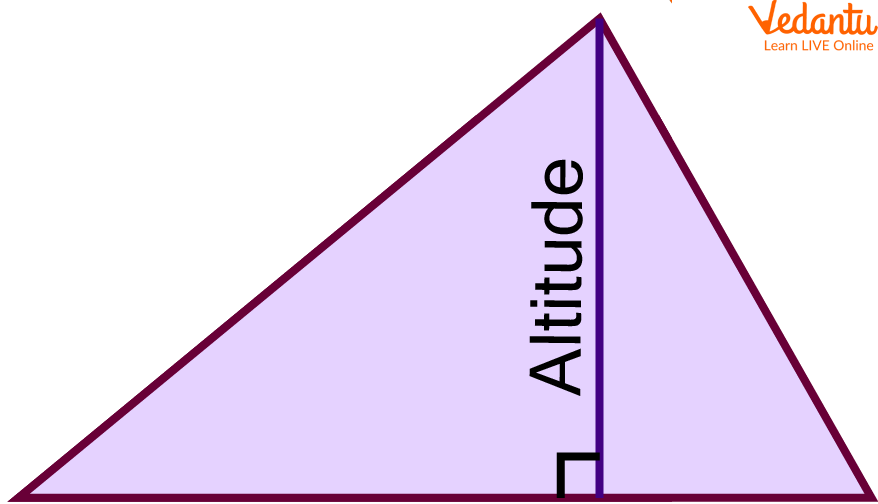
Altitude of a Triangle
What Is Altitude?
In a triangle, a particular Line segment which is drawn from its vertex and is connected to the opposite side of the triangle making a 90-degree inclination with that side is referred to as the altitude.
Triangles usually are of three kinds of obtuse, equilateral, and isosceles triangles.
In each type of triangle, the property of their altitude differs in various ways and usually is used to calculate the area of a triangle because the altitude is equivalent to the height of the triangle.
In an obtuse-angled triangle the altitude is present outside the main triangle body for which we have to extend the base of the triangle and then draw a perpendicular line segment from the opposite vertex touching the extended base
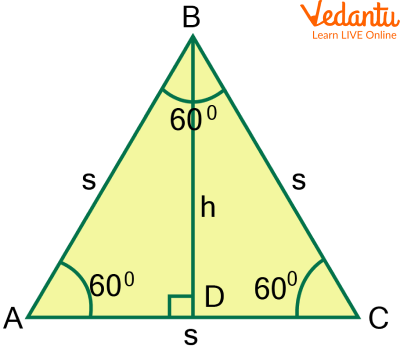
The altitude in an equilateral triangle interestingly divides the triangle into two equal parts.
The isosceles triangle altitude bisects the angle of the vertex and bisects the base. It should be noted that an isosceles triangle is a triangle with two congruent sides and so, the altitude bisects the base and vertex.
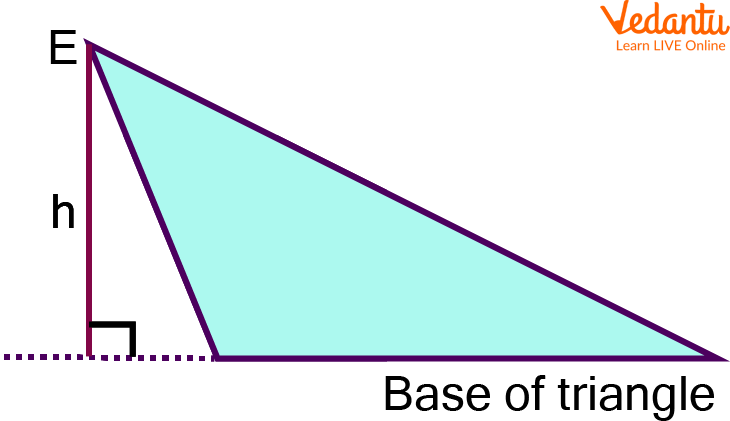
Altitude of an Obtuse-Angled Triangle
Properties of Altitude
Below are listed some properties of altitude:
There can only be a maximum of three altitudes inside or outside a triangle.
It is at a 90 degrees angle to the opposite side.
The altitude of a triangle can either be inside it or can also be outside it depending upon the type of triangle being talked about.
As we all know, there can only be a max of three altitudes inside a triangle. Therefore, the junction at which all those three altitudes meet is referred to as the orthocentre of a triangle.
Properties of Orthocentre
In this section of the article, we will discuss about the various properties of orthocenter:
As discussed in the above section a triangle can only have a maximum of three altitudes and the portion at which those three altitudes meet with one another is called an Orthocentre. Now we will look at the orthocenter of a triangle properties:
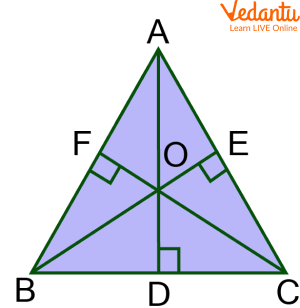
The point indicated as ‘O’ is the orthocentre of a right-angled triangle
For an acute angled Triangle, the orthocentre is drawn inside the triangle body.
For an obtuse-angled triangle, the orthocentre is drawn outside the triangle body
Whereas the orthocentre of a right-angled triangle is drawn at the vertices of the right angles.
Above were some unique orthocenters of a triangle properties.
Formulas to Calculate the Altitudes of Various Triangles
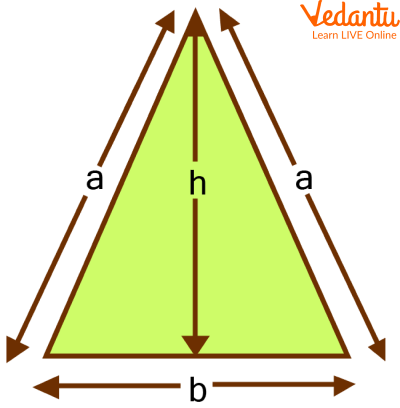
Geometrical Property of Altitudes
Below are listed the geometrical properties of altitudes
All of the altitudes in a triangle are concurrent or congruent.
The altitude of a triangle lies inside or outside the triangle.
Orthocentre can either lie inside or outside the triangle
Solved Examples
Below are some questions related to the altitude of a triangle:
Example 1: Calculate the altitude of a triangle having all equal sides of measure 6 cm.
Ans: According to the question the given triangle is an equilateral triangle
The formula for calculating the altitude of an equilateral triangle is $h=\dfrac{1}{2} \times \sqrt{3} \times s$ where $s$ is the length of the sides.
Therefore, $h=\dfrac{1}{2} \times \sqrt{3} \times 6$
$h=3 \sqrt{3} \mathrm{~cm}$
Example 2: Calculate the side of the equilateral triangle if the height or the altitude is 2cm.
Ans: For equilateral triangle
$h$ (height or altitude) $=\dfrac{1}{2} \times \sqrt{3} \times s$ where ' $s$ ' is the length of the side Given $h=2 \mathrm{~cm}$ noe putting the value in the equation we get
$(h \times 2) \div \sqrt{3}=s$
$(2 \times 2) \div \sqrt{3}=s$
Therefore, $\mathrm{s}=\dfrac{4}{\sqrt{3}} \mathrm{~cm}$
Practice Questions
Q 1. Write down all the formulas for finding altitude of the following triangles:
Right angle triangle
Isosceles triangle
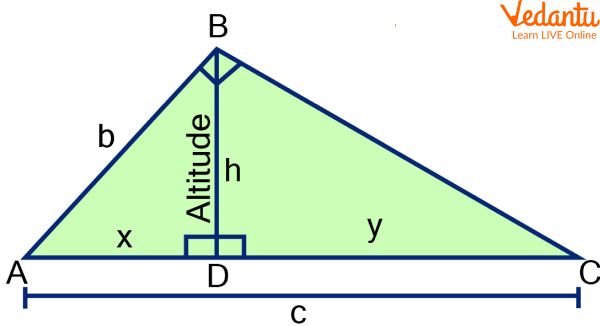
Ans: a. $h=\sqrt{x y}$
b. $h=\sqrt{a^2-\dfrac{b^2}{4}}$
Q 2. Find the measure of the altitude of a triangle having three equals sides of 8 cm
Ans: $4 \sqrt{3} \mathrm{~cm}$
Q 3. Calculate the height of a right angle triangle whose base values are $x=2 \mathrm{~cm}$ and $y=4 \mathrm{~cm}$
Ans: For right angle triangle $h=\sqrt{xy}$
Therefore, $h=\sqrt{2 \times 4}=2 \sqrt{2} \mathrm{~cm}$
Summary
To complete all the learnings from this article we can say that altitudes are the heights of a triangle and are usually used to calculate the area of the triangle. Altitudes can help us find and relate various triangle properties with each other for example congruency. Through this article, we learned about the basic properties of altitudes of the triangle and also looked at the positions of the altitudes. With this, we would like to end this article and hope that we were clear and understandable enough to clear all your doubts yet if you still have doubts you can write them down in the comment section below.
FAQs on Properties of Altitude in a Triangle
1. What is an altitude in a triangle?
An altitude of a triangle is a perpendicular line segment drawn from a vertex to the opposite side (or its extension).
- It forms a 90° angle with the opposite side.
- Every triangle has three altitudes, one from each vertex.
- The altitude represents the height of the triangle relative to a chosen base.
2. How many altitudes does a triangle have?
A triangle has three altitudes, one drawn from each vertex to the opposite side.
- Each altitude is perpendicular to its corresponding base.
- All three altitudes intersect at a single point called the orthocenter.
- This property holds true for all types of triangles: acute, right, and obtuse.
3. What is the orthocenter of a triangle?
The orthocenter is the point where the three altitudes of a triangle intersect.
- In an acute triangle, it lies inside the triangle.
- In a right triangle, it lies at the right-angled vertex.
- In an obtuse triangle, it lies outside the triangle.
4. What are the properties of altitudes in an acute triangle?
In an acute triangle, all three altitudes lie inside the triangle and meet at an interior orthocenter.
- Each altitude forms a right angle with its base.
- The orthocenter is located inside the triangle.
- All altitudes are shorter than the corresponding sides.
5. What happens to the altitude in a right triangle?
In a right triangle, two altitudes coincide with the legs, and the orthocenter lies at the right-angled vertex.
- The two sides forming the right angle act as altitudes.
- The third altitude is drawn from the right angle to the hypotenuse.
- The orthocenter is exactly at the 90° vertex.
6. Where is the orthocenter located in an obtuse triangle?
In an obtuse triangle, the orthocenter lies outside the triangle.
- Two altitudes must be extended beyond the triangle to meet.
- Only one altitude lies inside the triangle.
- The intersection point of the three altitudes is located outside the triangle.
7. What is the formula involving altitude in the area of a triangle?
The area of a triangle using altitude is given by Area = (1/2) × base × height.
- The height is the altitude corresponding to the chosen base.
- Example: If base = 10 cm and altitude = 6 cm, then Area = (1/2) × 10 × 6 = 30 cm².
- The altitude must always be perpendicular to the base.
8. Can the altitude of a triangle lie outside the triangle?
Yes, an altitude can lie outside the triangle in the case of an obtuse triangle.
- When one angle is greater than 90°, two altitudes fall outside.
- The sides must be extended to draw the perpendicular.
- This causes the orthocenter to lie outside the triangle.
9. What is the difference between altitude and median in a triangle?
An altitude is a perpendicular segment from a vertex to the opposite side, while a median connects a vertex to the midpoint of the opposite side.
- Altitude forms a 90° angle; median does not necessarily.
- Altitudes meet at the orthocenter.
- Medians meet at the centroid.
10. What are the properties of altitudes in an equilateral triangle?
In an equilateral triangle, each altitude is also a median, angle bisector, and perpendicular bisector.
- All three altitudes are equal in length.
- They intersect at a single common point.
- The orthocenter, centroid, and circumcenter coincide at the same point.
