








How to Find the Perimeter of a Trapezium with Formula and Solved Examples
Have you ever seen a trapezium shape in your daily life?

Is it Trapezium?
Can you mention a few examples of trapezium or trapezoid? Have a look at your surroundings and decide on the shape of a trapezium. Would you be able to find out any? A little bit confused between trapezium or trapezoid? No worries, you’ll learn the same here. Firstly, trapezium and trapezoid are the same in American and Canadian English, a trapezoid is a quadrilateral with at least one pair of parallel sides. A trapezoid is known as a trapezium in British and other forms of English.
Trapezium
A trapezium is a quadrilateral with one pair of parallel opposite sides, as defined by Euclidean geometry. Trapezium comes from the Greek word "trapeza," which means "table." So, the Trapezium is a four-sided shape with only two parallel sides.
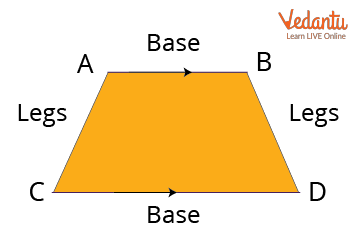
Trapezium
A trapezium is a two-dimensional quadrilateral with a pair of parallel opposite sides (because of its four straight lines). The base and the non-parallel sides of the trapezium are referred to as the base and legs of the trapezium, respectively.
It has four sides and four corners and is a closed plane shape. The following is a diagram of a trapezium shape:
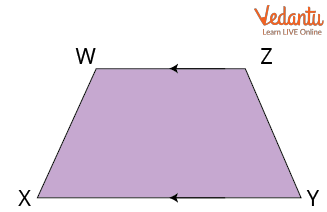
Trapezium WXYZ
In the above figure, XY and WZ are the bases while XW and YZ are the legs of the trapezium.
Properties of a Trapezium
Each quadrilateral has its unique set of characteristics that distinguish it from the other. These attributes provide extra information about a shape's geometrical construction. The following are the properties of trapezium:
It's a two-dimensional shape.
A trapezium's bases are parallel to one another.
A trapezium's diagonals are always intersected by each other.
The total of the adjacent internal angles is 180°.
In a trapezium, the sum of all internal angles is always 360°.
Trapezium Formula
Consider a trapezium with the lengths of parallel sides a and b units and the altitude "h."
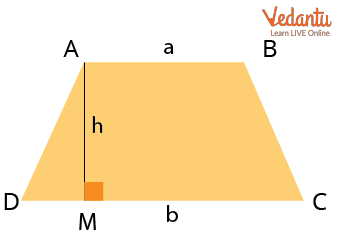
Trapezium with the Lengths of Parallel Sides and the Altitude
Calculating the average of bases and multiplying the result by the altitude yields the trapezium area. As a result, trapezium area $= \left(\dfrac{AB + DC}{2}\right) AM = \left(\dfrac{a+b}{2}\right) h$, where AB, CD represent the bases and AM represents the altitude.
The perimeter of a trapezium is calculated by adding all of its sides together (because the perimeter is the sum of boundaries). As a result, the perimeter of a trapezium ABCD = AB + BC + CD + AD.
Solved Examples
1. If a trapezium is given with its three sides whose measures are 10cm, 12cm, and 7cm. Find the length of the fourth side of the trapezium if the perimeter is 40 cm.
Ans: Perimeter of trapezium = Sum of all its sides (all four sides) = 40 cm
Let the fourth side be ‘a’ cm.
Thus, applying the formula:
Perimeter is 40 = 10 + 12 + 7 + a
a = 40 – (10 + 12 + 7)
a = 40 – 29
a = 11 cm
Therefore, the length of the fourth side is 11 cm.
2. Seeta bought a trapezium-shaped table whose bases and legs are 25 cm,20 cm, 10 cm, and 12 cm respectively. She wants to know the perimeter of the table. Can you help her to find it?
Ans: Perimeter of trapezium = Sum of all its sides
So, applying the formula:
Perimeter of trapezium = 25 + 20 + 10 + 12
Perimeter of trapezium = 67 cm
Hence, the perimeter of the table is 67 cm.
Practice on your own:
Q1. The parallel sides of a trapezium are 25 cm and 11 cm, while its nonparallel sides are 15 cm and 13 cm. Find the perimeter of the trapezium.
Ans: 64 cm
Q2. What is the perimeter of the trapezoid in which the sum of lengths of non-parallel sides is 12 units, and the sum of the parallel sides is 8 units?
Ans: 20 units
Conclusion
Trapezium comes from the Greek word "trapeze," which means "table." So, the Trapezium is a four-sided shape with only two parallel sides. The perimeter of a trapezium is calculated by adding all of its sides together (because the perimeter is the sum of boundaries). As a result, the perimeter of a trapezium ABCD = AB + BC + CD + AD.
FAQs on Perimeter of a Trapezium Explained Clearly
1. What is the perimeter of a trapezium?
The perimeter of a trapezium is the total length of all four of its sides added together. A trapezium is a quadrilateral with one pair of parallel sides, and its perimeter is found by summing every side length.
- Perimeter = sum of all sides
- If sides are a, b, c, and d, then Perimeter = a + b + c + d
2. What is the formula for the perimeter of a trapezium?
The formula for the perimeter of a trapezium is P = a + b + c + d, where a, b, c, and d are the lengths of its four sides. In a trapezium:
- a and b are usually the parallel sides (bases)
- c and d are the non-parallel sides (legs)
3. How do you find the perimeter of a trapezium?
To find the perimeter of a trapezium, add the lengths of all four sides. Follow these steps:
- Step 1: Identify the lengths of all sides.
- Step 2: Use the formula P = a + b + c + d.
- Step 3: Add the values carefully.
4. How do you calculate the perimeter of an isosceles trapezium?
The perimeter of an isosceles trapezium is calculated by adding its two parallel sides and its two equal non-parallel sides. In an isosceles trapezium:
- The legs (non-parallel sides) are equal.
- Perimeter = base₁ + base₂ + 2 × leg
5. What is the perimeter of a trapezium with given side lengths?
The perimeter of a trapezium with known side lengths is found by directly adding them together. Use the formula P = a + b + c + d.
- If sides are 10 m, 6 m, 5 m, and 7 m
- Then P = 10 + 6 + 5 + 7 = 28 m
6. Is the perimeter of a trapezium the same as its area?
No, the perimeter of a trapezium is different from its area. The perimeter measures the total boundary length, while the area measures the space inside the shape.
- Perimeter formula: P = a + b + c + d
- Area formula: A = ½ × (sum of parallel sides) × height
7. What is the perimeter of a right trapezium?
The perimeter of a right trapezium is the sum of all four sides, just like any trapezium. A right trapezium has one right angle, but the formula remains the same.
- Perimeter = a + b + c + d
- Add the two bases and the two legs
8. Can you find the perimeter of a trapezium if only three sides are known?
You can find the perimeter of a trapezium with three known sides only if the fourth side can be determined. Since P = a + b + c + d, all four side lengths are required.
- If the missing side is given indirectly (e.g., through Pythagoras theorem), calculate it first.
- Then add all four sides.
9. What units are used for the perimeter of a trapezium?
The perimeter of a trapezium is measured in linear units such as centimetres, metres, inches, or feet. Since perimeter measures total length:
- Use cm, m, mm for metric units
- Use inches or feet for imperial units
10. What are common mistakes when finding the perimeter of a trapezium?
Common mistakes when finding the perimeter of a trapezium include forgetting to add all four sides or confusing perimeter with area. Avoid these errors:
- Do not use the area formula instead of P = a + b + c + d.
- Do not forget one of the non-parallel sides.
- Ensure all measurements are in the same unit.
