








What Is the Divisibility Rule for 6 with Step by Step Examples
Mathematicians use divisibility tests or division rules to determine if a number is divisible by another integer without using the actual division mechanism. If one integer is totally divisible by another, the quotient is a whole number and the remainder is zero. But some numbers cannot be totally divided by any other integer, such numbers have a remainder other than zero.
These guidelines assist us in determining the actual divisor of a number just by studying the digits of the number. Similarly to check the divisibility by 6 there are specific rules which will further be discussed.
What is Meant by Divisibility?
Divisibility is the ability of numbers that can be divided without leaving any remainder behind. There are various divisibility tests of numbers between 1 to 9. Through this divisibility, we can determine whether a large complex number will be divisible or not. Let us now learn about the divisibility rule of 6 which includes the divisibility rule of 2 and 3.
How to Check Divisibility by 6?
If a whole integer meets the two requirements listed below, it is said to be divisible by 6.
The provided entire number must be divisible by two. A number is divisible by two if the digit in the unit's position is even, i.e., 0, 2, 4, 6, and 8.
The specified whole number has to be divisible by three. A number is divisible by three if the sum of its digits is exactly divisible by three.
When performing the divisibility test of 6, both requirements should apply to the number. If a number does not satisfy both of these requirements, it is not divisible by 6.
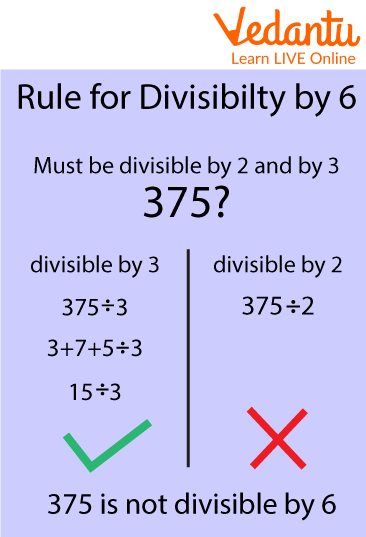
Example of Divisibility By 6
Numbers Divisible by 6
The numbers which are divisible by 6 are the ones having even numbers at the unit places and all the digits, if added, would be perfectly divisible by 3. Let us take an example of the number 12. In units place of 12, 2 is there, which is an even number and is divisible by 2, whereas, if we add both the digits 1 and 2 we get a result as 3 which is also divisible by 3. As the number is divisible by both 2 and 3 so, it will also be divisible by 6.
Test of Divisibility by 6
To understand and test the divisibility of 6 of the large numbers we can take the example of number 136582. In this number at the unit place, there is 2 which is, even so, making it divisible by 2. To check the divisibility by 3 we add all the digits 1, 3, 6, 5, 8, and 2 which will result in 25 which is not divisible by 3. So the number 136582 is not divisible by 6. This is so because to be divisible by 6, the number should be divisible by both 2 and 3.
Conclusion
The number is divisible by 6 if it is divisible by both 2 and 3. To check the divisibility of a number by 2 the unit's place should have an even number and the sum of the digits of the number should be divisible by 3. If the number is not divisible by either 2 or 3 then it would not be divisible by 6.
Sample Questions
1. The number 256 is divisible by 6.
True
False
Ans: False
Explanation: The number is not divisible by 6 because if we add all the digits then the sum would result in 13 which is not divisible by 3 making it the number which would not be divisible by 6.
2. The number divisible by 2 would have 5 in the ten’s place and 0 in the unit’s place.
True
False
Ans: True
Explanation: The number would be divisible by 2 as the number in the unit’s place should be 0, 2, 4, 6, and 8. The number in the ten’s place does not have any role in determining the divisibility by 2.
3. Which of the following numbers is divisible by 6?
966
964
935
961
Ans: 966
Explanation: The number 966 is divisible by 6 as the unit place of the number is even making it divisible by 2 and the sum of the digits is 21, which is divisible by 3. As the number is divisible by both 2 and 3 it is divisible by 6. The number 964 is not divisible by 6 because the sum of the digits is 19 which is not divisible by 3. And the numbers 935 and 961 have odd numbers in their unit place making them not divisible by 2.
FAQs on Numbers Divisible By 6 Explained with Rule and Examples
1. What are numbers divisible by 6?
Numbers divisible by 6 are integers that can be divided by 6 without leaving any remainder. In other words, when a number is divided by 6, the remainder is 0.
- Examples: 6, 12, 18, 24, 30
- 12 ÷ 6 = 2 (no remainder)
- 18 ÷ 6 = 3 (no remainder)
2. What is the divisibility rule for 6?
A number is divisible by 6 if it is divisible by both 2 and 3. Since 6 = 2 × 3, a number must satisfy both conditions.
- It must be even (last digit 0, 2, 4, 6, or 8).
- The sum of its digits must be divisible by 3.
3. How do you check if a number is divisible by 6?
To check if a number is divisible by 6, test divisibility by 2 and 3. Follow these steps:
- Step 1: Check if the number is even.
- Step 2: Add the digits and see if the sum is divisible by 3.
4. Why must a number be divisible by both 2 and 3 to be divisible by 6?
A number must be divisible by both 2 and 3 because 6 = 2 × 3. Since 2 and 3 are prime factors of 6, a number must contain both factors to be divisible by 6.
- If a number is only divisible by 2, it may not be divisible by 3.
- If it is only divisible by 3, it may not be even.
5. Can you give examples of numbers divisible by 6?
Yes, numbers divisible by 6 include 6, 12, 18, 24, 30, and 36. These are multiples of 6.
- 6 × 1 = 6
- 6 × 2 = 12
- 6 × 3 = 18
- 6 × 4 = 24
6. Is 0 divisible by 6?
Yes, 0 is divisible by 6 because 0 divided by any non-zero number equals 0 with no remainder. Since 0 ÷ 6 = 0, it satisfies the condition of divisibility.
- 0 is an even number.
- The sum of its digits is 0, which is divisible by 3.
7. What is the smallest number divisible by 6?
The smallest positive number divisible by 6 is 6 itself. Since 6 ÷ 6 = 1, it divides exactly.
- 6 is the first positive multiple of 6.
- Multiples follow the pattern: 6, 12, 18, 24, …
8. Are all even numbers divisible by 6?
No, not all even numbers are divisible by 6 because they may not be divisible by 3. A number must satisfy both conditions.
- Example: 8 is even but 8 ÷ 3 is not an integer, so 8 is not divisible by 6.
- Example: 12 is even and 1 + 2 = 3 (divisible by 3), so 12 is divisible by 6.
9. What is the difference between multiples of 6 and factors of 6?
Multiples of 6 are numbers obtained by multiplying 6 by integers, while factors of 6 are numbers that divide 6 exactly.
- Multiples of 6: 6, 12, 18, 24, …
- Factors of 6: 1, 2, 3, 6
10. What are the first 10 numbers divisible by 6?
The first 10 positive numbers divisible by 6 are 6, 12, 18, 24, 30, 36, 42, 48, 54, and 60. These are found by multiplying 6 by numbers from 1 to 10.
- 6 × 1 = 6
- 6 × 2 = 12
- 6 × 3 = 18
- …
- 6 × 10 = 60
