








What Is a Nonagon Definition Formula Properties and Examples
Does Geometry interest you? Then do you know how many sides a nonagon has? A nonagon is a kind of polygon that consists of nine sides and nine angles. The term ‘nonagon’ has been derived from the Latin word ‘nonus’, which means nine, and the Greek word ‘gon’, which means sides. It also has another name, ‘enneagon’, that is derived from the Greek word ‘enneagonon’, translating to nine corners. Despite ‘enneagon’ being a more appropriate term for this shape, ‘nonagon’ is more often used owing to the simplicity of the name and its convenience in use.
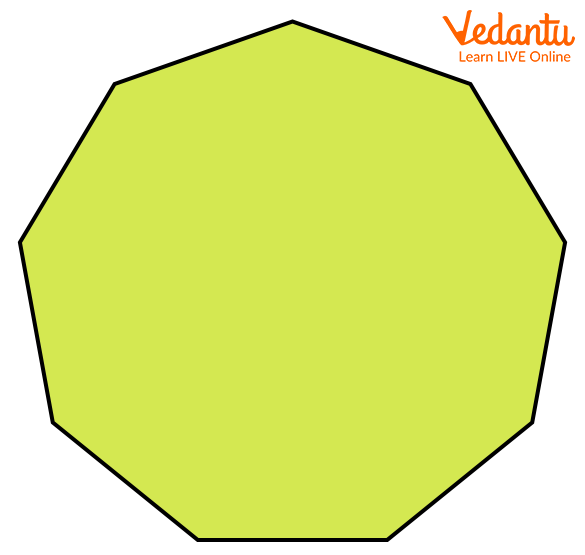
Regular Nonagon
Different Types of Nonagon
Based on their sides, angles, and vertices, nonagons can be categorised as follows:
ccc: A regular nonagon has nine sides of equal length and nine interior angles, each of which measures 1400, and has exterior angles measuring 400 each. It has nine lines of symmetry and rotational equilibrium of order nine. All regular nonagons are convex.
Irregular Nonagon: An irregular nonagon does not have all sides or all interior angles equal. However, the sum of all the nine interior angles measures up to 12600. Irregular nonagons can be both convex and concave.
Convex Nonagon: A convex nonagon has all nine vertices pointing outwards. All interior angles of this type of nonagon measure less than or equal to 1800 and all diagonals are bounded by the closed figure. Convex nonagons can be both regular and irregular.
Concave Nonagon: A concave nonagon has at least one vertex pointing inwards, having an interior angle that is greater than 1800. It has at least one diagonal lying outside the closed figure. Therefore, all concave nonagons are irregular.
Properties of a Regular Nonagon
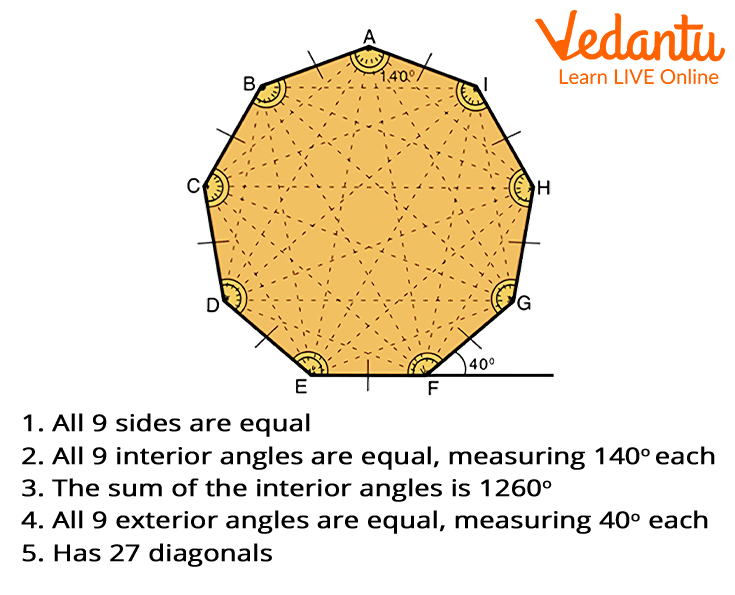
All 9 sides are of equal length. For instance, in a nonagon ABCDEFGHI, AB = BC = CD = DE = EF = FG = GH = HI = IA.
It comprises 9 interior angles, each measuring 1400. Hence, ∠ABC = ∠BCD = ∠CDE = ∠DEF = ∠EFG =∠FGH = ∠GHI = ∠HIA = ∠IAB.
All 9 interior angles add up to 1260°. Therefore, ∠ABC + ∠BCD + ∠CDE + ∠DEF + ∠EFG + ∠FGH + ∠GHI + ∠HIA + ∠IAB = 12600.
It consists of 9 exterior angles, each measuring 400.
It has 27 diagonals, that is, AC, BD, CE, DF, EG, FH, and GI.
Properties of a Regular Nonagon
Note: Even in an irregular nonagon, the sum of the interior angles will be 12600.
Some Formulas Related to a Regular Nonagon
Perimeter
The formula for the perimeter (P) of a regular nonagon ABCDEFGHI
P = 9a,
where a = length of each side of the nonagon, since all 9 sides are equal in a regular nonagon, that is, a = AB = BC = CD = DE = EF = FG = GH = HI = IA.
Sample Problem: Determine the perimeter of a regular nonagon, each of whose sides measures 9 cm.
Solution: It is given that a = 9 cm.
Since Perimeter (P) = 9a,
Then, the required perimeter P = 9 x 9 cm
= 81 cm
Area
The formula for determining the area of a regular nonagon ABCDEFGHI is as follows:
Area (A) = \[ \frac{9}{9} \] (a2cot \[ \frsc{π}{9} \] ),
where a = side length = AB = BC = CD = DE = EF = FG = GH = HI = IA, and π = 1800.
Angles
There are three major angle formulas concerned with regular nonagons - sum of interior angles, individual interior angles, and exterior angles. They can be elaborated as follows:
Sum of Interior Angles - It is the sum of the measures of all the interior angles taken together in a nonagon. The formula for the sum of interior angles in a regular nonagon is given below:
Sum of the interior angles = (n-2) x 1800, where n = number of sides
In nonagon ABCDEFGHI, n = 9
Therefore,
Sum of the interior angles = (9 -2) x 1800
= 12600
Individual Interior Angle - The measure of an individual interior angle in a regular nonagon can be obtained by dividing the sum of all the interior angles by the number of sides in the nonagon. The formula to obtain the value of an individual interior angle of a regular nonagon is given below:
One interior angle = (n-2) x 1800/n, where n = number of sides
In nonagon ABCDEFGHI, n = 9
Hence,
Sum of the interior angles = (9-2) x 1800/9
= 1400
Exterior Angle - An exterior angle is an angle formed by any side of a nonagon and the extension of its adjacent side. The formula to find the value of an exterior angle is given below:
Exterior angle = 3600/n, where n = number of sides
In nonagon ABCDEFGHI, n = 9
Therefore,
Exterior angle = 3600/9
= 400
Nonagons may not be as commonly observed as other shapes, like circles, squares, and triangles, but their application in art and architecture is no less crucial. The following image is that of the US Steel Building, Pittsburgh, Pennsylvania. Although it may look like a triangular structure at a glance, taking a closer look will reveal its nonagonal aspects, that is, the 6 extra line segments ingrained in the magnificent architecture.
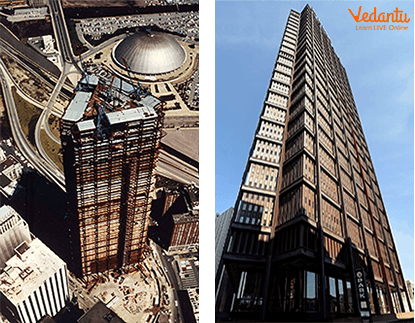
US Steel Building, Pittsburgh, Pennsylvania
Conclusion
To summarise the concept of nonagon, it is a two-dimensional figure (polygon) with nine sides and nine angles. It has 4 major types - regular, irregular, convex, and concave. Most of the properties and formulas are only applicable to regular nonagons, which have equal sides, and their interior and exterior angles are also equal, each measuring 1400 and 400, respectively. However, all nonagons have a total interior angle sum of 12600.
FAQs on Nonagon Nine Sided Polygon Definition and Properties
1. What is a nonagon in geometry?
A nonagon is a polygon with 9 sides, 9 vertices, and 9 interior angles. In geometry, it is also called a nine-sided polygon or sometimes an enneagon. A nonagon can be regular (all sides and angles equal) or irregular (sides and angles not equal). It is a type of polygon studied in plane geometry.
2. How many sides and angles does a nonagon have?
A nonagon has 9 sides and 9 interior angles. Because it is a polygon with nine edges, it also has 9 vertices where the sides meet. Each vertex forms one interior angle, so the total number of angles is equal to the number of sides.
3. What is the sum of interior angles of a nonagon?
The sum of the interior angles of a nonagon is 1260°. This is calculated using the polygon formula:
Sum = (n − 2) × 180°
For a nonagon, n = 9:
(9 − 2) × 180° = 7 × 180° = 1260°. This formula works for any polygon.
4. What is each interior angle of a regular nonagon?
Each interior angle of a regular nonagon measures 140°. Since the sum of interior angles is 1260°, divide by 9 equal angles:
1260° ÷ 9 = 140°.
This applies only to a regular nonagon, where all sides and angles are equal.
5. What is the formula for the area of a regular nonagon?
The area of a regular nonagon is given by Area = (9/4) × s² × cot(π/9), where s is the side length. Another common formula is:
Area = (Perimeter × Apothem) / 2.
- Perimeter = 9 × side length
- Apothem = distance from center to midpoint of a side
6. How many diagonals does a nonagon have?
A nonagon has 27 diagonals. The number of diagonals in any polygon is found using the formula:
Diagonals = n(n − 3) / 2
For n = 9:
9(9 − 3) / 2 = 9 × 6 / 2 = 54 / 2 = 27.
7. What is the difference between a regular and irregular nonagon?
A regular nonagon has all sides and all interior angles equal, while an irregular nonagon does not. In a regular nonagon:
- Each side has equal length
- Each interior angle is 140°
8. What is the measure of each exterior angle of a regular nonagon?
Each exterior angle of a regular nonagon measures 40°. The formula for each exterior angle of a regular polygon is:
Exterior angle = 360° / n
For n = 9:
360° ÷ 9 = 40°. The sum of all exterior angles of any polygon is always 360°.
9. How do you draw a regular nonagon?
A regular nonagon can be drawn by dividing a circle into 9 equal central angles of 40° each. Follow these steps:
- Draw a circle using a compass.
- Mark the center and use a protractor to measure 40° angles at the center.
- Mark 9 equally spaced points on the circumference.
- Join adjacent points to form the nonagon.
10. Where is a nonagon used in real life?
A nonagon appears in architecture, tiling patterns, coins, and decorative geometric designs. Regular nonagons are used in:
- Islamic geometric art and mosaics
- Architectural floor plans and windows
- Mathematical models and polygon studies
