








How to Solve Multiplication Word Problems Step by Step with Examples
Multiplication Word Problems are multiplication problems that are usually presented in the form of a sentence that generally relates to a real-life scenario.

Introduction to Multiplication Word Problems
These word problems will usually be given in a real-life context and will also include some introduction or starting lines to make the question clear.
We will need to read and understand these questions carefully in order to solve the questions. Children can practice multiplication word problems pdf.
Some of the examples of multiplication word problems are listed below:
In a garden, there is space for 11 rows of 30 seeds in a flower bed. How many seeds are in each flower bed?
20 marbles are sorted into boxes of ten. How many boxes are needed?
Multiplication Sums
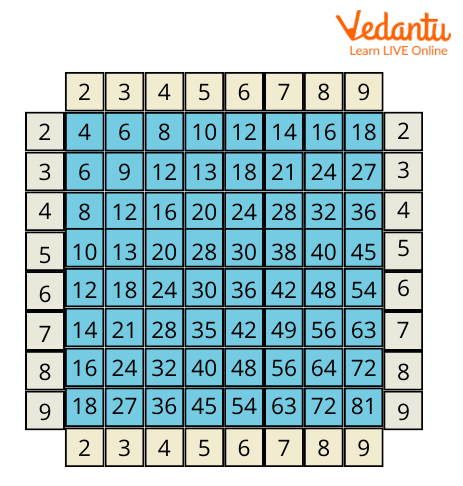
Multiplication Square
Multiplication is a way through which we can make the process of addition easier.
Suppose we have to add a number several times continuously, like 2+2+2+2+2=10.
But on the other hand, we can just multiply 2 by 5, which will also give us 10.
We can see that the second case is a much simpler and easier way.
This is what we mean by multiplication sums-
Instead of adding the number several times, we can just multiply the number.
Step-by-step solution for the multiplication of two double-digit numbers.
Let us multiply $34 \times 12$.
Step 1: Place the multiplicand (34) on top and the multiplier (12) below it. Multiply the multiplier's one digit by the multiplicand.This results in $34 \times 2=68$. This is the first incomplete item to be displayed in one line.
Step 2: Multiply the multiplicand by the multiplier's tens digit. Here, the multiplicand is 34, and the multiplier's tens digit is 1 . $(34+1)=34$ will be the result.
It should be observed that before writing the second partial product, we must place a zero below the one digit of the partial product. Thus, we arrive at 340.
Step 3: Combine the two partial goods to obtain the complete item. 68 plus 340 will equal $408 .$
Multiplication Word Problems with Answers
Here are some multiplication word problems with answers-
Q1. How many sheets of paper are there altogether if 20 folders each have 10 sheets of paper inside them?
Ans: Here, either we can add 10 sheets 20 times
Or
Since multiplication is repeated addition, we can also multiply 10 and 20 to get the answer.
$10 \times 20=200$ sheets of paper
Therefore, altogether we have 200 sheets of paper.
Q2. A carton holds 15 packets of biscuits. Each packet has 5 biscuits. How many biscuits can be packed in 10 cartons?
Ans: Here, we'll first find the number of biscuits in one carton-
In one carton, we can pack $15 \times 5$ biscuits.
So in 10 cartons, we can pack $15 \times 5 \times 10$ biscuits.
$15 \times 5 \times 10=750$ biscuits
Therefore, 750 biscuits can be packed in 10 cartons.
Simple Multiplication Word Problems
Here are some simple multiplication word problems to practice from. One can refer to multiplication word problems pdf to practice too.
Q1. Andrew decided to throw a party and invited some friends. If he has 5 friends coming over and he made 4 sandwiches for each one of them, how many sandwiches did he make in total?
Ans: 20 sandwiches
Q2. Sunil and his 4 friends are deciding on the games that they want to play on his birthday. If each game they decided on takes 10 minutes to end and they prepared a total of 4 games, in how much time will they be able to finish all the games they decided to play?
Ans: 40 minutes
Summary
Multiplication is a way through which we can easily solve the problem where the same number is being added multiple times.
While attempting multiplication word problems, we need to read the question carefully, understand which number is being multiplied how many times, and then attempt the answer.
FAQs on Multiplication Word Problems Explained with Methods and Practice
1. What are multiplication word problems?
Multiplication word problems are story-based questions where you use multiplication to find the total of equal groups. They describe real-life situations involving repeated addition, equal groups, or arrays.
- They often include phrases like “each,” “every,” or “groups of.”
- You multiply the number of groups by the number in each group.
- Example: If there are 4 bags with 6 apples each, total apples = 4 × 6 = 24.
2. How do you solve multiplication word problems step by step?
To solve multiplication word problems, identify the equal groups and multiply them correctly. Follow these steps:
- Read the problem carefully.
- Find the number of groups.
- Find the number in each group.
- Multiply using groups × number in each group.
- Write the answer with the correct unit.
3. What is the formula for solving multiplication word problems?
The basic formula for multiplication word problems is Total = Number of groups × Number in each group. This formula works when items are arranged in equal groups.
- Groups = how many sets
- Each group = same number of items
- Total = product of the two numbers
4. How can you tell if a word problem requires multiplication?
A word problem requires multiplication if it describes equal groups, repeated addition, or arrays. Look for keywords and patterns:
- “Each,” “every,” “per”
- “Groups of”
- Repeated equal amounts
5. Can you give an example of a multiplication word problem with a solution?
Yes, here is a simple example of a multiplication word problem with its solution. Problem: A teacher gives 6 students 4 stickers each. How many stickers are given in total?
- Number of students = 6
- Stickers per student = 4
- Total stickers = 6 × 4 = 24
6. What are common mistakes in multiplication word problems?
A common mistake in multiplication word problems is confusing multiplication with addition or division. Students often:
- Ignore the “each” or “per” clue.
- Add instead of multiply.
- Multiply the wrong numbers.
- Forget to include units in the final answer.
7. What is the difference between multiplication and addition word problems?
The main difference is that multiplication word problems involve equal groups, while addition word problems combine different amounts.
- Addition: 3 apples + 5 apples = 8 apples.
- Multiplication: 3 baskets with 5 apples each = 3 × 5 = 15 apples.
8. How do arrays help in solving multiplication word problems?
Arrays help solve multiplication word problems by organizing objects into rows and columns. An array visually shows equal groups.
- Rows represent one factor.
- Columns represent the other factor.
- Total objects = rows × columns.
9. How do you solve multi-step multiplication word problems?
To solve multi-step multiplication word problems, break the problem into smaller steps and solve one operation at a time.
- Identify the first multiplication.
- Find intermediate results.
- Perform the next operation if needed.
- First: 3 × 5 = 15 packs
- Then: 15 × 2 = 30 stickers
10. How are multiplication word problems used in real life?
Multiplication word problems are used in real life to calculate totals involving equal groups or repeated quantities. Common examples include:
- Shopping (price × quantity)
- Travel (distance per hour × hours)
- School supplies (items per student × number of students)
