








Definition and Examples of the More Than Symbol in Inequalities
What Does The More Than Symbol Mean in Math?
Let us understand the significance of the ‘more than’ symbol in Maths with a simple story.
One day, Priyanka purchased notebooks of the same size in stock from the wholesale shop to sell them at a profit. However, the wholesale retailer played a trick and gave her notebooks of different sizes. When Priyanka reached her shop to check the notebooks before setting them on the shelves, she found that wholesale retailers had packed the notebooks of varying sizes. Now, here comes a dilemma! She found notebooks starting from the size of 20, 18, 15, 14, 13, and 11.
Her cousin Niya gets confused to see the notebooks of various sizes and gives Priyanka an idea to categorize them as per their sizes. Following her advice, Priyanka started arranging the books of the sizes starting from 20, as it was more than the size of 18; 18 as it was more than the size of 15; 15 that was more than 14; 14 that was more than 13; and lastly 13 that was more than 11.
So, what do you understand from the above context, and what is the concept of more than in math? We will understand all about it in detail.
Concept of More Than With Examples
To understand the concept of more than we need to arrange the items in an order. Since maths relies more on using mathematical symbols than on theoretical long texts, we are going to understand the concept of more than with a symbol for the example mentioned above.
In the above example, we used the term more than often. So, let us replace it with a mathematical symbol.
20 > 18 > 15 > 14 > 13 > 11
Here, ‘>’ symbol stands for more than or greater than. Here, we have used descending order. In descending order, the values are arranged in decreasing order, starting from the greatest number and ending with the lowest number.
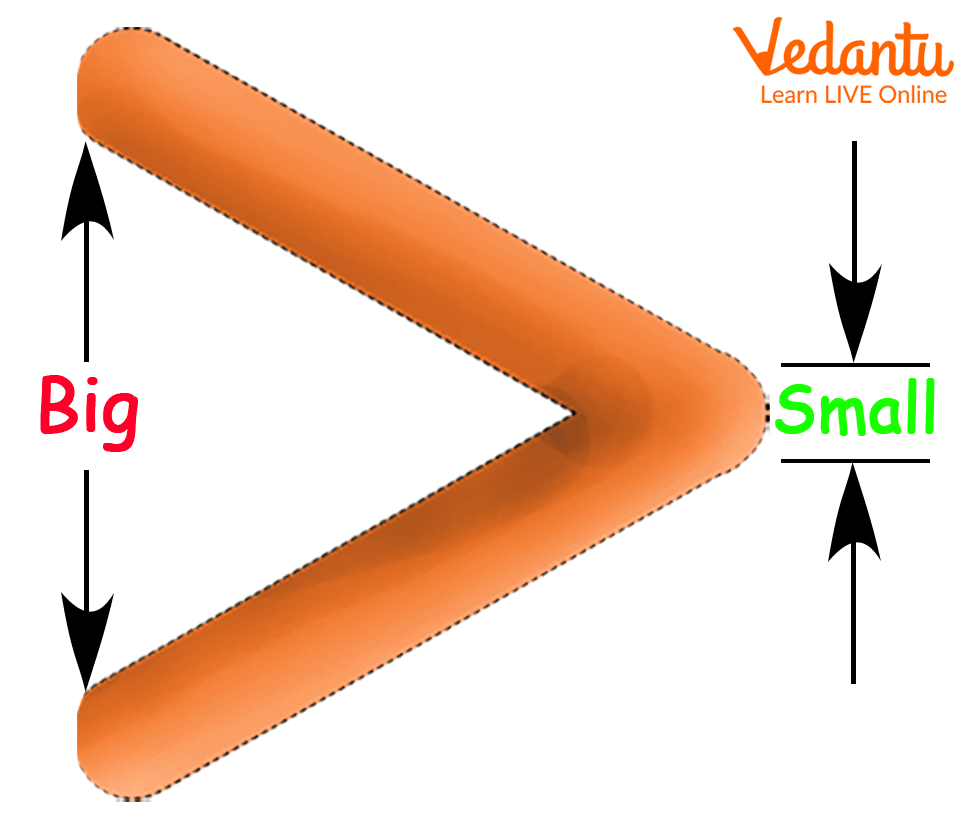
Now, if we reverse the sign, we have:
11 < 13 < 14 < 15 < 18 < 20
So, again if we look at the order from the right-end, we find that 20 is more than 18, 18 is more than 15, then 15 is more than 14, 14 is more than 13, and finally, 13 is more than 11.
Example 1: Let us assume that students of Class 6B have the following scores in a test cricket match.
56
80
67
84
65
74
Now, let us arrange the numbers by using the concept of the ‘greater than’ operator.
Here, the order is as follows.
84 is greater than 80, 80 is greater than 74, 74 is greater than 67, 67 is greater than 65, and 65 is greater than 56.
Now, to minimize our efforts of writing, we replace greater than with ‘>’ sign, which also means the same, so let us write it as:
84 > 80 > 74 > 67 > 65 > 56
Example 2: Niyama bought cakes of various flavors costing as follows.
Cake1 of Rs. 400, cake2 of Rs. 340, cake3 of Rs. 530, and cake4 of Rs. 890.
Now, she arranges these cakes as per the size starting from a higher price to a lower price, which is:
c4 > c3 > c1 > c2
Here, on changing the order of price, the sign also changes in the following way:
c2 < c1 < c3 < c4
So, this is how we can arrange any items/objects in terms of more than ‘>’ by taking various real-life examples.
FAQs on Understanding the More Than Symbol in Mathematics
1. What does the more than symbol mean in math?
The more than symbol (>) means that one number is greater than another number. It is used to compare values in mathematics.
- If a > b, then a is larger than b.
- Example: 7 > 3 means 7 is more than 3.
- This symbol is commonly used in inequalities and number comparisons.
2. How do you use the more than symbol in inequalities?
The more than symbol (>) is used in inequalities to show that one expression is greater than another. To use it correctly:
- Write the larger number or expression on the left.
- Place the symbol > in the middle.
- Write the smaller number or expression on the right.
3. What is the difference between more than and greater than?
In mathematics, more than and greater than mean the same thing and both use the symbol (>). The phrase “more than” is often used in word problems, while “greater than” is commonly used in formal math statements. Example: “8 is more than 6” and “8 is greater than 6” both mean 8 > 6.
4. What is the symbol for more than or equal to?
The symbol for more than or equal to is ≥. It means a value is either greater than or exactly equal to another value.
- Example: x ≥ 4 means x can be 4 or any number larger than 4.
- It combines the greater than symbol (>) and the equal sign (=).
5. How do you remember the more than symbol?
You can remember the more than symbol (>) by thinking of it as an open mouth that eats the bigger number. The wide open side always faces the larger value.
- Example: In 9 > 2, the open side faces 9.
- The pointed side faces the smaller number.
6. Can you give an example of a more than inequality?
An example of a more than inequality is 12 > 5, which means 12 is greater than 5. Here is another example with a variable:
- x > 10
- This means x can be 11, 12, 13, and so on.
7. How is the more than symbol shown on a number line?
On a number line, a more than inequality (>) is shown with an open circle and shading to the right. This represents all numbers greater than a given value.
- For x > 3, draw an open circle at 3.
- Shade or draw an arrow to the right.
8. What is the difference between more than and less than symbols?
The more than symbol (>) shows a value is greater, while the less than symbol (<) shows a value is smaller. They are opposite inequality symbols.
- 8 > 3 means 8 is greater than 3.
- 3 < 8 means 3 is less than 8.
9. How do you solve an inequality with the more than symbol?
To solve an inequality with the more than symbol (>), isolate the variable just like solving an equation, but keep the inequality sign. Example:
- Solve x + 4 > 9
- Subtract 4 from both sides: x > 5
10. When do you flip the more than symbol in inequalities?
You flip the more than symbol (>) only when multiplying or dividing both sides of an inequality by a negative number. Example:
- Start with -2x > 6
- Divide both sides by -2 and flip the sign
- Result: x < -3
