








How to Subtract Mixed Fractions with Borrowing and Unlike Denominators
What are Fractions?
Like fractions are two or more fractions with the same denominator. Another way to represent an improper fraction made up of a whole number, and a proper fraction is with mixed fractions. The subtraction operation between any two mixed fractions is known as subtracting mixed fractions. This article will examine various approaches and regulations to comprehending subtracting mixed fractions. The same procedures as subtracting mixed fractions with like denominators can be used for, unlike denominators by first converting them to like denominators using the LCM.
What are Mixed Fractions?
A mixed fraction, sometimes referred to as a mixed number, combines a whole number with a fraction. The fraction appears after the whole number to the right. Mixed fraction examples include the integers \[1\dfrac{1}{2}\] and \[33\dfrac{1}{3}\]. Both mixed fraction addition and subtraction are possible. Here we will learn about how to subtract mixed fractions.
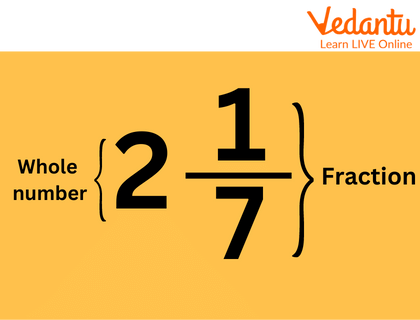
Mixed Fraction Example
How to Subtract Mixed Fractions with Whole Numbers
Case I: Subtracting Mixed Fractions Having Like terms
Fractions are two or more fractions with the same denominator. As a result, mixed fractions with denominators, such as \[3\dfrac{2}{7}\], will have the same denominator as \[2\dfrac{1}{7}\]. Consider the following considerations when you're subtracting mixed fractions.
A mixed number \[a\dfrac{b}{c}\] can be expressed as \[a + \left[ {\dfrac{b}{c}} \right]\]
An improper fraction is created by multiplying a mixed number by its denominator, keeping the denominator, and adding the resulting number to the appropriate fraction's numerator.
For instance, to change\[1\dfrac{6}{{11}}\]
We multiply 1 by 11 \[\left[ {1 \times 11 = 11} \right)\] and add it to 6 [\[11 + 6 = 17\]]. Therefore, 17/11 is the improper fraction.
We shall divide the improper fraction's numerator by its denominator to transform it into a mixed number. The denominator stays the same, the remainder becomes the correct fraction's numerator, and the quotient becomes the whole number portion. For instance, to turn \[\dfrac{{22}}{3}\] into a mixed number, we must first divide 22 by 3, yielding a result of 7 and a remainder of 1. Thus, \[7\dfrac{1}{3}\] is the mixed fraction.
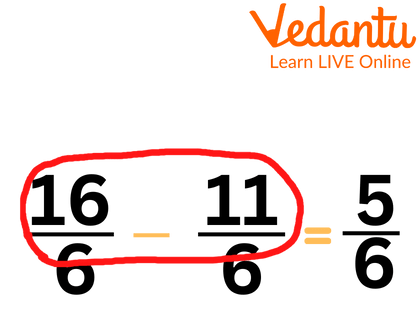
Subtraction Of Like terms
Case II: Subtracting mixed fractions having unlike terms
Unlike fractions are those that have different denominators. Thus, \[5\dfrac{1}{3}{\rm{ and }}3\dfrac{2}{5}\] are two examples of mixed fractions with dissimilar denominators. To understand the processes for subtracting mixed fractions with dissimilar denominators, let's use an example.
There are two options on how to subtract.
Method I: Subtracting fractions and whole integers separately by bringing their denominators to the same value
Method II: It involves turning Mixed Fractions into improper fractions, then subtracting them by setting their denominators to the same value.
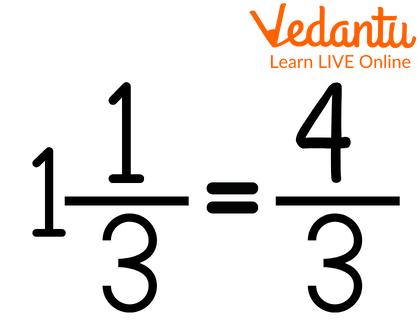
Conversion of Mixed fraction to Improper Fraction
Conclusion
Using mixed fractions is another way to represent an improper fraction made up of a whole integer and a proper fraction. Subtracting mixed fractions is the process of taking away any two mixed fractions. The procedure of removing any two mixed fractions is referred to as subtracting mixed fractions.
Solved Examples
Example 1: Subtract \[20\dfrac{2}{3}\] from \[15\dfrac{1}{3}\]
Ans: To answer this question, we'll apply the idea of subtracting mixed fractions. Given mixed fractions with the same denominator are \[15\dfrac{1}{3}\] and \[20\dfrac{2}{3}\] . We must solve\[20\dfrac{2}{3}\] \[ - \]\[15\dfrac{1}{3}\].
The whole numbers and the fractional parts will be subtracted separately and then combined as indicated below.
\[\begin{array}{l} = [20 - 15] + \left[ {\left[ {\dfrac{2}{3}} \right] - \left[ {\dfrac{1}{3}} \right)} \right]\\ = 5 + \dfrac{1}{3}\\ = 5\dfrac{1}{3}\end{array}\]
Thus, \[20\dfrac{2}{3}\] \[ - \]\[15\dfrac{1}{3}\]=\[\;5\dfrac{1}{3}\].
Example 2: Sam has a 16-meter-long cloth. In order to make curtains for the house, he took \[13\dfrac{1}{4}\] m of fabric from it. How much fabric is still on him for future use?
Ans: If Sam had 16m long fabric with him and he took \[13\dfrac{1}{4}\]m of fabric away. Then he will have \[16 - 13\dfrac{1}{4}\] m of clothes with him.
\[\begin{array}{l}16 - 13\dfrac{1}{4}\\ = \dfrac{{16}}{1} - \dfrac{{53}}{4}\\{\rm{Taking LCM and solving:}}\\ = \dfrac{{84}}{4} - \dfrac{{53}}{4}\\ = \dfrac{{84 - 53}}{4}\\ = \dfrac{{31}}{4}\end{array}\]
Thus, he will have \[\dfrac{{31}}{4}\] m of cloth with him.
Example 3: When subtracting mixed fractions, how do you borrow?
Ans: When subtracting mixed fractions, the whole number will lend to the proper fraction to increase it if the proper fractional part of the mixed fraction from which the other mixed fraction is being subtracted is less. For instance, to carry out
\[3\dfrac{1}{3} - 1\dfrac{2}{3}\]
\[\dfrac{1}{3} > \dfrac{2}{3}\], as can be seen. As a result, 1/3 will take 1 full from 3. 3/3 can be used to represent a whole. After subtracting one, the full number 3 becomes 2, and the fraction 1/3 becomes\[\left( {\dfrac{1}{3}} \right] + \left[ {\dfrac{3}{3}} \right) = \dfrac{4}{3}\]. Consequently, upon borrowing, the resulting modified mixed fraction is
\[2\dfrac{4}{3}\]
The subsequent subtraction will be
\[\begin{array}{l}2\dfrac{4}{3} - 1\dfrac{2}{3}\\ = 1\dfrac{2}{3}\end{array}\]
FAQs on Mixed Fraction Subtraction Explained with Clear Steps
1. What is mixed fraction subtraction?
Mixed fraction subtraction is the process of subtracting one mixed number (a whole number and a proper fraction) from another.
A mixed number has two parts:
- A whole number
- A proper fraction
2. How do you subtract mixed fractions step by step?
To subtract mixed fractions, first make the denominators the same, then subtract the fractional parts and whole numbers.
Follow these steps:
- Make sure the fractions have a common denominator.
- Subtract the fractional parts.
- Subtract the whole numbers.
- Simplify the result if needed.
3. How do you subtract mixed numbers with different denominators?
To subtract mixed numbers with different denominators, first convert the fractions to a common denominator before subtracting.
Steps:
- Find the LCM of the denominators.
- Rewrite each fraction with the common denominator.
- Subtract the fractions and whole numbers.
LCM of 2 and 3 is 6.
1/2 = 3/6, 1/3 = 2/6
So, 4 3/6 − 2 2/6 = 2 1/6.
4. What do you do if the top fraction is smaller when subtracting mixed numbers?
If the top fraction is smaller, you borrow 1 from the whole number and convert it into a fraction.
Steps:
- Reduce the whole number by 1.
- Convert 1 into a fraction with the same denominator.
- Add it to the top fraction.
- Then subtract normally.
Borrow 1 → 2 5/4
Now subtract: 2 5/4 − 1 3/4 = 1 2/4 = 1 1/2.
5. Can you convert mixed numbers to improper fractions to subtract?
Yes, you can subtract mixed numbers by converting them into improper fractions first.
Steps:
- Convert each mixed number using: whole × denominator + numerator.
- Subtract the fractions.
- Simplify and convert back to a mixed number if needed.
2 1/3 = 7/3, 1 1/6 = 7/6
7/3 = 14/6
14/6 − 7/6 = 7/6 = 1 1/6.
6. What is the formula for subtracting mixed fractions?
The formula for mixed fraction subtraction is: (a + b/c) − (d + e/c) = (a − d) + (b/c − e/c) when denominators are the same.
If denominators differ, first rewrite with a common denominator. If the fractional part becomes negative, borrow 1 from the whole number to adjust the subtraction correctly.
7. What is an example of subtracting mixed fractions with borrowing?
An example of subtracting mixed fractions with borrowing is 6 1/5 − 2 3/5 = 3 3/5.
Solution:
- Since 1/5 is smaller than 3/5, borrow 1 from 6.
- 6 becomes 5, and 1 becomes 5/5.
- 5/5 + 1/5 = 6/5.
- Now subtract: 5 6/5 − 2 3/5.
- Whole numbers: 5 − 2 = 3.
- Fractions: 6/5 − 3/5 = 3/5.
8. What are common mistakes in mixed fraction subtraction?
Common mistakes in mixed fraction subtraction include forgetting common denominators and incorrect borrowing.
Frequent errors:
- Not finding a common denominator.
- Subtracting denominators directly (which is incorrect).
- Forgetting to borrow 1 when needed.
- Not simplifying the final answer.
9. How do you simplify the answer after subtracting mixed numbers?
To simplify after subtracting mixed numbers, reduce the fraction to its lowest terms.
Steps:
- Find the GCF of the numerator and denominator.
- Divide both by the GCF.
- If the fraction is improper, convert it to a mixed number.
10. Why do we need a common denominator in mixed fraction subtraction?
We need a common denominator in mixed fraction subtraction because fractions can only be subtracted when they refer to equal-sized parts.
For example, 1/2 − 1/3 cannot be subtracted directly since halves and thirds are different-sized parts. Converting to sixths gives 3/6 − 2/6 = 1/6, which makes the subtraction valid and accurate.
