








How to Solve Lcm Questions Using Prime Factorization and Division Method
In mathematics, LCM stands for a least common number. It can be used to pair two objects against each other. In easy language, we can say that the smallest repeated multiple between two or more numbers is found using the Least Common Multiple (LCM) method. We can calculate LCM by using three methods.

Full Form of LCM
Each method has different formulas. LCM is also known as the lowest common number. In this chapter, we learn to solve LCM problems using all three methods and practice LCM sums. All three methods are explained below with examples.
LCM using Listing Method
LCM using Prime Factorization
LCM using Division Method.
Now understand these methods with the help of examples.
LCM by Listing Method
We can find out the common multiples of two or more numbers. Out of these repeated multiples, the LCM of two numbers can be calculated.
Let's take an example.
Q1. Find the LCM of numbers 4 and 5 by listing methods.
Ans: LCM of 4 and 5 by listing method:
4 is multiplied by: 4, 8, 12, 16, 20, 24, 28, 32, 36, 40, ..
and 5 is multiplied by: 5, 10, 15, 20, 25, 30, 35, 40, …
The first common multiple of 4 and 5 is 20
according to the least method the LCM of 4 and 5 is 20.
LCM by Prime Factorisation Method
We can find out the prime factors of the numbers by using the prime factorization method. There are two steps to calculate the LCM using the prime factorization method.
Step 1: Put the numbers in the prime factored form
Step 2: The LCM of the given two numbers is the product of all the prime factors. (common factors will be included only once)
Understand this method using the example given below.
Q1. Find the least common multiple of 60 and 80
Ans: The prime factorization of 60 and 80 are:
60 = 2 × 2 × 3 × 5 = 2 × 2 × 3 × 5
80 = 2 × 2 × 2 × 5 × 2
LCM of 60 and 80 =2 × 2 × 3 × 2 × 5 × 2 = 240.
LCM by Division Method
To calculate the LCM of two numbers using the division method we have to follow the steps given below:
Step 1: Find a prime number that is a factor of at least one of the given numbers. Put this prime number to the left of the given numbers.
Step 2: If the prime number in step 1 is a factor of the number, divide the number by the prime and write the quotient below. If the prime number in step 1 is not a factor of the number, write the number in the row below as it is. Continue the steps until only one is left in the last row.
LCM Word Problems
1. Find the least common multiple (LCM) of 6 and 15 using the division method.
Ans:
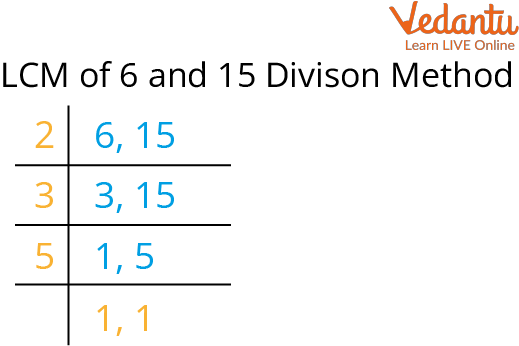
LCM by Division Method
LCM of 6 and 15 is 2 × 3 × 5 = 30.
2. What is the least common multiple of 980 and 9000 using the prime factorization method?
Ans: Prime factorization of 980 = 2 × 2 × 5 × 7 × 7 = 22 × 51 × 72 and
9000 = 2 × 2 × 2 × 3 × 3 × 5 × 5 × 5 = 23 × 32 × 53.
∴ LCM (980, 9000) = 23 × 32 × 53 × 72 = 441000.
Practice Questions
Q1. Find the LCM of 4, 6 and 12 by using the listing method.
Ans: 12
Q2. Find the LCM of 14 and 12.
Ans: 84
Summary
LCM is known as the lowest common number. LCM problems use three methods:
LCM using Listing Method
LCM using Prime Factorization
LCM using Division Method.
FAQs on Lcm Questions with Step by Step Solutions
1. What is LCM in Maths?
The Least Common Multiple (LCM) is the smallest positive number that is exactly divisible by two or more given numbers. It is the lowest number that appears in the list of multiples of each number.
- For example, multiples of 4: 4, 8, 12, 16, 20…
- Multiples of 5: 5, 10, 15, 20…
- The smallest common multiple is 20.
2. How do you find the LCM of two numbers?
The LCM of two numbers can be found using the prime factorization method or the division method. One common method is:
- Step 1: Write the prime factors of each number.
- Step 2: Take the highest power of each prime factor.
- Step 3: Multiply them together.
- 12 = 2² × 3
- 18 = 2 × 3²
- LCM = 2² × 3² = 36
3. What is the formula for LCM using HCF?
The formula relating LCM and HCF is LCM × HCF = Product of the two numbers. This formula works for two numbers only.
- If a and b are two numbers, then:
- LCM(a, b) = (a × b) ÷ HCF(a, b)
- HCF = 4
- LCM = (8 × 12) ÷ 4 = 96 ÷ 4 = 24
4. What is the LCM of 3 and 5?
The LCM of 3 and 5 is 15. Since both 3 and 5 are prime numbers, their LCM is simply their product.
- Multiples of 3: 3, 6, 9, 12, 15…
- Multiples of 5: 5, 10, 15…
- Smallest common multiple = 15
5. What is the difference between LCM and HCF?
The LCM is the smallest common multiple of given numbers, while the HCF (Highest Common Factor) is the greatest common divisor of those numbers.
- LCM deals with multiples.
- HCF deals with factors.
- Example for 12 and 18: HCF = 6, LCM = 36.
6. How do you find the LCM using the division method?
The division method finds the LCM by dividing the numbers by common prime numbers until no common factors remain.
- Step 1: Write numbers in a row.
- Step 2: Divide by a common prime number.
- Step 3: Continue dividing until only 1s remain.
- Step 4: Multiply all divisors.
- Divide by 2 → 3, 4
- Divide by 2 → 3, 2
- Divide by 2 → 3, 1
- Divide by 3 → 1, 1
- LCM = 2 × 2 × 2 × 3 = 24
7. What is the LCM of 12 and 15?
The LCM of 12 and 15 is 60. Using prime factorization:
- 12 = 2² × 3
- 15 = 3 × 5
- LCM = 2² × 3 × 5 = 60
8. Why do we use LCM in Maths?
We use the LCM to find a common denominator in fractions and to solve real-life problems involving repeating events. Common uses include:
- Adding or subtracting fractions
- Word problems about cycles or schedules
- Finding when events occur together
9. Can the LCM of two numbers be smaller than the numbers?
No, the LCM of two positive numbers cannot be smaller than both numbers. The LCM is always greater than or equal to the greatest of the given numbers.
- If one number divides the other, the LCM equals the larger number.
- Example: LCM of 4 and 8 is 8.
10. How do you find the LCM of three numbers?
To find the LCM of three numbers, use the prime factorization method and take the highest powers of all prime factors involved.
- Example: Find LCM of 4, 6, and 8.
- 4 = 2²
- 6 = 2 × 3
- 8 = 2³
- LCM = 2³ × 3 = 24
