








How to Find LCM by Division Method with Examples and Rules
Have you ever heard about LCM? The Least Common Multiple is the meaning of the abbreviation LCM. The lowest number that can be divided by both numbers is known as the least common multiple (LCM) of two numbers. It can also be computed using two or more numbers. Finding the LCM of a given set of numbers can be done in a variety of ways. Utilising the prime factorization of each number and then calculating the product of the highest powers of the shared prime factors is one of the quickest ways to determine the LCM of two numbers.
LCM by Common Division Method
LCM by Division Method
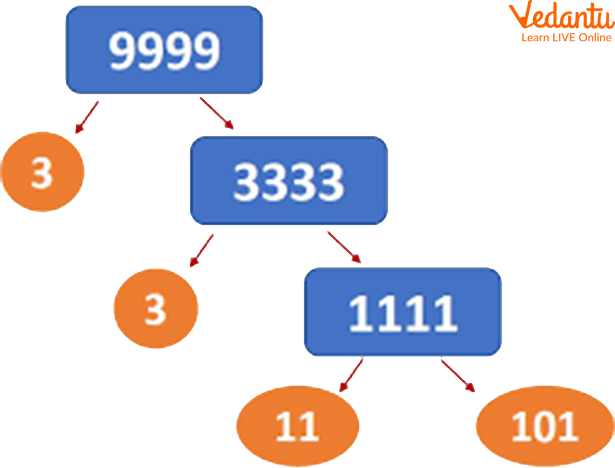
Diving Numbers
To find the LCM by division method, we write the given numbers in a row separated by commas, then divide the numbers by a standard prime number. We stop dividing after reaching the prime numbers. The product of common and uncommon prime factors is the LCM of given numbers.
Example: How to find LCM by the division method.
Ans: Here, we are given the numbers 20, 36, 63, and 67.
First, let us find their least common multiple using the division method.
First, we depict all numbers in a row, dividing them by a comma. Then we divide by a least prime number 2, which divides two of the numbers. Then we put the quotient directly under them, and the number which does not get divided remains the same. After dividing by 2, two numbers get separated, and the other remains the same. Then dividing by 3, two numbers get divided. Again, dividing by 3, two numbers get divided. Now dividing by 5, only one number gets divided. We are similarly divided by 7 and 67. So we get prime numbers by the division method as 2, 2, 3, 3, 5, 7, 67.
Difference Between Factors and Prime Factors
A number's factors are the numbers that are multiplied to get the original number. For example, 4 and 5 are factors of 20, i.e., 4 X 5 = 20, whereas prime factors of a number are prime numbers multiplied to obtain the original number. For example, the prime factors of 20 are 2, 2, and 5, i.e., 2 X 2 X 5 = 20.
Prime factorisation is similar to number factorisation but only considers prime numbers as factors (2, 3, 5, 7, 11, 13, 17, 19, and so on). As a result, the prime factors of a given number are those that ultimately divide the original number and cannot be divided into more factors.
All About Prime Factorisation
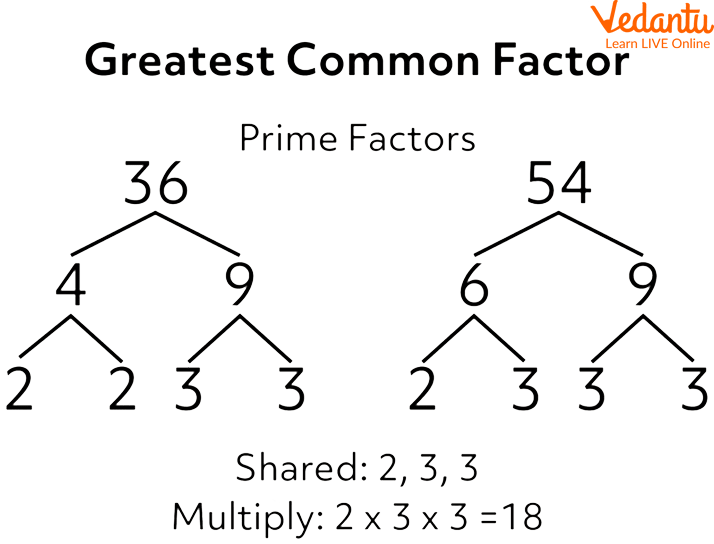
Prime Factorisation
A number can be expressed as a product of its prime factors using prime factorisation. The number 30 is not a prime number. The number 6 can be factored further into 2 X 3, where 2 and 3 are prime numbers. As a result, the prime factorisation of 30 is 2 X 3 X 5, with all factors being prime numbers.
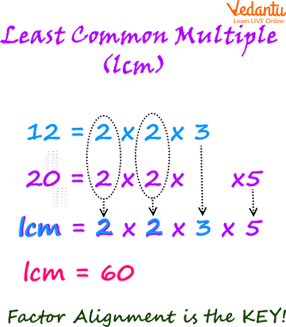
Defining Factors
Steps for Finding Prime Factorisation Through Division
The standard division method is a very convenient way to find the LCM. In this prime factorisation method, we proceed as follows:
Put all of the numbers in a row, separated by commas.
Begin with the lowest prime number that exactly divides at least one of the given numbers.
In the following line, write down the quotients and any undivided numbers.
Repeat the procedure until 1 is the only common factor.
Determine the product of all divisors. Then, it is the necessary LCM.
To understand better, check the below example.
Example: Determine the LCM of the numbers 36, 48, and 72.
Ans: The calculation is given in the picture as follows:

LCM of the Numbers 36, 48, and 72
LCM = 2 x 2 x 2 x 2 x 3 x 3 = 144
Summary
The smallest number that is a multiple of all the numbers in a set is called the Least Common Multiple (LCM) of the group of numbers. For instance, 80 is the smallest number that is both a multiple of 16 and a multiple of 20, making it the LCM of 16 and 20. The LCM of two or more numbers can be calculated in some ways. LCM is defined to be 0 if either of the two is 0. The sum of all relative prime numbers is known as the LCM.
FAQs on LCM by Division Method with Step by Step Process
1. What is LCM by division method?
The LCM by division method is a technique to find the least common multiple of two or more numbers by dividing them simultaneously by common prime numbers until all become 1. It is also called the ladder method or short division method.
- Write the numbers in a row.
- Divide by the smallest common prime number.
- Repeat the process until all numbers reduce to 1.
- Multiply all the divisors to get the LCM.
2. How do you find LCM using the division method?
To find the LCM using the division method, divide the given numbers by common prime factors step by step and multiply all the divisors.
- Step 1: Write the numbers side by side.
- Step 2: Divide by the smallest prime number that divides at least one number.
- Step 3: Write the quotients and repeat until all become 1.
- Step 4: Multiply all divisors to get the LCM.
3. Can you give an example of LCM by division method?
Yes, here is an example of finding the LCM of 15 and 20 using the division method.
- Divide by 2 → 15, 20 → 15, 10
- Divide by 2 → 15, 10 → 15, 5
- Divide by 3 → 15, 5 → 5, 5
- Divide by 5 → 5, 5 → 1, 1
4. What is the formula for LCM using division method?
There is no single formula, but the LCM is obtained by multiplying all the prime divisors used during the division process.
- LCM = Product of all common and uncommon prime divisors
- LCM × HCF = Product of the two numbers
5. What is the difference between LCM by division method and prime factorization method?
The main difference is that the division method divides numbers simultaneously, while the prime factorization method factors each number separately.
- Division method: Continuous division until all numbers become 1.
- Prime factorization: Write each number as a product of prime factors.
- Both methods give the same LCM.
6. Can LCM by division method be used for more than two numbers?
Yes, the LCM by division method can be used for two or more numbers at the same time.
- Write all numbers in one row.
- Divide by common prime numbers.
- Continue until all numbers reduce to 1.
- Multiply all divisors.
7. Why do we use prime numbers in the LCM division method?
We use prime numbers because every composite number can be expressed as a product of primes, ensuring the correct calculation of LCM.
- Prime numbers break numbers into basic factors.
- They prevent missing any common factor.
- This guarantees the smallest common multiple.
8. What are common mistakes in LCM by division method?
Common mistakes in the LCM division method include missing divisors or stopping the process too early.
- Not dividing until all numbers become 1.
- Forgetting to multiply all divisors.
- Using non-prime numbers incorrectly.
- Skipping a number that is not divisible in a step.
9. Is LCM by division method the same as ladder method?
Yes, the LCM division method is also called the ladder method or short division method.
- Both involve repeated division by prime numbers.
- Both methods multiply all divisors at the end.
- The layout may look slightly different, but the steps are the same.
10. How do you check if your LCM answer is correct?
You can check the LCM by verifying that it is divisible by all given numbers and using the HCF relation for two numbers.
- The LCM must be a multiple of each number.
- For two numbers: LCM × HCF = Product of the numbers.
