








Step by Step Method to Multiply Decimals by Whole Numbers with Examples
Brief about How to Multiply Decimals with Whole Numbers Step by Step
Decimal multiplication is crucial when discussing the grouping of elements. Let's say there are 12 kids in all, and you have to give each one 0.25 parts of a chocolate bar. How many bars of chocolate would you require? We need to multiply 12 by 0.25 to get the required amount of chocolate bars. When multiplying decimals, one must first multiply the integers without considering the decimal point, followed by the number of decimals.
Whole Numbers
The term "whole numbers" refers to numbers which are devoid of fractions and are made up of positive integers and zero. It is denoted by the letter "W," and its corresponding set of numbers are “0, 1, 2, 3, 4, 5, 6, 7,…”The entire number zero denotes nothing or a null value.
Decimal Numbers
One type of number that has a whole number and a fractional component separated by a decimal point is a decimal. A decimal point is a dot that appears between parts of a whole number and a fraction. An example of a decimal number is 24.5.
How to Multiply a Decimal with Whole Numbers Step by Step
The fundamental distinction between multiplying decimals by whole numbers and multiplying whole numbers is where the decimal point is placed. Let's examine the procedures listed below to comprehend the division of a decimal by a whole number.
Step 1: Multiply the integers using the standard approach, initially ignoring the decimal point.
Step 2: Count the number of decimal places in the given integers after the multiplication.
Step 3: The number of decimal places in the result of the multiplication should match the number provided in the numbers. In other words, the decimal point in the product should be positioned so that it equals the total of all the multiplicand and multiplier decimal places.
Key Points to Remember
These are a few essential ideas on the idea of dividing decimals by whole numbers:
The same guidelines apply when multiplying a decimal by a whole number as when multiplying whole integers.
The decimal point in the product should be positioned so that it equals the total of all the multiplicand and multiplier decimal places.
When adding the decimal point, all of the product's zeros must remain.
Before inserting the decimal point, zeros can be added to the left if the product has more decimal places than the number of digits.
The final product's trailing zeros can be removed.
Conclusion
One of the crucial applications is multiplying a decimal by a whole number when billing for things where the amount is frequently expressed in decimals. We need decimals in our daily life. The majorities of their applications are in industries like measurement and finance where precise computations are required.
Solved Examples
Example 1: Salina is attempting to calculate the product of two numbers, 654 and 4.445. Can you help her in doing the multiplication?
Ans: We can see that the numbers are 654 and 4.445, which are decimals and whole numbers, respectively.
We will thus use the procedures for multiplying a decimal by a whole number in order to obtain the product of these two values.
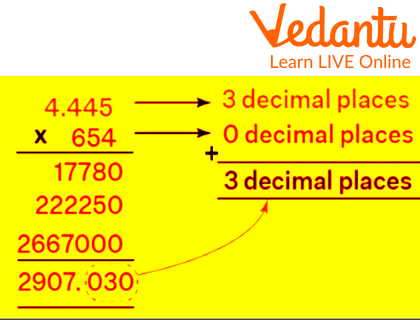
Multiplication of 4.445 and 654
Therefore, 4.445 multiplied by 654 results in 2907.03
Example 2: If Raj got 88.63 marks in English, Math and Hindi. Then how many marks did Raj get in these three subjects? (Use multiplication)
Ans: Given that Raj got 88.63 marks in 3 subjects.
Thus, his marks in total in these 3 subjects would be \[88.63 \times 3 = 265.89\]
Total marks he got is 265.89.
Example 3: Find the product of 16.45 and 8.5.
Ans:
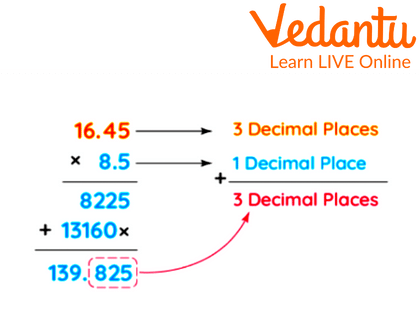
Multiplication of 16.45 and 8.5
FAQs on How To Multiply Decimals By Whole Numbers Easily
1. How do you multiply decimals by whole numbers?
To multiply decimals by whole numbers, multiply as if there are no decimals, then place the decimal point in the product. Follow these steps:
- Ignore the decimal point and multiply the numbers normally.
- Count the number of decimal places in the decimal number.
- Place the decimal point in the answer so it has the same number of decimal places.
- 34 × 5 = 170
- There is 1 decimal place in 3.4
- So the final answer is 17.0 or 17
2. What is the rule for multiplying decimals by whole numbers?
The rule for multiplying decimals by whole numbers is to multiply normally and then adjust the decimal point based on the decimal places. The key rule is:
- Multiply as whole numbers.
- Count the decimal places in the decimal factor.
- Place the decimal in the product accordingly.
3. Do you move the decimal when multiplying by a whole number?
Yes, you place the decimal point in the final answer based on the decimal places in the original decimal number. You do not move the decimal before multiplying. Instead:
- Multiply the numbers first.
- Then insert the decimal point in the product.
- 26 × 3 = 78
- One decimal place → 7.8
4. Can you give an example of multiplying a decimal by a whole number?
Yes, for example, 4.25 × 6 = 25.5. Here’s how:
- Ignore the decimal: 425 × 6 = 2550
- 4.25 has 2 decimal places
- Place the decimal two places from the right → 25.50 or 25.5
5. Why does multiplying a decimal by a whole number make the number bigger?
Multiplying a decimal by a whole number greater than 1 makes the number bigger because you are adding the decimal value multiple times. For example:
- 0.8 × 4 = 3.2
- This means 0.8 + 0.8 + 0.8 + 0.8
- × 0 gives 0
- × 1 keeps the number the same
6. How do you multiply decimals by whole numbers using the column method?
To multiply decimals by whole numbers using the column method, write the numbers vertically and multiply as whole numbers first. Steps:
- Write the decimal number and whole number in columns.
- Ignore the decimal point and multiply.
- Count decimal places in the decimal factor.
- Insert the decimal point in the final answer.
- 13 × 4 = 52
- One decimal place → 5.2
7. What happens to the decimal point when multiplying by 10, 100, or 1000?
When multiplying a decimal by 10, 100, or 1000, the decimal point moves to the right. Specifically:
- × 10 → move 1 place right
- × 100 → move 2 places right
- × 1000 → move 3 places right
- 2.45 × 10 = 24.5
- 2.45 × 100 = 245
8. How do you check your answer when multiplying decimals by whole numbers?
You can check your answer by estimating or using inverse operations. Two common methods are:
- Estimation: Round the decimal and multiply mentally.
- Division: Divide the product by the whole number to see if you get the original decimal.
- If 3.6 × 5 = 18
- Check: 18 ÷ 5 = 3.6
9. What are common mistakes when multiplying decimals by whole numbers?
The most common mistake when multiplying decimals by whole numbers is placing the decimal point incorrectly. Other mistakes include:
- Forgetting to count decimal places.
- Moving the decimal before multiplying.
- Basic multiplication errors.
10. How is multiplying decimals by whole numbers used in real life?
Multiplying decimals by whole numbers is used in real life for money, measurements, and scaling quantities. Common examples include:
- Cost calculation: $2.75 × 4 = $11.00
- Distance: 1.5 km × 3 trips = 4.5 km
- Weight: 0.25 kg × 8 = 2 kg
