








Ratio To Percentage Formula With Solved Examples and Steps
In maths, a ratio shows how many times one number contains another number, or can say that ratio is the comparison of numbers? Suppose there are two numbers a and b. In ratios, the ratio of number a to number b is often written as a:b ‘:' is the sign of ratios.
For example- Neha's weight is 40 kg and her mother's weight is 60 kg. So the ratio of Neha's mother's weight To Neha's weight will be $\dfrac{60}{40} = \dfrac{3}{2}$ = 3:2. This Ratio can be converted into percentages just by using a simple formula. Ratios are converted into percentages to make us easy to understand.
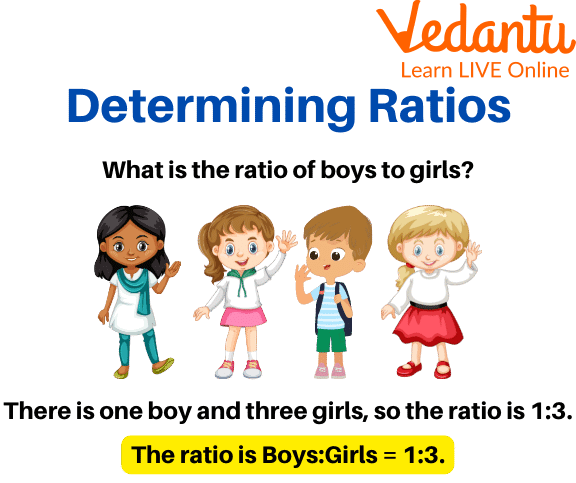
Image Showing Ratio of Boys to Girls.
What is the Percentage?
In maths, we can say that a percentage is a number expressed as a fraction of a hundred. It is often denoted by the '%' sign.
How to Convert Ratio into Percentage?
Ratios can be converted into percentages in different ways. These ratios can be converted into normal percentages, fraction percentages, and decimal percentages. Let us understand how to convert each part of the ratio into a percentage.
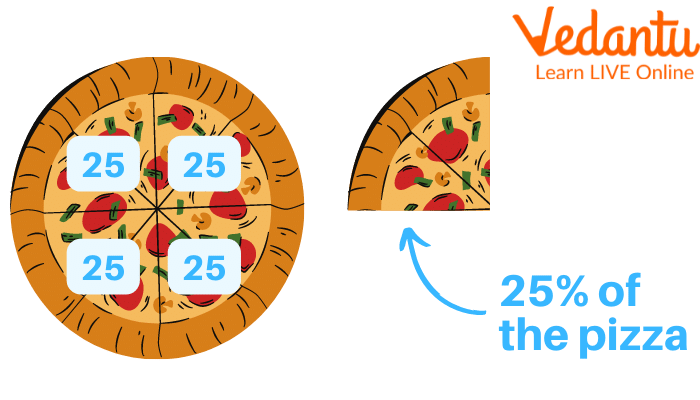
Image Showing Part of Pizza as a Percentage.
There is a basic formula for converting ratios into percentages. This formula can be used with any value Percentage Formula = ( Ratio × 100 ) %
Now let's understand the method of converting each part of the ratios into percentages in detail.
To convert the ratio into a percentage.
Step 1. Obtain the given ratio in the form of x:y
Step 2. Convert the above ratio into a fraction such as $\dfrac{x}{y}$
Step 3. See if you can further simplify the given fraction.
Step 4. Multiply the given fraction by 100 and put the percentage sign (%)
For example- Let the given ratio be 3:4
Ans: Let us understand the percentage of 3:4. On converting the given ratio into a fraction 3:4 = $\dfrac{3}{4}$
On multiplying the obtained fraction by 100.
$\dfrac{3}{4} \times 100$ % = 75 %
Therefore, the percentage of 3:4 is 75%
Example: Convert $\dfrac{21}{15}$ into a percentage
Ans. On converting into fraction 21:15 = $\dfrac{21}{15}$
On simplify
$\dfrac{21}{15}$ = $\dfrac{7}{5}$
On multiplying by 100.
$\dfrac{7}{5} \times 100$ %= 140%
To Convert the Given Ratio into a Fraction Percentage
Sometimes the given ratio cannot be fully converted into a percentage so convert it into a fraction percentage.
Example 1: Convert 3:14 into a percentage.
Ans. Let us understand how to convert 3:14 by using a ratio to percentage formula. On converting the ratio into fraction 3:14 = $\dfrac{3}{14}$
Now on multiplying the given fraction by 100.
$\dfrac{3}{14} \times 100$ % = $\dfrac{150}{7}\%$
Therefore, 3:4 into fraction percentage is $\dfrac{150}{7}\%$
Example 2: Convert 6:36 into a percentage.
Ans. On converting it into fraction 6:36 = $\dfrac{6}{36}$
If the given numerator and denominator have the same factors, they can be further simplified by curing.
On simplification
$\dfrac{6}{36}$ = $\dfrac{1}{6}$
On multiplication by 100
$\dfrac{1}{6} \times 100$ % =$\dfrac{50}{3}\%$
Therefore 6:36 into percentage is $\dfrac{50}{3}\%$.
How To Convert a Given Ratio into a Decimal Percentage
Let us convert 14:16 into a decimal percentage
On converting into a fraction
14:16 = $\dfrac{14}{16}$
On simplification
$\dfrac{14}{16}$ = $\dfrac{7}{8}$
On multiplication by 100
$\dfrac{7}{8} \times 100$ % =$\dfrac{175}{2}\%$
And on further dividing
$\dfrac{175}{2}$ = 87.5 %
Example: Convert 7:6 into a decimal percentage.
Ans. Converting the given ratio into fraction 7:6= $\dfrac{7}{6}$
On multiplying the given number by 100
( $\dfrac{7}{6}$ × 100 ) % = $\dfrac{350}{3}\%$
On further dividing $\dfrac{350}{3}$ = 116.67 %
Practice Questions
Q1. Convert the following ratios into percentages.
1.16:25
Ans: 64%
2. 10:25
Ans: 40%
Q2. Convert the following ratios into a fraction and decimal percentage
1. 8:15
Ans: $\dfrac{160}{3}\%$ or 53.34%
2. 4:75
Ans: $\dfrac{16}{3}\%$ or 5.34%
Summary
The ratio shows how many times one number contains another number. It is denoted by the ': ' sign. The ratio of two numbers a and b is a:b. A percentage is a number expressed as a fraction of a hundred. It is often denoted by the '%' sign. Ratio and percentage help us to understand numbers better. These ratios can be converted into a normal percentage, fraction percentage, and decimal percentage. The formula to convert the given ratio into a percentage is ( Ratio × 100 ) %.
FAQs on How To Convert Ratio Into Percentage Easily
1. What is the formula to convert a ratio into a percentage?
The formula to convert a ratio into a percentage is (Part ÷ Whole) × 100%. To apply this formula:
- Write the ratio in fraction form (Part/Whole).
- Divide the part by the whole.
- Multiply the result by 100 to get the percentage.
2. How do you convert a ratio like 2:5 into a percentage?
To convert the ratio 2:5 into a percentage, calculate (2 ÷ 5) × 100 = 40%. Follow these steps:
- Write the ratio as a fraction: 2/5.
- Divide 2 by 5 to get 0.4.
- Multiply 0.4 by 100 to get 40%.
3. How do you convert a ratio to a percentage step by step?
To convert a ratio into a percentage, divide the first term by the second term and multiply by 100. The step-by-step process is:
- Step 1: Write the ratio as a fraction (a/b).
- Step 2: Divide a by b.
- Step 3: Multiply the result by 100%.
4. How do you convert a three-term ratio into a percentage?
To convert a three-term ratio into percentages, first find the total and then divide each part by the total and multiply by 100. For example, for 2:3:5:
- Total = 2 + 3 + 5 = 10.
- First part: (2 ÷ 10) × 100 = 20%.
- Second part: (3 ÷ 10) × 100 = 30%.
- Third part: (5 ÷ 10) × 100 = 50%.
5. What is 3:4 as a percentage?
The ratio 3:4 as a percentage is 75%. Convert it by writing 3/4, then divide 3 by 4 to get 0.75, and multiply by 100 to get 75%. This is a common example when learning how to convert ratio into percentage.
6. Can you convert a ratio directly into a percentage without simplifying?
Yes, you can convert a ratio into a percentage without simplifying by directly dividing the first term by the second and multiplying by 100. Simplifying is helpful but not required. For example, 6:12 → (6 ÷ 12) × 100 = 0.5 × 100 = 50%. Simplifying 6:12 to 1:2 gives the same result.
7. What is the difference between ratio and percentage?
A ratio compares two quantities, while a percentage expresses a quantity out of 100. Key differences include:
- Ratio is written as a:b or a/b.
- Percentage is written with the % symbol.
- Percentage = (Part ÷ Whole) × 100.
8. How do you convert a ratio into a percentage when the numbers are large?
To convert large ratios into percentages, divide the first number by the second and multiply by 100, simplifying if helpful. For example, 250:500 → 250 ÷ 500 = 0.5 → 0.5 × 100 = 50%. Simplifying 250:500 to 1:2 makes the calculation easier but gives the same percentage.
9. How do you convert a ratio into a percentage using a calculator?
To convert a ratio into a percentage using a calculator, divide the first term by the second and multiply by 100. Steps:
- Enter the first number.
- Press ÷ and enter the second number.
- Press × 100.
10. What are common mistakes when converting a ratio into a percentage?
A common mistake when converting a ratio into a percentage is multiplying before dividing or reversing the terms. Important points to remember:
- Always divide Part ÷ Whole, not Whole ÷ Part.
- Multiply the decimal result by 100.
- Ensure you are converting the correct part of the ratio.
