








What are the factors of 33 and how to find them
The numbers that when multiplied together result in the number 33 are called factors of 33. For instance, when we multiply 2 and 7, we get 14, which means that \[7\times 7\text{ }=\text{ }14\] and that 2 and 7 are factors of 14. The factors of the number 33 may be discovered in the same way. You will learn the factors of 33, how to discover the factors of a number 33, and the prime factors of 33 in this post, along with clear instructions.
What are the Factors of 33?
An integer that has been divided by the original number into equal parts without a remainder is called a factor. So, the factors of 33 are the numbers that divide 33 exactly with no remainder. Hence, the factors of 33 are 1, 3, 11 and 33.
How Can We Find the Factors for 33?
To calculate the factor of 33, just divide 33 by all the integers from 1 to 33. Also, find the integer that divides 33 without leaving a remainder. Let's do it and figure out all the 33 factors.
\[33\div 1=33\]
1 is a factor of 33.
\[33\div 3=11\]
3 is a factor of 33.
\[33\div 11=3\]
11 is a factor of 33.
\[33\div 33=1\]
33 is a factor of 33.
Hence, the factors of 33 are 1, 3, 11, and 33.
Prime Factorization of 33
The set of prime numbers whose product is 33 is known as the prime factorisation of the number 33. Divide 33 by the smallest prime number possible to get the prime factor of 33. Then, take the result and divide it by the lowest prime number. Repeat this step until we have 1.
The first step is to divide 33 by the lowest prime integer, which is 2.
\[33\div 2=16.5\]
It can’t be a factor, so go to the next prime number, i.e., 3
\[33\div 3=11\]
Since 3 and 11 are prime numbers, we cannot use the division method.
Hence, the prime factor of 33 is \[3\times 11\], where 3 and 11 are prime numbers.
Prime Factor Tree of 33
Factor tree represents the factors of a number, especially its prime factorisation. Each tree branch is divided into factors. The end of the branch in the factor tree must be a prime number because the only two factors are itself and one, so the branch stops.
Factor Tree of 33 is given below:
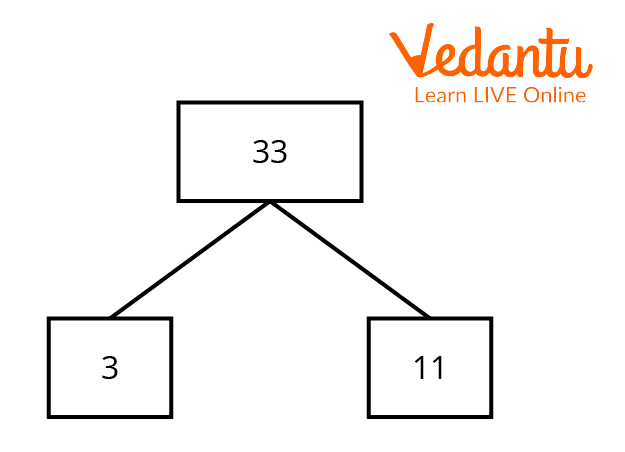
Factor Tree of 33
Factors of 33 in Pairs
Pair factors may be positive or negative, but they cannot be a fraction or a decimal. To get the pair factor of 33, multiply the two numbers in a pair to obtain the original number, which is 33, as follows:
So, the positive pair factors of 33 are \[\left( 1,\text{ }33 \right)\], \[(3,\text{ }11)\], \[\left( 11,\text{ }3 \right)\] and \[\left( 33,\text{ }1 \right)\].
So, the negative pair factors are \[\left( -1,\text{ }-33 \right)\], \[\left( -3,\text{ }-11 \right)\], \[\left( -11,\text{ }-3 \right)\] and \[\left( -33,\text{ }-1 \right)\].
Interesting Facts
33 has a total of 4 factors. The total of all 33 factors equals 48.
Since 33 is an odd number, all of its factors are likewise odd numbers.
Solved Important Questions
1. Find common factors of 33 and 39.
Solution: A factor is an integer that is divided by the original number into equal parts without the remainder. A number that divides each of the provided numbers perfectly is a common factor of two or more numbers.
Hence, factors of 33 and 39 are 1, 3, 11, and 33 and 1, 3, 13, and 39, respectively.
Therefore, the common factors of 33 and 39 are 1 and 3.
2. Find the factors of 44 and 55.
Solution: The factors of 44 are the numbers that divide 44 exactly with no remainder. So,
\[44\div 1=44\]
\[44\div 2=22\]
\[44\div 4=11\]
\[44\div 11=4\]
\[44\div 22=2\]
\[44\div 44=1\]
Therefore, the factors of 44 are 1, 2, 4, 11, 22, and 44.
Similarly, the factors of 55 are 1, 5, 11, and 55.
3. Find the multiples of 33 and the sum of its first 3 multiples.
Ans: A number and a counting number are known as a multiple of the original number. So, the multiples of 33 are 33, 66, 99, 132, 165, 198, 231, …
Sum of its first 3 multiples \[=33+66+99=198\].
Conclusion
The numbers that divide 33 exactly with no remainder are known as the factors of 33. The factors of 33 are 1, 3, 11, and 33. The prime factorization of 33 is 3x11, where 3 and 11 are prime numbers. The positive pair factors of 33 are \[\left( 1,\text{ }33 \right)\], \[(3,\text{ }11)\], \[\left( 11,\text{ }3 \right)\] and \[\left( 33,\text{ }1 \right)\] and the negative pair factors are \[\left( -1,\text{ }-33 \right)\], \[\left( -3,\text{ }-11 \right)\], \[\left( -11,\text{ }-3 \right)\] and \[\left( -33,\text{ }-1 \right)\]
Practice Question
1. How many factors does 150 have?
10
11
12
13
Ans: Option D
2. Which one is correct?
The prime factorisation of 52 is \[4\times 5\times 13\]
The prime factorisation of 150 is \[2\times 3\times 5\times 5\]
The prime factorisation of 37 is \[3\times 13\]
The prime factorisation of 9 is \[2\times 3\]
Ans: Option B
FAQs on Factors of 33 Explained with Examples
1. What are the factors of 33?
The factors of 33 are 1, 3, 11, and 33. These are the numbers that divide 33 exactly without leaving a remainder.
- 33 ÷ 1 = 33
- 33 ÷ 3 = 11
- 33 ÷ 11 = 3
- 33 ÷ 33 = 1
2. How do you find the factors of 33?
You can find the factors of 33 by checking which numbers divide 33 exactly with no remainder.
- Start from 1 and test division.
- 33 ÷ 1 = 33 → factor pair (1, 33)
- 33 ÷ 3 = 11 → factor pair (3, 11)
- 33 ÷ 2, 4, 5, etc., do not divide evenly.
3. Is 33 a prime or composite number?
The number 33 is a composite number because it has more than two factors. A prime number has exactly two factors: 1 and itself.
- Factors of 33: 1, 3, 11, 33
- Total factors: 4
4. What is the prime factorization of 33?
The prime factorization of 33 is 3 × 11. This means 33 can be expressed as the product of its prime factors.
- 33 ÷ 3 = 11
- 11 is a prime number
5. What are the factor pairs of 33?
The factor pairs of 33 are (1, 33) and (3, 11). Factor pairs are two numbers that multiply together to give 33.
- 1 × 33 = 33
- 3 × 11 = 33
6. What are the common factors of 33 and 11?
The common factors of 33 and 11 are 1 and 11. Common factors are numbers that divide both numbers exactly.
- Factors of 33: 1, 3, 11, 33
- Factors of 11: 1, 11
7. What is the greatest common factor (GCF) of 33 and 22?
The greatest common factor (GCF) of 33 and 22 is 11. The GCF is the largest number that divides both numbers exactly.
- Factors of 33: 1, 3, 11, 33
- Factors of 22: 1, 2, 11, 22
8. How many factors does 33 have?
The number 33 has 4 factors. These factors are 1, 3, 11, and 33.
- Prime factorization: 33 = 3 × 11
- Number of factors formula: (1+1)(1+1)
- = 2 × 2 = 4 factors
9. What are the multiples of 33?
The multiples of 33 are numbers obtained by multiplying 33 by whole numbers.
- 33 × 1 = 33
- 33 × 2 = 66
- 33 × 3 = 99
- 33 × 4 = 132
10. What is the difference between factors and multiples of 33?
The difference is that factors of 33 divide 33 exactly, while multiples of 33 are numbers formed by multiplying 33 by whole numbers.
- Factors of 33: 1, 3, 11, 33
- Multiples of 33: 33, 66, 99, 132, ...
