








How to Use the Expansion Method of Multiplication with Steps and Examples
Let's start with an example: suppose you go to the market and buy 62 apples, and 1 apple costs 7 rupees. You have to calculate the rupees spent to buy 62 apples. Here, we can expand the number into two parts $60+2$. Now multiply $60 \times 7=420$ and $2 \times 7=14$, and the total rupees would be 434. So it's quite easy to multiply using the expansion method. In this article, we will learn about the expanded form multiplication and box method of multiplication. We will also solve some practice questions.
What do You Mean by Expanded Form Multiplication?
The expanded form of multiplication is useful for splitting the higher-order digits and representing them in the form of units, 10s, 100s, and 1000s. Expanded forms help you better understand and read the top digits correctly. When solving multiplication problems using expanded form, you give each digit a value based on its position within the number.
Writing Numbers in Expanded Form
A number expansion is the separation of numbers by their place values. This is an intermediate step that helps you understand how to read numbers. The expanded form is useful for knowing the number of digits in each number. Also, there are three different ways to write numbers in expanded form. The number 4537 is expanded in one form as $4537=4000+500+30+7$, in a second form as
$4531=4 \times 1000+5 \times 100+3 \times 10+7 \times$ 1.
And in the third form can be written as
$4537=4 \times \operatorname{thousand}(1000)+5 \times \operatorname{Hundred}(100)+3 \times \operatorname{ten}(10)+7 \times$ one (1).
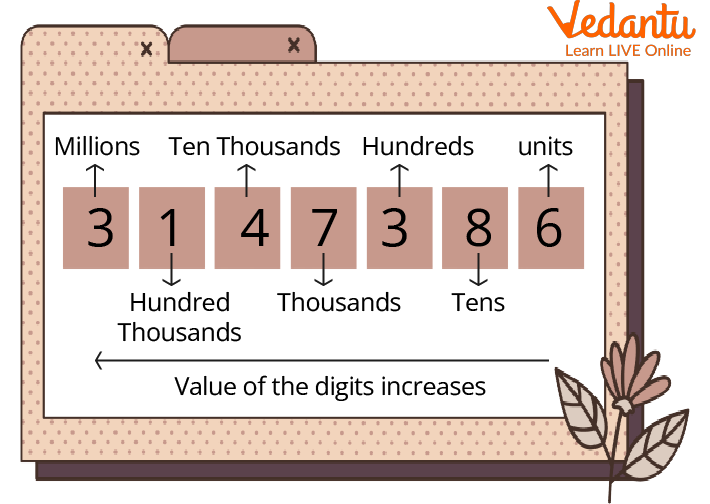
Placing Value in the Place Value Chart
Expansion Method Multiplication
In the Expansion Method of Multiplication, we generally expand the number using expanded form into place value then we multiply the units and add them together.
For example, Multiply by expanding the bigger number, $25 \times 5$
We separate the number into two unit
20 (in Tens place value) and 5 (in one place value)
$20 \times 5=100$
$5 \times 5=25$
$100+25$ (Now add the number)
= 125
Thus the multiplication of 25 and 5 using an expanded form is 125.
Box Method of Multiplication
The box method is another way to multiply two-digit and three-digit numbers. Instead of stacking numbers and remembering placeholders, the box method expands numbers and uses addition. The box method reduces multiplication to the basic ability of addition, without having to remember all the tedious rules that come with traditional multiplication.
Box Method Formula and its Use
To use the box method for multiplication, we need to follow a few steps.
Write both numbers in expanded form
Draw a box based on the number of digits in each number
Multiply each row and column of the box by the corresponding number
Add the numbers in the box to get the final value.
The first step in using the box multiplication method is to write each number in expanded form. Writing numbers in expanded form means writing each number separated by various digits 1, 10, 100, etc. added together.
The image below shows exactly what this box will look like when fully set up. Multiply to fill individual boxes and then take the sum to obtain the corresponding product, i.e. 3440 + 688 = 4128.
Thus, the multiplication of 12 and 344 gives 4128.
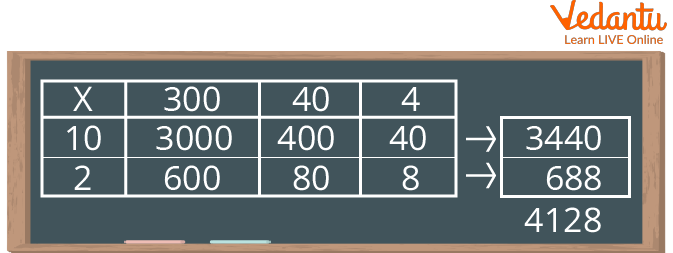
Box Method Calculation
Solved Examples
Q 1. Multiply by expanding the bigger number, $902 \times 7$.
Ans: We separate the number into two units
900 (in Hundred place value), 00 (in tens place value), and 2 (in one place value)
Now, multiplying $900 \times 7=6300$
$00 \times 7=00$
and $2 \times 7=14$
$6300+00+14$ (Now add the number)
= 6314
Thus the multiplication of 902 and 7 using an expanded form is 6314.
Q 2. Multiply by expanding the bigger number using the box method for 34 and 5344.
Ans: Set the box to multiply 34 and 5344. Looking at the two numbers above, we can see that 34 has 2 digits and 5344 has 4 digits. You will need to set up $2 \times 4$ boxes. The image below shows exactly what this box will look like when fully set up. Multiply to fill individual boxes and then take their sum to obtain the multiplication of two numbers, i.e. $160320+21376=181696$
Thus, the multiplication of 34 and 5344 gives 181696.
Practice Questions
A. Using Expansion Method:
Q 1.954 90.
Ans: 85860
Q 2. $769 \times 2$.
Ans: 1524
B. Using Box Method of Multiplication:
Q 1.5054 90.
Ans: 454860
Q 2. $769 \times 20$.
Ans: 15380
Summary
In this article, we have learned about how to use the expanded form multiplication & expansion method to expand the biggest digit and put them into place with values of ones, tens, hundreds, and so on. We learned how to multiply them and take their sum to get the result of multiplication. We also learn about the box method of multiplication. It solves multiplication problems using a box, which is drawn taking into mind the number of digits. Some examples and practice problems are also given for clarity of concepts.
FAQs on Expansion Method of Multiplication Using Place Value
1. What is the expansion method of multiplication?
The expansion method of multiplication is a technique where numbers are broken into place values and multiplied separately before adding the results. It uses the distributive property to simplify multiplication of large numbers.
- Split numbers into tens, hundreds, etc.
- Multiply each part separately.
- Add all partial products.
2. How do you solve multiplication using the expansion method?
To solve multiplication using the expansion method, break both numbers into place values, multiply each pair, and add the results. Follow these steps:
- Step 1: Expand the numbers (e.g., 34 = 30 + 4).
- Step 2: Multiply each part (30×20, 30×6, 4×20, 4×6).
- Step 3: Add all partial products.
3. What is the formula for the expansion method of multiplication?
The formula for the expansion method is based on the distributive property: (a + b)(c + d) = ac + ad + bc + bd. This formula shows that each term in the first bracket multiplies each term in the second bracket. It works for whole numbers, decimals, and algebraic expressions.
4. Can you give an example of the expansion method of multiplication?
Yes, for example, 47 × 32 can be solved using the expansion method by splitting into place values.
- 47 = 40 + 7
- 32 = 30 + 2
- 40×30 = 1200
- 40×2 = 80
- 7×30 = 210
- 7×2 = 14
5. Why is the expansion method useful in multiplication?
The expansion method is useful because it makes large multiplication problems easier by breaking them into smaller, manageable parts. It:
- Improves understanding of place value.
- Uses the distributive property clearly.
- Reduces calculation errors.
- Builds a strong foundation for algebra.
6. What is the difference between the expansion method and long multiplication?
The main difference is that the expansion method shows all place value parts separately, while long multiplication is a compact, shortened format. In expansion method:
- Numbers are fully broken into tens, hundreds, etc.
- All partial products are written clearly.
- Steps are compressed vertically.
- Some place value steps are implied.
7. Can the expansion method be used for decimal multiplication?
Yes, the expansion method can be used for decimals by expanding according to place value. For example, 2.3 × 1.4 = (2 + 0.3)(1 + 0.4). Multiply:
- 2×1 = 2
- 2×0.4 = 0.8
- 0.3×1 = 0.3
- 0.3×0.4 = 0.12
8. Is the expansion method the same as the distributive property?
The expansion method is based on the distributive property of multiplication over addition. The distributive property states that a(b + c) = ab + ac, and the expansion method applies this idea to multi-digit numbers. So, the expansion method is a practical application of the distributive property.
9. What are common mistakes in the expansion method of multiplication?
Common mistakes in the expansion method include missing partial products or incorrect place value multiplication. Typical errors are:
- Forgetting to multiply one pair of terms.
- Adding partial products incorrectly.
- Ignoring place values (e.g., 30×20 written as 60 instead of 600).
10. How does the expansion method help in learning algebra?
The expansion method helps in algebra because it prepares students to expand algebraic expressions like (x + 3)(x + 5). Using the same rule:
- (x + 3)(x + 5) = x² + 5x + 3x + 15
- Combine like terms: x² + 8x + 15
