








What Is The Division Property Of Equality And How To Use It In Equations
Division is a method of distributing evenly and fairly. Similarly, in an equation you need to operate on both sides of the equation fairly. Whatever you operate on the left side of an equation, you must do it on the right side of the equation as well. You cannot divide something from one side without performing anything on the other side.
Suppose, you have two cakes of equal size. And you have 8 guests at the party. You have to divide both the cakes evenly throughout. How will you be able to do this?
To divide both the cakes evenly, you can cut each cake into 4 pieces. If you divide each cake into 4 pieces, you will be left with a total of 8 pieces of cakes. Now you can easily distribute an equal piece of cake among your 8 guests.
In short, cutting both the cakes evenly to get the balance is the division property of equality.
How to Divide an Equation Equally?
The division property of equality states that if you divide both sides of an equation by the same non zero number, the two sides remain equal.
In other words, if a, b, and c are real numbers, such that a = b , and c ≠ 0, then \[\frac{a}{c} = \frac{b}{c} \]
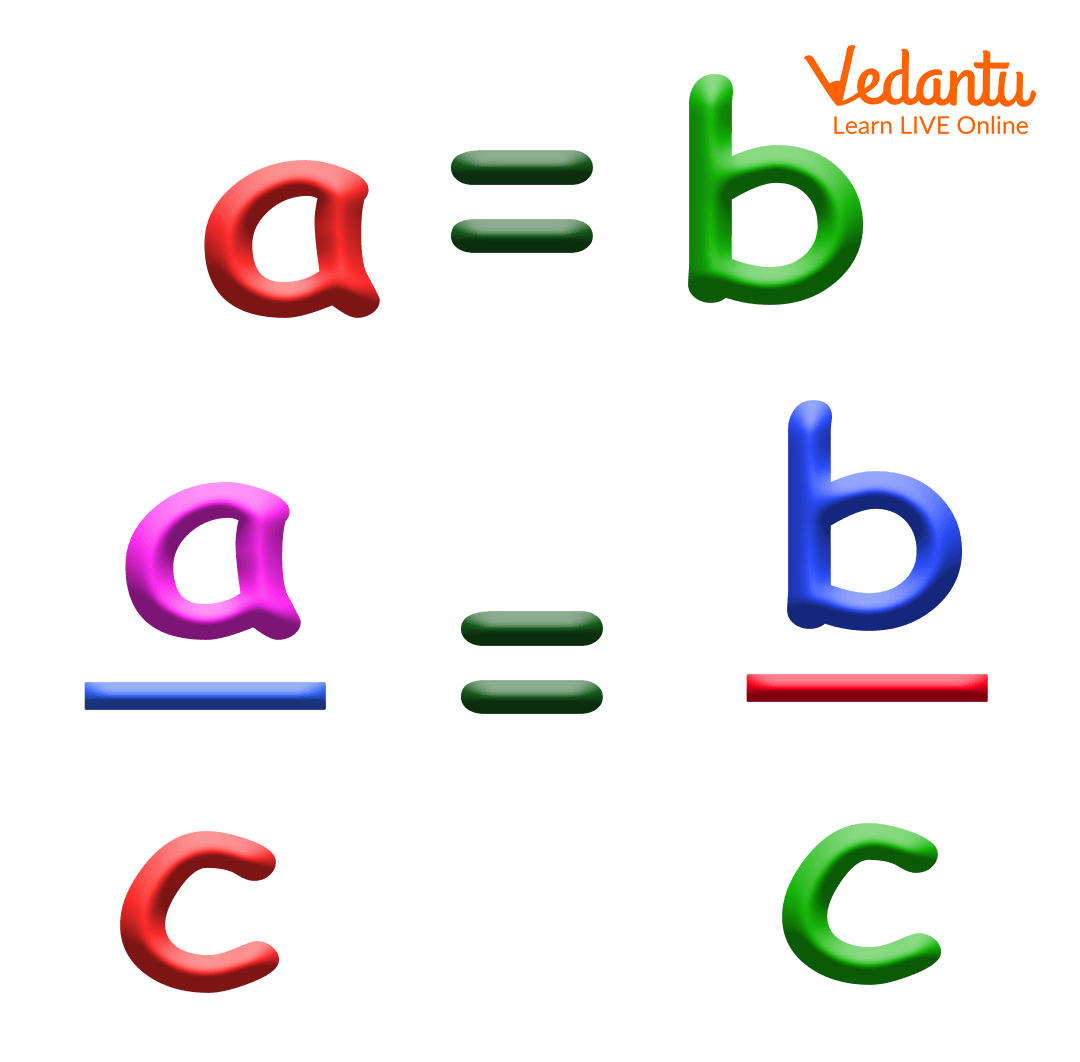
Division Property of Equality
Let us understand with an example:
Consider the equation, 20 = 20
Divide both the sides by 2.
\[\frac{20}{2} = \frac{20}{2} \]
10 = 10
LHS = RHS
The equation remains balanced.
Division Property of Equality Definition
The division property of equality states that dividing both sides of an equation by the same number does not affect the equation.
In other words, it states that if you are given an equation and you divide each side of an equation equally, the equation will always remain balanced and equal. This is termed as division property of equality.
Division Property of Equality Formula
The division property of equality formula states that:
Division Property of Equality Proof
To prove the division property of the equality statement, we will consider the following linear equation.
Consider the equation 5x = 30,
Dividing both sides of the equation by 5:
5x = 30
\[\frac{5x}{5} = \frac{30}{5} \]
x = 6
Therefore, the value of x is 6.
Hence, we applied the division property of equality here to solve for x.
You can verify, if x = 6 is the solution of the given equation by substituting x = 6 in the given equation.
LHS = 5x
= 5 x 6
= 30
RHS = 30
Therefore, LHS = RHS
Hence, we have proved the division property of equality
Division Property of Equality Examples
1. Solve 5x = 40
Solution:
Given Equation: 5x = 40
On dividing 8 from both the side, we get
\[\frac{5x}{8} = \frac{40}{8} \]
\[\frac{5x}{8} \] = 5
5x = 40
x = \[\frac{40}{5} \]
x = 8
To check, we can substitute the value of x in the original equation.
5 x 8 = 40
40 = 40
LHS = RHS
Hence proved
2. Tina brought 100 toffees for ₹ 50. What is the cost of each toffee?
Solution:
Total number of toffees brought by Tina = 100
Cost of 100 toffees = ₹ 50
Let the cost of each toffee be ‘a’. Hence, 100 times ‘a’ is the total cost ₹ 50.
Accordingly, the equation will be
100 a = 50
By dividing both side of the above equation by 10, we get
\[\frac{100}{10} = \frac{50}{10} \]
100 a x 10 = 50 x 10 (Cross multiplication)
1000 a = 500
a = \[\frac{1000}{500} \]
a = 2
To check, we can substitute the value of ‘a’ in the original equation.
500 a = 1000
500 x 2 = 1000
1000 = 1000
LHS = RHS
Hence proved.
In short, the division property of equality states that if we divide both sides of the equation by the same number, the equation remains balanced and equal. Hope you have now understood the division property of equality, now you can easily try questions based on this given on Vedantu’s official website.
FAQs on Division Property Of Equality Explained With Formula And Examples
1. What is the Division Property of Equality?
The Division Property of Equality states that if both sides of an equation are divided by the same nonzero number, the two sides remain equal. In algebra, this property helps isolate variables while solving equations.
- If a = b and c ≠ 0, then a / c = b / c.
- You must never divide by zero.
- This property is commonly used in solving linear equations.
2. How do you use the Division Property of Equality to solve an equation?
To use the Division Property of Equality, divide both sides of the equation by the same nonzero number to isolate the variable. For example:
- Solve: 5x = 20
- Divide both sides by 5
- x = 4
3. Why can't you divide by zero in the Division Property of Equality?
You cannot divide by zero because division by zero is undefined in mathematics. The Division Property of Equality requires dividing both sides by the same nonzero number to maintain equality. Dividing by zero would make the equation meaningless and mathematically invalid.
4. What is an example of the Division Property of Equality?
An example of the Division Property of Equality is solving 8x = 40 by dividing both sides by 8.
- 8x ÷ 8 = 40 ÷ 8
- x = 5
5. What is the formula for the Division Property of Equality?
The formula for the Division Property of Equality is: if a = b and c ≠ 0, then a / c = b / c. This algebraic rule ensures that dividing both sides of an equation by the same nonzero number keeps the equation balanced.
6. Is the Division Property of Equality used only in algebra?
The Division Property of Equality is mainly used in algebra, but it applies to any mathematical equation involving equality. It is especially important in:
- Solving linear equations
- Simplifying algebraic expressions
- Working with formulas in geometry and physics
7. What is the difference between the Division Property of Equality and the Multiplication Property of Equality?
The difference is that the Division Property of Equality divides both sides by the same nonzero number, while the Multiplication Property of Equality multiplies both sides by the same number.
- Division: If a = b, then a / c = b / c, where c ≠ 0.
- Multiplication: If a = b, then ac = bc.
8. Can you use the Division Property of Equality with fractions?
Yes, you can use the Division Property of Equality with fractions as long as you divide by a nonzero number. For example:
- (1/2)x = 6
- Divide both sides by 1/2
- x = 12
9. When should you apply the Division Property of Equality?
You should apply the Division Property of Equality when a variable is multiplied by a number and you need to isolate it. It is commonly used:
- After simplifying both sides of an equation
- When the variable has a coefficient
- In solving one-step or multi-step equations
10. What are common mistakes when using the Division Property of Equality?
Common mistakes include dividing by zero or dividing only one side of the equation. To avoid errors:
- Always divide both sides of the equation.
- Ensure the divisor is not zero.
- Simplify completely after dividing.
