








How to Divide Two Digit Numbers Step by Step with Solved Examples
Division is the process of dividing a group of things into equal parts. There are 4 things to know about while dividing, i.e. dividend, divisor, quotient, and remainder. The two-digit division is a very small calculation and does not involve too many steps.
Dividend is the number that is being divided. Divisor is the number by which the dividend is being divided. Quotient is the result of division. Remainder is the amount that is left after the division. Division is the tool used to separately distribute objects among different people in equal numbers. Let’s see the division of 2-digit numbers in more detail.
Process of Division
The following discusses the process of division in a step-by-step manner.
Let's take the first digits of the dividend which should be equal to the number of digits that the divisor has.
The number that is taken from the dividend is smaller than the divisor, we take the next digit of the dividend.
We begin by dividing the first number of the dividend by the first digit of the divisor.
The result of that division has to be written in the space of the quotient.
The digit of the quotient is multiplied by the divisor, and the result is written below the dividend and subtracted.
But in case the dividend is a smaller number we cannot do so. Therefore, we will need to choose a smaller number in the quotient till the time we can subtract it.
Once we perform the subtraction, use the next digit of the dividend and repeat the process of the division until the point where there are no more remaining numbers present in the dividend.

Three Aspects in a Division
Two-digit Division Questions: Solved Examples
In the below examples, we will solve some problems based on two-digit division questions.
Example 1. Divide 94 by 12.
Ans: The number 12 is multiplied by the number 7 so that it equals 84.
94 - 84 = 10
Quotient = 7
Remainder = 10
Example 2. Divide 96 by 16.
Ans: The number 16 is multiplied by 6, so that equals 96.
Quotient = 6
Remainder = 0
Example 3. Divide 88 by 17
Ans: The number 17 is multiplied by 5, so that equals 85.
Quotient = 5
Remainder = 3
Example 4. Divide 192 by 24
Ans: The number 24 is multiplied by 8, so that equals 192.
Quotient = 8
Remainder = 0
Example 5. Divide 51 by 32
Ans: The number 32 is multiplied by 1, so that equals 32.
Now, 51 - 32 = 19
So, 190 is left which is divided now.
Now, again, 32 is multiplied by 5, so that equals 160.
Now, 190 - 160 = 30
Quotient = 15
Remainder = 30
6. Divide 275 by 24
Ans: The number 24 is multiplied by 1, so that equals 24. Now, 27 - 24 = 3
Therefore, 35 is now the dividend. Now, again, 24 is multiplied by 1, so that equals 24
35-24 = 11
Quotient = 11
Remainder = 11
7. Divide 803 by 70
Ans: The number 70 is multiplied by 1, so that equals 70. Now, 80 - 70 = 10
Therefore, 103 is now the dividend. Now, again 70 is multiplied by 1, so that equals 70.
103 - 70 = 33
Quotient = 11
Remainder = 33
8. Divide 345 by 49
Ans: The number 49 is multiplied by 7 so that equals 343. Now, 345 - 343= 2
Therefore, 2 cannot be divided further as the divisor is much larger than the dividend.
Quotient = 7
Remainder = 2
9. Divide 4963 by 14
Ans: The number 14 is multiplied by 3 so that equals 42. Now, 49 - 42 = 7
Therefore, 763 is now the dividend but we use only 76. Now, again 14 is multiplied by 5 so that equals 70.
76 - 70 = 6
Now, 63 is the dividend and we multiply 14 with 4 so that equals 56
63 - 56 = 7
Quotient = 354
Remainder = 7
Practice Problems
Q1. Divide 300 by 15
Ans: 20
Q2. Divide 155 by 25
Ans: Quotient = 6, Remainder = 5
Q3. Divide 267 by 30
Ans: Quotient = 8, Remainder =27
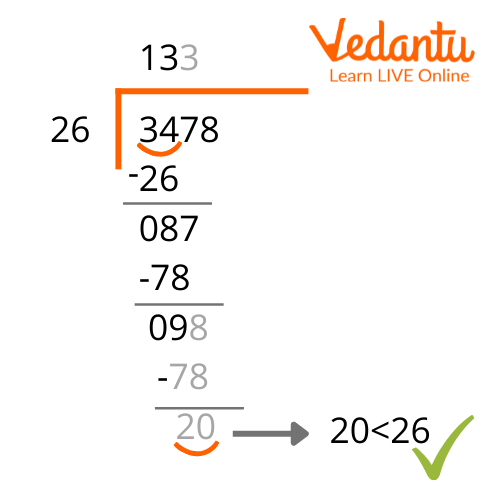
Two-Digit Division in Steps
Summary
Division is an important tool for calculation in Mathematics. The four components of division are divisor, dividend, remainder, and quotient. This process of division involves subtraction as well, and it allows us to complete the division by using up all the values of the dividend. Some sums of two digit division questions are discussed in detail and then in practice problems sums are given for practising. We hope now you will no longer struggle with division and enjoy Maths even more.
FAQs on Division of Two Digit Numbers Made Easy
1. What is division of two digit numbers?
Division of two digit numbers is the process of splitting a number into equal parts when either the divisor or the dividend (or both) has two digits. It tells us how many times one number fits into another.
- Dividend: the number being divided
- Divisor: the number you divide by
- Quotient: the answer
- Remainder: the amount left over (if any)
2. How do you divide by a two digit number step by step?
To divide by a two digit number, use the long division method step by step: divide, multiply, subtract, and bring down.
- Step 1: Divide the first digits of the dividend by the divisor.
- Step 2: Multiply the divisor by the quotient digit.
- Step 3: Subtract the result.
- Step 4: Bring down the next digit and repeat.
- 12 goes into 96 exactly 8 times.
- 12 × 8 = 96
- 96 − 96 = 0
3. How do you divide a three digit number by a two digit number?
To divide a three digit number by a two digit number, apply the long division method carefully digit by digit. Example: 156 ÷ 12.
- 12 goes into 15 → 1 time.
- 1 × 12 = 12; 15 − 12 = 3.
- Bring down 6 → 36.
- 12 goes into 36 → 3 times.
- 3 × 12 = 36; remainder 0.
4. What is the formula for division?
The basic formula for division is Dividend = Divisor × Quotient + Remainder. This is called the division algorithm.
- If there is no remainder, then Dividend = Divisor × Quotient.
- If there is a remainder, it must be smaller than the divisor.
5. Can you give an example of division of two digit numbers with remainder?
An example of division of two digit numbers with a remainder is 85 ÷ 12 = 7 remainder 1.
- 12 × 7 = 84
- 85 − 84 = 1
6. Why is long division used for two digit divisors?
Long division is used for two digit divisors because mental math becomes difficult when numbers are larger. The long division method breaks the calculation into small, manageable steps.
- It ensures accuracy.
- It helps track remainders.
- It works for large numbers.
7. What are common mistakes when dividing by two digit numbers?
Common mistakes when dividing by two digit numbers include incorrect estimation and subtraction errors.
- Choosing a quotient digit that is too large.
- Forgetting to multiply correctly.
- Making subtraction mistakes.
- Ignoring the remainder.
8. How do you check your answer in two digit division?
You can check your answer by using the formula Divisor × Quotient + Remainder to see if it equals the dividend.
- Example: 144 ÷ 12 = 12
- Check: 12 × 12 = 144
9. What is the difference between single digit and two digit division?
The main difference is that two digit division requires estimation and the long division process, while single digit division is usually simpler and can often be done mentally.
- Single digit divisor: e.g., 84 ÷ 4
- Two digit divisor: e.g., 84 ÷ 12
10. How do you divide two digit numbers using partial quotients?
The partial quotients method divides by subtracting large multiples of the divisor step by step.
- Example: 156 ÷ 12
- 12 × 10 = 120 → 156 − 120 = 36
- 12 × 3 = 36 → 36 − 36 = 0
