








Printable Division Facts Worksheets with Answers and Practice Problems
You must have heard your mathematics teacher talk about division. But do you know what division facts are? As we all know, the division is one of the four basic pillars of math. In very simple words, division can be defined as a process that helps in sharing a collection of items or numbers into equal parts and finding out how many equal parts can be made. In this article, we will learn what division facts are with the help of division facts worksheets. Here we will also solve the long division practice worksheet to get hold of the concepts.
Division Facts
Division Facts
Multiplication tables are one of the most important concepts as far as basic mathematics is concerned. Right from the first grade and above, children have multiplication tables to learn from their mathematics textbooks. If one knows multiplication tables, it will be easier to understand the division facts.
Division facts are division number sentences related to the knowledge of multiplication tables.
For example, 40 4 = 10, 20 4 = 5, and 8 4 = 2 are all division facts of the four. Let us understand more about the division facts with the help of a long division practice worksheet.
Long Division (Worksheet)
Mathematically, long division is a method of dividing large numbers into smaller parts or groups. It helps to break a problem into small and simple steps. Dividends, divisors, quotients, and remainders are important parts of long division. In a problem relating to long division, the dividend is the large number divided by another number called the divisor. The quotient is the result of the division, and the excess quantity or number which cannot be divided is known as the remainder.
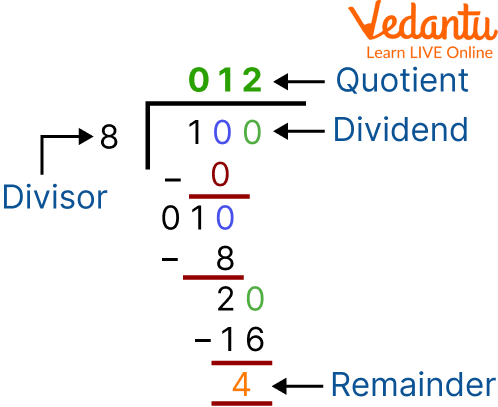
An Example From Math Division Worksheets
2-Digit Division
The division is a tool that is used to distribute objects or numbers among different people in equal parts. Let's go through the division of 2-digit numbers in detail, along with 2-digit division worksheets. Here is the process of 2-digit division in a step-by-step manner:
Let’s take the first digit of the dividend, which should be equal to the number of digits the divisor carries.
The number borrowed from the dividend is smaller than the divisor, and then we take the next digit of the dividend.
The result of that division has to be written in the space of quotients.
The digit of the quotient is multiplied by the divisor, and the result is written below the dividend and subtracted.
In case the dividend is a smaller number, we cannot do so. Therefore, we need to choose a smaller number in the quotient until we can subtract it.
Once we perform the subtraction, use the next digit of the dividend and repeat the division process until there are no more remaining numbers present in the dividend.
Solved Examples
Q 1. Divide 50 by 15.
Ans. The number 15 is multiplied by the number 3 so that it is equal to 45.
50 - 45 = 5
Quotient = 3
Remainder = 5
Thus, the quotient and the remainder of the division of 50 and 15 are 3 and 5, respectively.
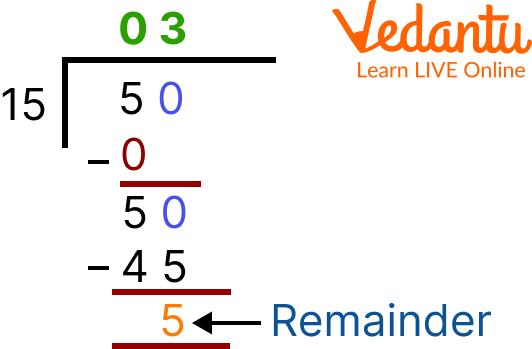
Divide 50 by 15
Q 1. Divide 70 by 13.
Ans. The number 13 is multiplied by the number 5 to equal to 65.
70 - 65 = 5
Quotient = 5
Remainder = 5
Thus, the quotient and the remainder of the division of 70 and 13 are 5 and 5, respectively.
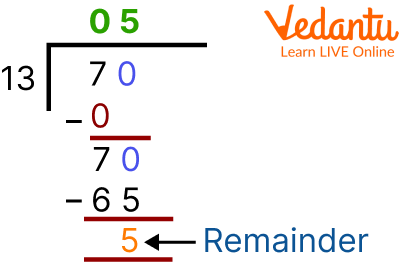
2-digit Division
Practice Questions
Q 1. 56 8 =?
Ans: 7
Q 2. 44 4 =?
Ans: 11
Q 3. 70 7 =?
Ans: 10
2-Digit Division Worksheets

Long Division Practice Worksheet
Long Division Worksheets

Long Division Practice Worksheet
Summary
In this article, we learned and discussed division facts along with long division worksheets, 2-digit division worksheets, and other math division worksheets. We have also referred to some solved examples to understand the concept of the topics in a very convenient manner. Along with that, we tried to explain what division facts are and how they are practised. We have learned to solve long divisions and also the 2-digit divisions. We hope now the children have understood all the concepts and they enjoy solving the math division worksheets even more.
FAQs on Division Facts Worksheets for Building Strong Division Skills
1. What are division facts worksheets?
Division facts worksheets are practice sheets designed to help students memorize and apply basic division facts, usually within 0–12. These worksheets typically include:
- Single-digit division problems (e.g., 24 ÷ 6)
- Fact family exercises
- Missing number problems
- Timed drills for fluency
2. What are basic division facts?
Basic division facts are division problems involving numbers from 0 to 12 that students are expected to recall quickly. For example:
- 12 ÷ 3 = 4
- 25 ÷ 5 = 5
- 36 ÷ 6 = 6
3. How do you solve a basic division fact?
To solve a basic division fact, use your knowledge of multiplication to find the missing factor. Follow these steps:
- Step 1: Identify the division problem (e.g., 20 ÷ 4).
- Step 2: Ask, “4 × what number equals 20?”
- Step 3: Since 4 × 5 = 20, the answer is 20 ÷ 4 = 5.
4. Why are division facts important?
Division facts are important because they build the foundation for long division, fractions, ratios, and algebra. When students know their division tables fluently, they can:
- Solve multi-digit division faster
- Simplify fractions easily
- Work confidently with word problems
- Improve overall math fluency
5. What is the relationship between multiplication and division facts?
Multiplication and division facts are inverse operations, meaning one undoes the other. For example:
- If 6 × 8 = 48, then
- 48 ÷ 6 = 8
- 48 ÷ 8 = 6
6. What are division fact families?
Division fact families are sets of related multiplication and division equations using the same three numbers. For example, with 3, 7, and 21:
- 3 × 7 = 21
- 7 × 3 = 21
- 21 ÷ 3 = 7
- 21 ÷ 7 = 3
7. How can I help my child memorize division facts?
You can help your child memorize division facts by combining repetition, multiplication review, and timed practice. Effective strategies include:
- Practicing multiplication tables first
- Using daily division facts worksheets
- Playing math fact games
- Doing short timed drills (e.g., 2–5 minutes)
8. At what grade do students learn division facts?
Students typically learn division facts in Grade 3 or Grade 4, after mastering multiplication tables. In most math curricula:
- Grade 2: Introduction to equal groups
- Grade 3: Basic division facts (within 100)
- Grade 4: Multi-digit division
9. What is an example of a division facts worksheet problem?
An example of a division facts worksheet problem is 42 ÷ 7 = ?, where the correct answer is 6. To solve it:
- Think: 7 × what number equals 42?
- Since 7 × 6 = 42,
- The answer is 42 ÷ 7 = 6.
10. What are common mistakes when learning division facts?
Common mistakes when learning division facts include confusing multiplication facts and miscounting equal groups. Students often:
- Reverse numbers incorrectly (e.g., mixing up 24 ÷ 6 and 6 ÷ 24)
- Forget related multiplication facts
- Rush during timed drills and lose accuracy
