








What is the Division Algorithm Formula with Proof and Solved Examples
The division algorithm formula is a systematic way of verifying the long division of two numbers or two polynomials. The division formula is a less tedious way of verifying the long division method. Let us learn more about the division algorithm.
What is the Division algorithm?
Before we dive into using the division algorithm with polynomials we first need to understand what a division algorithm is. Euclid gave the division algorithm. You must be familiar with dividing two numbers. [say] \[{\rm{dividend}} = {\rm{divisor}} \times {\rm{quotient}} + {\rm{remainder}}\] This is Euclid's division algorithm. The dividend is the number being divided, the divisor is the number that divides the dividend, and the quotient is the quantity when multiplied by the divisor giving the closest multiple less than the dividend. The remainder is the residue left at the end of the division process. We note that the remainder is always less than the quotient and divisor.

Division algorithm
Division Algorithm Formula for Numbers
The division algorithm formula in numbers states that when a positive number a is divided by another positive number b, we get a unique quotient q and a unique remainder r. Here we say that q and r are positive integers and r is greater than or equal to 0 and less than b.
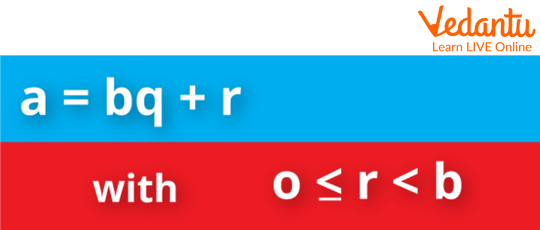
Division Algorithm in Numbers
Properties of Division Algorithm
A positive number can only be divided by a smaller number.
If the divisor is not a factor of the dividend, then a non-zero remainder will be left behind.
There is a unique pair of quotients and remainder.
Steps to do Division of Two Numbers
Always remember that the divisor is always smaller than the dividend
First, notice the first digit from the left of the dividend. if the divisor is less than the first digit then take the 2nd digit as well, and put a 0 in the quotient as many times as you find the dividend less than the divisor and keep repeating this process till you get the dividend greater than or equal to the divisor.
now write the largest multiple of the divisor that is less than the dividend and write the quotient.
Subtract the multiple from the dividend and write down the next digit of the original dividend.
Repeat steps 2, 3, and 4. Till you get a remainder smaller than the divisor.
Solved Examples
1. Divide the numbers 6 and 250.
Ans. Here the divisor is 6 and the dividend is 250.
Step1. First, we see that 6 cannot divide 2 so we write 0 and include the 5 in our dividend.
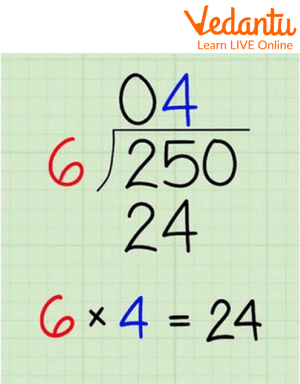
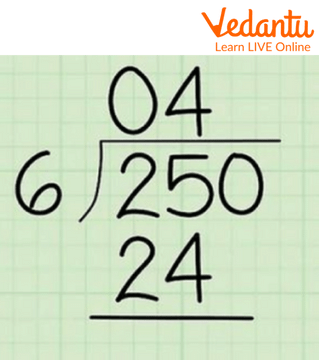
Division Algorithm example
Step2. Now we see that 25 is greater than 6 so we start the division process. We will write the largest multiple of 6 which is less than 25. We have 6 x 4 = 24. So 4 will be our quotient and 24 will now be subtracted from the dividend.
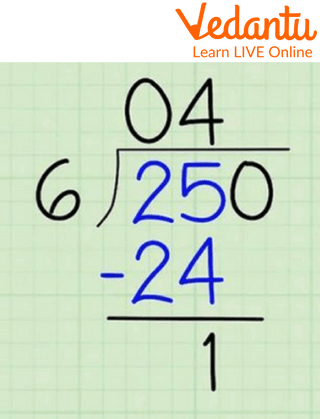
Division Algorithm example
Step3. This gives 1 as the remainder. Now we use the 0 left in the dividend. Now our new dividend is 10.
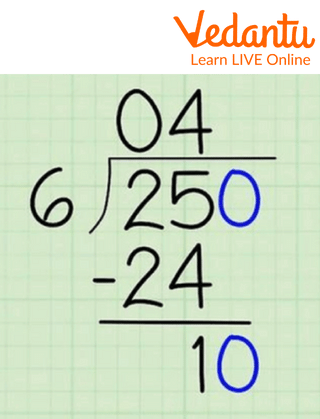
Division Algorithm example
Step4. Now we can see 6 x 1 = 6. So 1 will be our quotient and we will have a remainder of 10 - 6 = 4. As we can see 4 is less than 6, and we are finished with the problem. Hence, our quotient is 41 and the remainder is 4 and the division algorithm formula will be, 250 = ( 6 x 41 ) + 4.
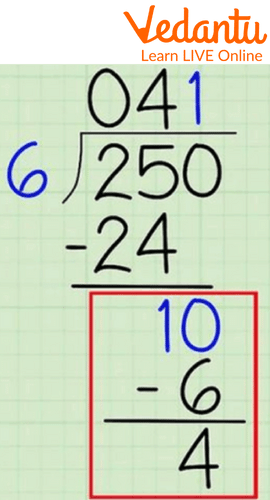
Division Algorithm example
2. Divide 813 by 9 and verify the result by the division algorithm.
Ans. We have a divisor as 9 and dividend as 813.
We first start with 9 and 8, we see that 8 is less than 9 so we use 1 as well. Now we see that 9 x 9 = 81. so 9 will be our quotient and we write down 81 under 81 and subtract it. We get 0 as the remainder now we use 3 from the original dividend. Now we see that 3 is less than 9 so we add 0 at the end of the quotient, so our quotient is 90, and we have a remainder of 3. Now we need to verify this, we have
813 = ( 9 x 90 ) + 3 from the division algorithm formula
813 = 810 + 3
813 = 813
Hence, verified.
Conclusion
A division algorithm is an essential tool for verifying and proving important facts in mathematics. We have learned how to use the division algorithm formula. We have learned some of its important properties and solved several examples.
FAQs on Division Algorithm Formula in Number System
1. What is the Division Algorithm formula?
The Division Algorithm formula states that for any integers a and b (where b ≠ 0), there exist unique integers q and r such that a = bq + r with 0 ≤ r < |b|.
- a = dividend
- b = divisor
- q = quotient
- r = remainder
2. What does the Division Algorithm state?
The Division Algorithm states that for any integer a and any non-zero integer b, there exist unique integers q and r such that a = bq + r and 0 ≤ r < |b|. This means every division of integers produces a unique quotient and remainder satisfying this condition.
3. How do you use the Division Algorithm formula?
To use the Division Algorithm formula, write the dividend in the form a = bq + r where 0 ≤ r < |b|.
- Step 1: Divide a by b.
- Step 2: Identify the quotient q.
- Step 3: Find the remainder r.
4. Can you give an example of the Division Algorithm?
Yes, an example of the Division Algorithm is: 23 = 4 × 5 + 3.
- Dividend (a) = 23
- Divisor (b) = 4
- Quotient (q) = 5
- Remainder (r) = 3
5. Why is the remainder always less than the divisor in the Division Algorithm?
The remainder is always less than the divisor because the Division Algorithm requires 0 ≤ r < |b| to ensure uniqueness of quotient and remainder. If r were equal to or greater than b, we could increase the quotient by 1 and reduce the remainder, which would violate the uniqueness condition.
6. What is the difference between division and the Division Algorithm?
The difference is that ordinary division gives a numerical result, while the Division Algorithm expresses division in the form a = bq + r with integer quotient and remainder.
- Division may produce decimals.
- Division Algorithm works strictly with integers.
- It guarantees a unique quotient and remainder.
7. Does the Division Algorithm work for negative numbers?
Yes, the Division Algorithm works for negative integers as long as the remainder satisfies 0 ≤ r < |b|. Example: For a = −17 and b = 5, we write −17 = 5(−4) + 3, where q = −4 and r = 3.
8. Is the quotient and remainder unique in the Division Algorithm?
Yes, the quotient and remainder are unique for given integers a and b (b ≠ 0). The condition 0 ≤ r < |b| ensures that only one pair (q, r) satisfies the equation a = bq + r.
9. How is the Division Algorithm used to find HCF or GCD?
The Division Algorithm is used in the Euclidean Algorithm to find the HCF (GCD) of two numbers by repeated division.
- Step 1: Divide the larger number by the smaller number.
- Step 2: Replace the larger number with the divisor and the smaller number with the remainder.
- Step 3: Repeat until the remainder is 0.
10. What are the key conditions of the Division Algorithm?
The key conditions of the Division Algorithm are given by a = bq + r with 0 ≤ r < |b| and b ≠ 0.
- a, b, q, and r are integers.
- b cannot be zero.
- The remainder must be non-negative and less than |b|.
- The quotient and remainder are unique.
