








How To Use The Divisibility Rule Of 7 With Solved Examples
Have you ever heard of the "7" or the "divisibility rule of seven" that many people use today? We will discuss the meaning of the divisibility rule of seven and how it applies to coins and money in this blog post.
Let's begin with the rule of seven's divisibility: Because it divides, the number 7 (7), is referred to as a divisor. When something can be divided into two or more equal parts, it is said to be divisible.

Simple Explanation for Divisibility Rule of 7
If one wants to know what a number is divisible by, all one will have to do is divide the individual digits of the number by 7. If any of the digits divide evenly by 7, then the original number is divisible by 7.
What is the Divisibility Test of 7
Well, first you need to know that there are 7 days in a week, 7 days in a fortnight, and so on. There are 7 colours of the rainbow. A rainbow has 3 primary colours: Red, orange, and yellow.
As a result, there are always seven numbers that may be used to solve any division problem. For example, the number 8 is 1+1+1+1+1+1+1+1, which always divides into the even number 2 as 1+1(2) and the even number 4 as 1+1+1+1(4).
Where is the Divisibility Rule of 7 used?
The Rule is used in a variety of situations. For example, it can be used when trying to figure out if a number is divisible by 7.
To see how this divisibility test of 7 works, let's look at the numbers 1 to 10. Any integer that is different from the others when divided by seven will have a remainder of 0 or one. Each of these numbers can therefore be divided by 7 without leaving a leftover.
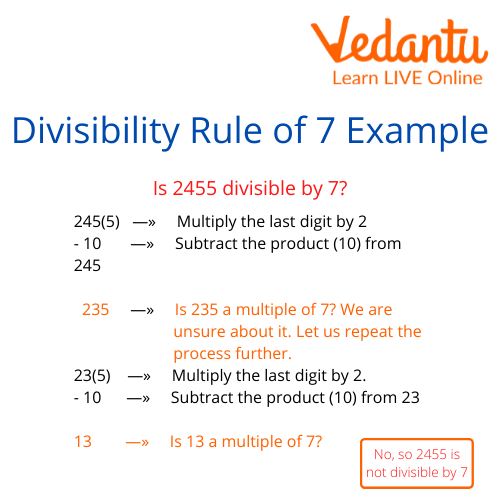
Where Divisibility Rule of 7 used
Which Numbers are Divisible by 7?
7 x 2 = 14 and 14 / 7 = 2.
In the given example, the number divisible by 7 is 14. In this case, the number 14 is divisible by 7 by dividing both digits into 4. (without reducing it to a single digit).
As you can see above the divisibility rule of 7 for example, at each place value of the number (1,2,3, and 4) either of them will divide into a common factor or both of them will separate into an even multiple. This means that all numbers between 1 to 10 are the numbers divisible by 7.
The divisibility rule of 7 is also used in a lot of games over the internet. As we all know that online games, including online casino games, all follow a specific set of rules, which means that no matter what game or slot machine game or table game it is, it will always follow the same rules and it will be fair to everyone. The same goes for cryptologic casino games.
In our opinion, it is one of the ways to learn Maths quickly, because you can use this rule over and over again. At first, you do not understand what it truly means, but as you keep applying it in real-life situations and play games, you begin to grasp the meaning of how many even numbers there are in a set of numbers. After knowing how to check divisibility by 7 this stuff for sure helps to raise your IQ scores!
Solved Examples
Example 1. Is 154 divisible by 7?
Ans: The last digit in the given number 15 4 (unit digit ) is 4.
We now use the given number without the last digit which is 15.
Subtract twice the last digit 4 from 15:
15 - 2 (4) = 15 - 8 = 7
The result 7 is a multiple of 7 and therefore 154 is divisible by 7.
Checking using long division: 154 ÷ 7 = 22 with remainder 0.
Example 2. Consider the number; 308. check if it is divisible by 7.
Ans: Following the rule:
Double of the last digit =16
Subtracting the result from the rest of the number; 30-16 =14
14 is a multiple of 7, hence the number is divisible by 7.
Practice Questions
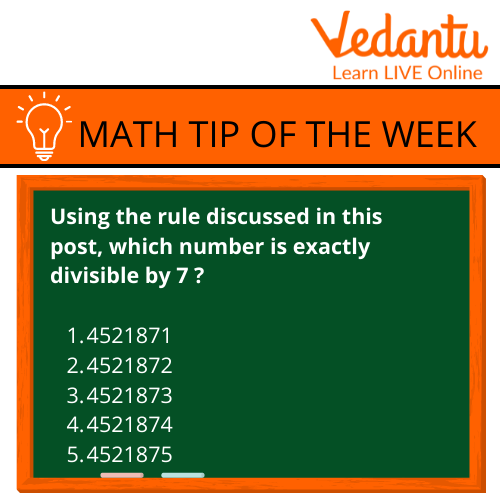
Sums to Practice
Ans: Only (4) 4521874 is divisible by 7
Summary
We learned how to check divisibility by 7 as well as the divisibility rule of 7 is a fundamental rule that all numbers can be divided by 7 without having any remainder after the division and this is because whenever we divide a number by 7, the resulting number is always even.

Divisibility Rule of 7
FAQs on Divisibility Rule Of 7 Step By Step Guide
1. What is the divisibility rule of 7?
The divisibility rule of 7 states that a number is divisible by 7 if twice the last digit subtracted from the remaining number results in a multiple of 7 (including 0).
Steps to apply the rule:
- Take the last digit of the number.
- Multiply it by 2.
- Subtract this value from the remaining truncated number.
- If the result is divisible by 7, then the original number is divisible by 7.
2. How do you check if a number is divisible by 7?
You can check if a number is divisible by 7 by repeatedly subtracting twice the last digit from the remaining number and seeing if the result is a multiple of 7.
Example with 203:
- Last digit = 3
- Double it: 3 × 2 = 6
- Remaining number = 20
- 20 − 6 = 14
3. Can you give an example of the divisibility rule of 7?
Yes, for example, the number 672 can be tested using the divisibility rule of 7.
Steps:
- Last digit = 2
- Double it: 2 × 2 = 4
- Remaining number = 67
- 67 − 4 = 63
4. Why does the divisibility rule of 7 work?
The divisibility rule of 7 works because it is based on the properties of modular arithmetic and place value in base 10.
In base 10:
- 10 ≡ 3 (mod 7)
- This relationship allows transforming a number by subtracting twice its last digit without changing its divisibility by 7.
5. Is there a shortcut trick for divisibility by 7?
Yes, the main shortcut trick for divisibility by 7 is the “double the last digit and subtract” method.
Quick trick summary:
- Double the last digit.
- Subtract it from the rest of the number.
- Repeat if needed.
6. How do you check divisibility of large numbers by 7?
To check large numbers for divisibility by 7, repeatedly apply the divisibility rule until the number becomes small and manageable.
Example with 5278:
- Last digit = 8 → 8 × 2 = 16
- 527 − 16 = 511
- Last digit = 1 → 1 × 2 = 2
- 51 − 2 = 49
7. What are the common mistakes when using the divisibility rule of 7?
Common mistakes in the divisibility rule of 7 usually involve calculation errors in doubling or subtraction.
Typical errors include:
- Forgetting to multiply the last digit by 2.
- Adding instead of subtracting.
- Stopping too early before reaching a clear multiple of 7.
- Miscalculating subtraction.
8. Does the divisibility rule of 7 work for negative numbers?
Yes, the divisibility rule of 7 works for negative numbers because divisibility depends on absolute value.
If a number like −203 is given:
- Check divisibility of 203 using the rule.
- Since 203 is divisible by 7, −203 is also divisible by 7.
9. Is there a formula for divisibility by 7?
There is no simple single formula, but the process can be written mathematically as: if a number is 10a + b, then check a − 2b.
Where:
- a = number without the last digit
- b = last digit
10. How is the divisibility rule of 7 different from other divisibility rules?
The divisibility rule of 7 is different because it requires repeated subtraction steps, unlike simpler rules for 2, 5, or 10.
Comparison:
- Divisibility by 2: check if last digit is even.
- Divisibility by 5: last digit is 0 or 5.
- Divisibility by 9: sum of digits is a multiple of 9.
- Divisibility by 7: double last digit and subtract repeatedly.
