








How to Divide Multi Digit Numbers Step by Step with Examples
Do you ever realise the importance of dividing a number in everyday life? If so, then you might be wondering about what the division is. Division is the basic arithmetic operation used in maths to divide a group of things into equal parts. There are 4 parts to know about when using the concept of division, i.e. dividend, divisor, quotient, and remainder. Let’s see more about the division and 2-digit division worksheets, along with 4-digit by 2-digit division worksheets, in the article given below.
Explain the Division of Two Numbers
Division is the tool used to distribute objects equally among different groups of people. The dividend is the number being divided; the divisor is the number by which the dividend is being divided; the quotient is the result of division, and the remainder is the amount left after the division.
Steps of Division
The following steps discuss the process of division:
Step 1: Take the first digit of the dividend from the left. Check if this digit is greater than or equal to the divisor.
Step 2: Divide it by the divisor and write the answer on top as the quotient.
Step 3: Subtract the result from the digit and write the difference below.
Step 4: Bring down the next digit of the dividend (if present).
Step 5: Repeat the same process.
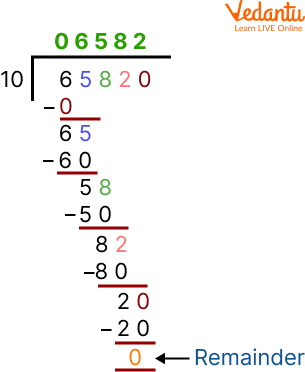
Division
Solved Examples of Dividing by 2-Digit Numbers Worksheet
In the following module, we will solve some examples based on the dividing by 2-digit number worksheet:
Q 1. Divide 94 by 12.
Ans: Given the dividend is 94, and the divisor is 12
We need to calculate the quotient and remainder. For that, one should divide the number 94 by 12.
Select the least number in the multiple of 12, which is near 94 or nearly equal to it.
Here, the number 12 is multiplied by the number 7 to equal to 84, and note the difference between 94 and 84, which is equal to 10 with a quotient of 7.
Thus, the quotient and remainder of a given division problem are 7 and 10, respectively.
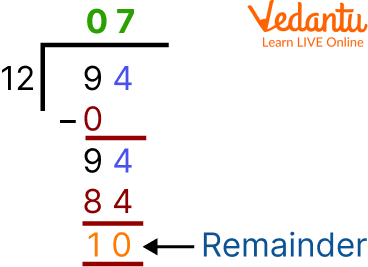
Division of 94 by 12
Q 2. Divide 514 by 32.
Ans: Given the dividend is 514, and the divisor is 32
The number 32 is first multiplied by 1 so that it equals 32. Then, subtract 32 from the dividend; 51 - 32 = 19.
Now, the new dividend is 194. The number 32 is then multiplied by 6 to obtain 192. Take the difference between 194 and 192, i.e. 194 - 192 = 2.
The difference, 2, is less than the divisor, hence called the remainder.
Thus, the quotient and remainder of a given division problem are 16 and 2, respectively.
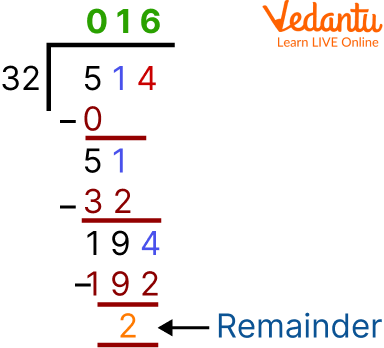
Division of 514 by 32
Q 3. Divide 4963 by 14.
Ans: Given the dividend is 4963, and the divisor is 14
The number 14 is first multiplied by 3 so that it equals 42. Now, take the difference between 49 and 42, i.e. 49 - 42 = 7.
Consider the use of 76. Again, 14 is multiplied by 5 so that it equals 70. Then take the difference between 76 and 70, which equals 6.
63 becomes the dividend, so we multiply 14 by 4 to equal 56. Taking the difference between 63 and 56, we get 7, which is less than the divisor, hence called the remainder.
Thus, the quotient and remainder of the given division problem are 354 and 7, respectively.
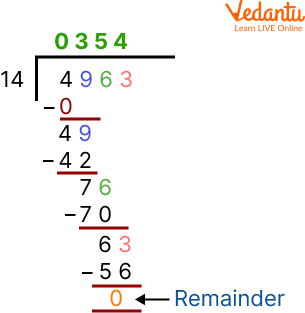
Division of 4963 by 14
2-Digit Division Worksheets
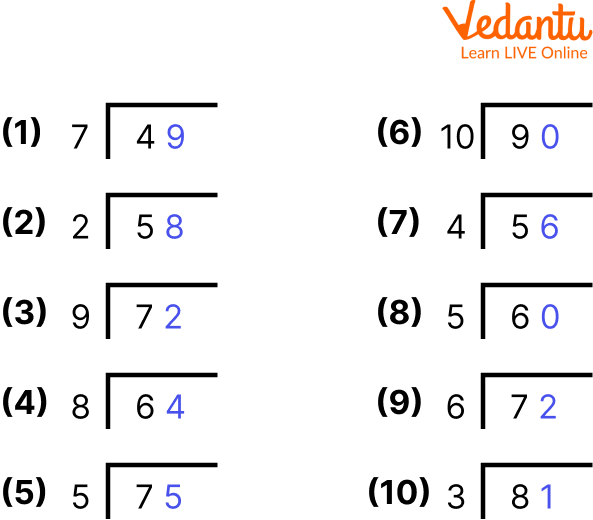
2-Digit Division Worksheets
4-Digit By 2-Digit Division Worksheets
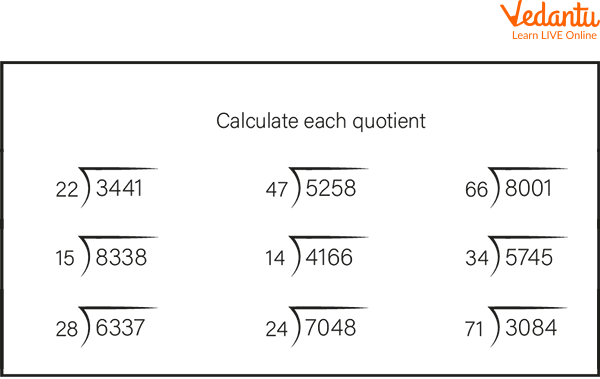
4-Digit By 2-Digit Division Worksheets
Long Division Problems for Practice
Q 1. Divide 200 by 50.
Ans: 4
Q 2. Find the quotient and remainder when 1550 is divided by 25.
Ans: Quotient = 62, Remainder = 0
Q 3. Compute the remainder when 257 is divided by 15.
Ans: Remainder = 2
Summary
To sum up here with the topic of dividing multi-digit numbers worksheets. Division is an important tool for performing calculations in mathematics. The four parts of a division expression are divisor, dividend, remainder, and quotient. This module covers the division of two numbers and the steps for dividing, along with some solved examples of dividing by 2-digit numbers worksheets and long division problems for practice. Hoping now you will no longer face any difficulty in solving the division problems.
FAQs on Dividing Multi Digit Numbers with Long Division Method
1. What does it mean to divide multi digit numbers?
Dividing multi digit numbers means splitting a large number (dividend) into equal parts using another number (divisor) to find the quotient and sometimes a remainder. In division:
- Dividend = number being divided
- Divisor = number you divide by
- Quotient = result of division
- Remainder = amount left over (if any)
2. How do you divide multi digit numbers step by step?
To divide multi digit numbers, use the long division method with divide, multiply, subtract, and bring down steps.
- Step 1: Divide the first digits of the dividend by the divisor.
- Step 2: Multiply the divisor by the quotient digit.
- Step 3: Subtract the result from the current number.
- Step 4: Bring down the next digit and repeat.
3. How do you divide a 3 digit number by a 2 digit number?
To divide a 3 digit number by a 2 digit number, apply the long division method carefully digit by digit.
- Example: 432 ÷ 12
- 12 goes into 43 → 3 times (3 × 12 = 36)
- Subtract: 43 − 36 = 7
- Bring down 2 → 72
- 12 goes into 72 → 6 times
4. What is the long division method?
The long division method is a step by step process used to divide large numbers by breaking the problem into smaller parts. It follows four main actions:
- Divide
- Multiply
- Subtract
- Bring down
5. What is the formula for division?
The basic division formula is Dividend ÷ Divisor = Quotient. It can also be written as:
- Dividend = Divisor × Quotient + Remainder
6. How do you divide multi digit numbers with remainders?
To divide multi digit numbers with remainders, stop when the divisor no longer fits and write the leftover as the remainder.
- Example: 125 ÷ 4
- 4 goes into 12 → 3 times (12)
- Subtract → 0, bring down 5
- 4 goes into 5 → 1 time
- Remainder = 1
7. Can you divide multi digit numbers with decimals?
Yes, you can divide multi digit numbers with decimals by placing the decimal point correctly in the quotient. If the dividend has a decimal, bring it straight up into the answer.
- Example: 45.6 ÷ 3
- 456 ÷ 3 = 152
- Place decimal → 15.2
8. What are common mistakes when dividing multi digit numbers?
Common mistakes in dividing multi digit numbers usually happen during subtraction or place value alignment.
- Forgetting to bring down the next digit
- Incorrect multiplication of the divisor
- Misplacing the decimal point
- Ignoring the remainder
9. How can you check your answer in long division?
You can check long division by multiplying the quotient by the divisor and adding the remainder. Use the formula:
- Divisor × Quotient + Remainder
10. What is an example of dividing large multi digit numbers?
An example of dividing large multi digit numbers is 2,484 ÷ 12 using long division.
- 12 goes into 24 → 2 times
- Subtract → 0, bring down 8
- 12 goes into 8 → 0 times, bring down 4
- 12 goes into 84 → 7 times
