








How to Decompose Fractions with Step by Step Method and Examples
You must be familiar with the concept of fractions; in this section, we will learn how fractions are split up or divided into smaller fractions forming decomposed fractions.
We will be learning the methods of decomposing fractions and mixed fractions. This study is done with the help of several examples so that the students understand the concept of decomposing fractions in an effective manner.
What Is Meant by Decomposing Fractions?
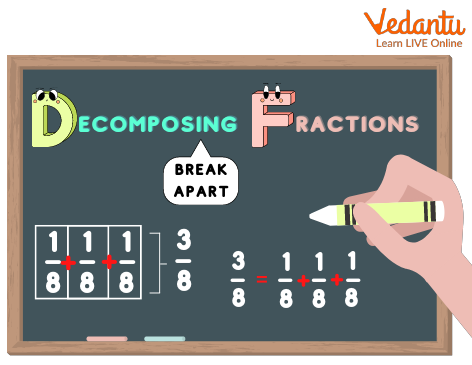
Decomposition of fractions
In real terms, the meaning of decompose means ‘splitting up’ or ‘dividing the fractions into smaller parts or chunks. When we decompose a fraction, we divide it into smaller fractions. It is to be noted that the decomposed fractions or the smaller fractions add up to form the initial fraction.
How Can You Decompose Fractions?
We can decompose fractions by breaking them into unit fractions.
What Are Unit Fractions?
Unit fractions are those fractions in which the numerator is 1. For example - ⅓, ⅕, etc. This means that a unit fraction is a part of a whole unit or a part of 1.
Larger Fractions into Many Unit Fractions
The easiest way to break larger fractions is by decomposing them into many unit fractions. Like ⅝ is the same as ⅛, ⅛, ⅛, ⅛, ⅛, which is fives times ⅛. Let us take another example. Consider the fraction ⅚; this means there are 5 parts among 6 parts in total. This can be decomposed as ⅙, ⅙, ⅙, ⅙, ⅙.
Sum of Smaller Fractions That Are Not Unit Fractions
There is yet another way to decompose larger fractions. We can decompose a large fraction into smaller fractions. This method of decomposition of large fractions into smaller ones can be applied where we cannot decompose the larger fraction into unit fractions, as observed in the previous section.
We can also decompose a fraction by using the sum of smaller fractions.
Like - ⅚ can also be split into 1⁄6, 1⁄6, and 3⁄6 or 2⁄6 and 3⁄6 or 1⁄6 and 4⁄6
Another example - 5⁄6 = 2⁄6 + 3⁄6 = 1⁄3 + 1⁄2
Here, we can again simplify the fraction as 2⁄6 = 1⁄3 and 3⁄6 = 1⁄2
Decomposing Mixed Fractions
A mixed fraction is a combination of a whole number and a proper fraction, which is represented together. The mixed fraction represents a number that is between any two of the whole numbers.
The numerator and denominator in the mixed fraction are a part of the proper fraction, thereby forming the mixed number. The result, after we split a mixed fraction, is a whole number and a proper fraction.
Conclusion
One can study the decomposition of fractions only with a proper understanding of fractions. For parents, in order to help their kids, it's always advisable to use images and other visual representations which will help them to grasp the method of decomposition.
Also, another note to remember, while working with fractions, you can only add or subtract the parts which refer to the same size or the whole.
FAQs on Decompose Fractions Into Simpler Parts
1. What does it mean to decompose a fraction?
To decompose a fraction means to break it into a sum of two or more simpler fractions that add up to the original fraction. This is also called fraction decomposition or writing a fraction as a sum of fractions.
- For example, 5/6 can be decomposed as 1/6 + 4/6.
- It can also be written as 2/6 + 3/6.
- Both sums equal the original fraction 5/6.
2. How do you decompose a fraction into unit fractions?
To decompose a fraction into unit fractions, write it as a sum of fractions with numerator 1. A unit fraction has the form 1/n.
- Example: 3/4 = 1/4 + 1/4 + 1/4.
- Example: 2/3 = 1/3 + 1/3.
3. How do you decompose an improper fraction?
To decompose an improper fraction, write it as a mixed number or as a sum of a whole number and a proper fraction. An improper fraction has a numerator larger than the denominator.
- Example: 7/3.
- Divide 7 by 3: 7 ÷ 3 = 2 remainder 1.
- So, 7/3 = 2 + 1/3.
4. Can you give an example of decomposing a fraction step by step?
Yes, for example, 4/5 can be decomposed step by step into smaller fractions.
- Start with the fraction: 4/5.
- Break the numerator into parts: 4 = 1 + 3.
- Write: 4/5 = 1/5 + 3/5.
- Further decompose: 3/5 = 1/5 + 1/5 + 1/5.
5. What is the difference between decomposing and simplifying a fraction?
The difference is that decomposing a fraction breaks it into a sum of fractions, while simplifying a fraction reduces it to lowest terms. These are two different fraction operations.
- Decomposing example: 3/4 = 1/4 + 2/4.
- Simplifying example: 4/8 = 1/2 (divide numerator and denominator by 4).
6. Why is decomposing fractions important in maths?
Decomposing fractions is important because it helps students understand fraction value, addition, and number sense. It builds a deeper understanding of how fractions work.
- It supports learning fraction addition and subtraction.
- It prepares students for algebra and partial fraction decomposition.
- It improves mental maths and problem-solving skills.
7. How do you decompose a fraction with unlike denominators?
To decompose a fraction with unlike denominators, rewrite it as equivalent fractions before splitting it. The key is to use a common denominator.
- Example: Decompose 3/4 into fractions with denominator 8.
- Convert: 3/4 = 6/8.
- Then decompose: 6/8 = 1/8 + 5/8 or 2/8 + 4/8.
8. What is partial fraction decomposition?
Partial fraction decomposition is an algebra method that rewrites a rational expression as a sum of simpler fractions. It is used when the numerator and denominator are polynomials.
- Example: 1/(x(x+1)).
- It can be written as 1/x − 1/(x+1).
9. How do you decompose a mixed number into fractions?
To decompose a mixed number, write it as the sum of a whole number and a proper fraction. A mixed number already shows this structure.
- Example: 2 3/5.
- It equals 2 + 3/5.
- You can further decompose: 3/5 = 1/5 + 2/5.
10. What are common mistakes when decomposing fractions?
A common mistake when decomposing fractions is changing the value of the fraction instead of keeping it equal. The sum of the parts must always equal the original fraction.
- Incorrect: 3/4 = 1/4 + 1/3 (denominators are different and values do not match).
- Correct: 3/4 = 1/4 + 2/4.
- Always check by adding the decomposed fractions back together.
