








What Is a Decimal Point Definition Place Value Chart and Solved Examples
Before understanding decimal points we should know about decimal numbers. So, the decimal number is a number that is made up of the whole number part and fraction part. The decimal is in the form of a point that is used to separate the part of a whole number from the fractional part of a decimal number. Hence, these are numbers in between whole numbers. An example of a decimal number is 15.2, which is between 15 and 16. It is more than 15, but less than 16. Decimal numbers are the same as fractions but their method of expression is different. One more example of a decimal number is given below.

Example of Decimal Number
Points to Remember
A few points are mentioned below that are necessary to remember.
If 49.15 is a decimal number and you are confused about which part is a whole number and which is a rational number, remember that the whole number is written to the left of the decimal point.
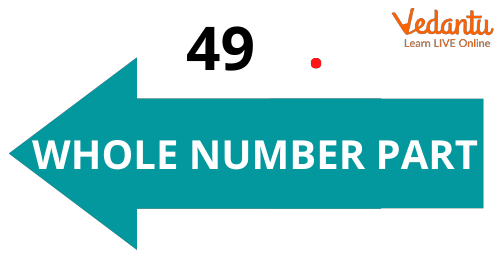
Whole Number
The fractional part in a decimal number is usually written to the right of the decimal point.
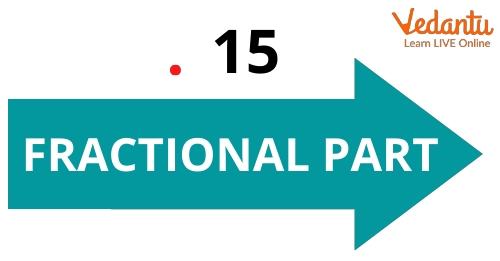
Fractional Number
The use of decimal points makes the reading of decimal numbers easy. A decimal number can be read in two ways. They are as follows.
(i) Reading decimal points as “and”:
In this method, the whole number part is read as it is and the decimal point is read as “and”. The fractional part is then read. For example, the number 363.16 is read as “three hundred sixty-three and sixteen hundredths”.
(ii) Reading the decimal point as “point”:
In this method, the whole number part is read as it is and the decimal point is read as “point”. Then the fractional part to the right of the decimal point is read as individual digits. For example, the number 363.16 is read as “three hundred sixty-three point one six”.
Tips for Teaching Decimal to Kids
Before starting any new concept, it is important that kids revise previous concepts. When teaching decimal numbers, first revisit and revise the basics of thousands, hundreds, tens and ones and then introduce or revise the tenths, hundredths and thousandths.
You can do activities with money and explain how the coins are related to ones, tenths and hundredths.
Do You Know?
In a decimal number, the fractional part is present to the right of the decimal point, which denotes a number less than 1.
A whole number can also be written as a decimal number by writing .0 (point zero) after the one digit. For example, we can write 34 as 34.0.
The decimal point is also referred to as a decimal separator.
Conclusion
When kids move to higher classes, the concept of decimal numbers becomes very essential for them to solve the problem. In this article, the decimal point is explained through examples that would help students to grab the concept of decimal numbers.
FAQs on Decimal Point in Maths Meaning Place Value and Use
1. What is a decimal point in mathematics?
A decimal point is a dot used to separate the whole number part from the fractional part of a number. In a decimal number like 5.75, the number 5 is the whole part and 75 represents the fractional part. The decimal point helps express numbers that are not whole numbers, such as money, measurements, and percentages.
2. How do you read a decimal number correctly?
To read a decimal number correctly, say the whole number, then say “point,” followed by each digit after the decimal individually. For example:
- 3.14 is read as “three point one four.”
- 0.506 is read as “zero point five zero six.”
The digits after the decimal represent place values such as tenths, hundredths, and thousandths.
3. What does each place value after the decimal point represent?
Each place after the decimal point represents a fractional value based on powers of 10. The first three decimal places are:
- Tenths (1/10)
- Hundredths (1/100)
- Thousandths (1/1000)
For example, in 4.372, 3 is in the tenths place, 7 in the hundredths place, and 2 in the thousandths place.
4. How do you add decimal numbers?
To add decimal numbers, line up the decimal points and add as you would with whole numbers. Steps:
- Write numbers vertically with decimal points aligned.
- Add zeros if needed to make equal decimal places.
- Add from right to left.
Example: 2.5 + 1.75 = 4.25.
5. How do you multiply decimals?
To multiply decimals, multiply as whole numbers and then place the decimal point based on total decimal places. Steps:
- Ignore decimal points and multiply normally.
- Count total decimal places in both numbers.
- Place the decimal point in the product accordingly.
Example: 0.4 × 0.3 = 0.12 (two decimal places in total).
6. How do you divide decimals?
To divide decimals, make the divisor a whole number by moving the decimal point in both numbers equally. Steps:
- Move the decimal in the divisor to make it whole.
- Move the decimal in the dividend the same number of places.
- Divide as usual.
Example: 4.5 ÷ 0.5 = 9.
7. What is the difference between a decimal and a fraction?
A decimal represents fractions using powers of 10, while a fraction uses a numerator and denominator. For example:
- 0.75 is a decimal.
- 3/4 is a fraction.
Both represent the same value because 0.75 equals 75/100, which simplifies to 3/4.
8. How do you convert a fraction into a decimal?
To convert a fraction to a decimal, divide the numerator by the denominator. Formula:
Decimal = Numerator ÷ Denominator
Example: 3 ÷ 4 = 0.75. Therefore, 3/4 as a decimal is 0.75.
9. What is a recurring or repeating decimal?
A recurring decimal is a decimal in which one or more digits repeat infinitely. It is written using a bar over the repeating digit(s). Example:
- 1/3 = 0.333…
- Written as 0.3̅
Repeating decimals often result from dividing fractions whose denominators are not factors of 10.
10. Why is the decimal point important in mathematics?
The decimal point is important because it determines the place value and size of a number. A small change in its position changes the value significantly. For example:
- 5.6 is five and six tenths.
- 56 is fifty-six.
- 0.56 is fifty-six hundredths.
Correct placement of the decimal point is essential in calculations, measurements, money, and scientific data.
