








How to Find Terminating and Recurring Decimal Expansion of Rational Numbers
Let's first define rational numbers before discussing how they are represented when expanded to decimal form. The term "rational number" refers to any number that can be expressed as $\dfrac{p}{q}$, where $p$ and $q$ are integers and $q\neq 0$. Decimals are what is produced when these numbers are further simplified. Let’s learn more about the decimal expansion of rational numbers through this article.
Examples: $3, -5.8, \dfrac{4}{6}$.
Decimal Expansion of the Rational Number
The decimal expansion of a rational number is obtained by dividing the numerator by the denominator of the rational number.
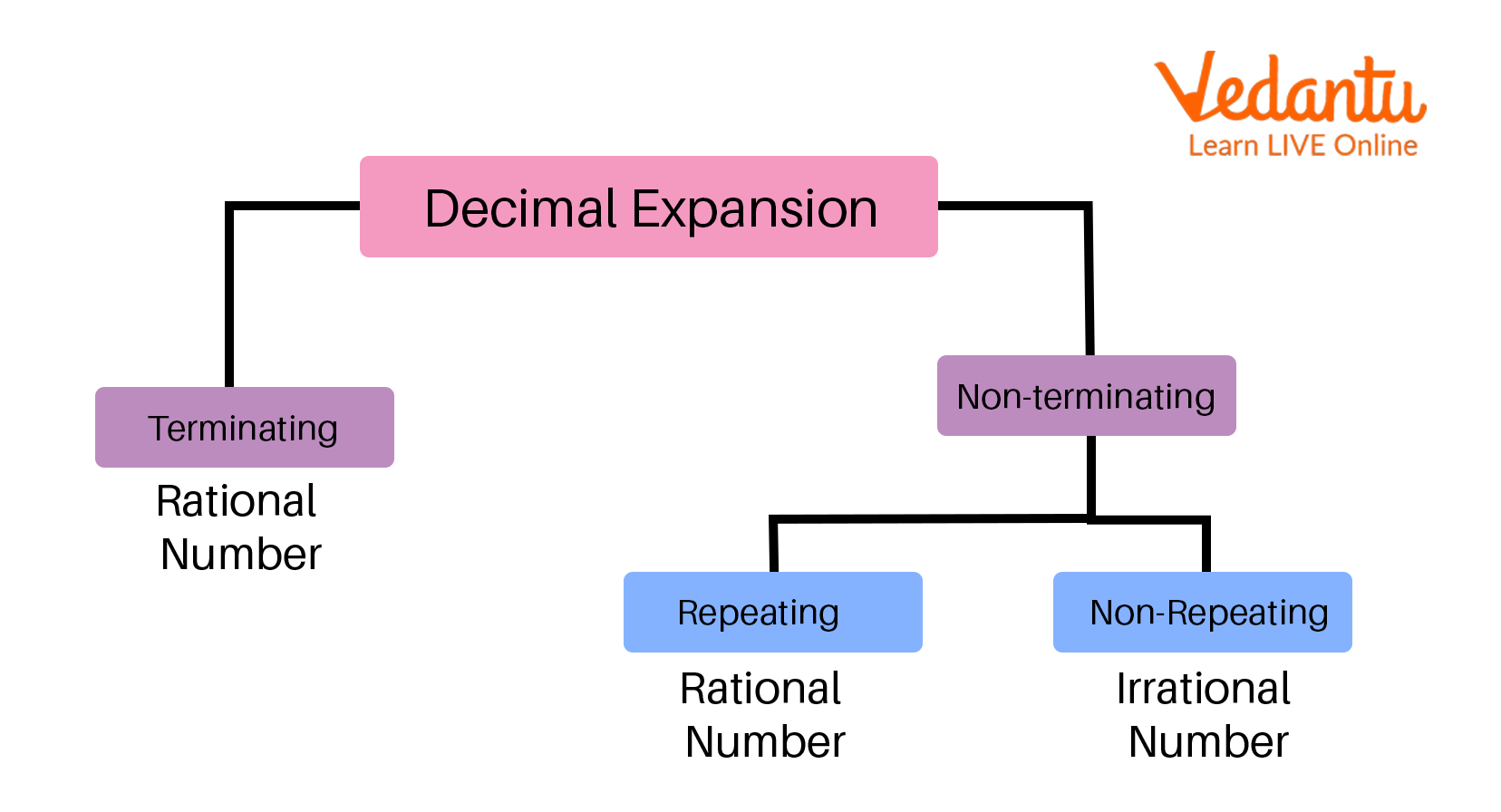
Decimal Expansion
Types of Decimal Expansion
By dividing a rational number's numerator by its denominator, one can get the decimal expansion of a rational number. Two types of decimal numbers may result from this process.
Terminating Decimal Numbers
Non-Terminating Decimal Numbers
Terminating Decimal Numbers: Terminating decimal numbers are those decimal numbers with a limited number of digits following the decimal point. These decimal integers can be expressed in the $\dfrac{p}{q}$ form, where $q$ is not equal to $0$.
For example,
$2.4, 4.436$ are the terminating decimal numbers.
$2.4$ is represented as $\dfrac{24}{10}$.
Here, $p=24$ and $q=10$ and the number of decimal places $=1$.
Non-terminating Decimal Numbers: Non-terminating decimal numbers are those that have an endless number of digits following the decimal point.
Non-terminating decimal numbers include, for instance, $0.3333…, 4.53333…, and 5.3431034310…$.
How to Expand Rational Numbers in Decimals
Whole numbers, natural numbers, and integers are all examples of rational numbers because they can all be expressed in $\dfrac{p}{q}$ form, as we have explained. Decimal numbers that are stated as rational numbers may be repeating decimals that terminate or do not.
Example: Find the decimal expansion of $\dfrac{1}{3}$.
Let's divide the numerator by the denominator.
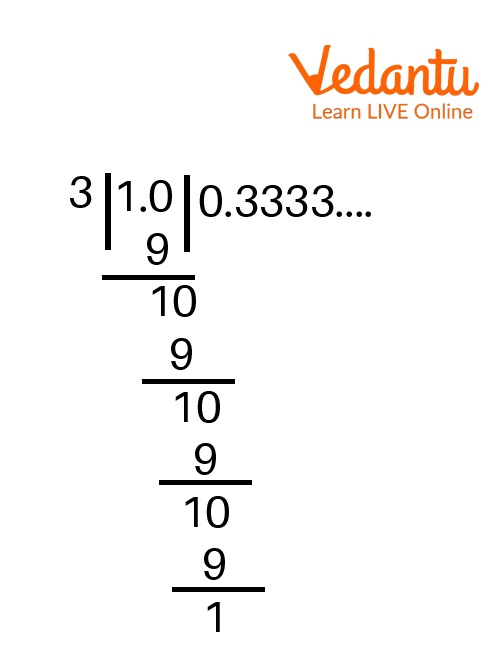
Decimal Expansion
$\dfrac{1}{3}$ is expanded to its decimal value of $0.333333$.
In this case, the divisor is $3$, and each step's remainder is $1$.
Terminating Decimal Expansion of Rational Numbers
When the digits after the decimal point are either terminated or finite, a number has a terminating decimal expansion. The decimal expansion for the fraction $\dfrac{5}{10}$ is $0.5$, which is known as a terminating decimal expansion since digits after the decimal point stop after one digit.
Non-terminating Decimal Expansion of Rational Numbers
The term "repeating" or "recurring" indicates that the repetition of the decimal values leads to a recognisable pattern that is easy to recognise, even though the decimal places in this expansion will never end and carry on forever. The expression $dfrac29=0.2222222$ is an illustration of a non-terminating recurring decimal expansion. For example, $0.222222...$ can also be written as $overline0.2$, demonstrating decimal repetition.

Non-terminating Decimal Expansion
Irrational Numbers Decimal Expansion
The use of decimal numerals to indicate an irrational number's most accurate value is referred to as the "decimal representation of irrational numbers." Non-terminating decimals with non-repeating digits are used to represent irrational numbers. For instance: Let's consider $\sqrt{2}$.
Attempting to write $\sqrt{2}$. For example, to $5$ decimal digits in decimal form, we have
$\sqrt{2} = 1.41421…$ If we enlarge √$\sqrt{2}$ to $10$ decimal places then we get $\sqrt{2}=1.4142135623…$
Interesting Facts
Any number that can be stated as a fraction is rational.
The examples include rational numbers: whole numbers, integers, fractions of integers, and terminating decimals.
Rational numbers also include recurring decimal patterns and non-terminating decimals.
A fraction is regarded as negative if it has a negative sign, either in the numerator, the denominator, or the fraction itself.
Solved Examples
Example 1: How would you characterize the prime factorization of the denominator of 42.123456789?
Solution: Since 42.123456789 is a decimal number with a terminating expansion, its denominator has the form $2^m 5^n$, where $m$ and $n$ are positive integers.
$43.123456789 =\dfrac{43123456789}{1000000000}$
$=\dfrac{43123456789}{(10)^9} \\$
$=\dfrac{43123456789}{(2 \times 5)^9} \\$
$=\dfrac{43123456789}{2^9 \times 5^9}$
Hence, it has prime factorisation in the terms of 2 and 5.
Example 2: How many digits does the rational number $\dfrac{1}{2^6 \times 5^2}$ end-on?
Solution: Let's use a whole number as the denominator.
$\dfrac{1}{2^6 \times 5^2}\\$
$=1\times \dfrac{(5^4)}{(2^6 \times 5^2 \times 5^4)}\\$
$=\dfrac{625}{2^6 \times 5^6}\\$
$=\dfrac{625}{1000000}\\$
$=0.00000625$
The supplied rational number thus comes to an end at six decimal digits.
Practice Questions
Which of the following is the decimal representation of $\dfrac{5}{13}$ ?
$0.\overline{384615}$
$0.384384$
$0.\overline{384}$
None of these
0 is not a
Rational number
Irrational number
Whole number
Natural number
Answers
(A)
(D)
Summary
Let's summarise everything we've learnt in this article. Fractions can be used to represent rational numbers. Decimal numbers come in two varieties: repeating and non-repeating for the terminating and non-terminating numbers, respectively. Rational numbers are real numbers that repeat or terminate. For further information on rational numbers and their decimal expansions, have a look at some of the cases that have been solved and are provided in this article.
FAQs on Decimal Expansion of Rational Numbers with Concepts and Examples
1. What is the decimal expansion of a rational number?
The decimal expansion of a rational number is the decimal form obtained when a fraction is divided, and it is either terminating or repeating. A rational number is any number of the form p/q where q ≠ 0. When we divide p by q:
- If the division ends, the decimal is terminating (e.g., 1/4 = 0.25).
- If the digits repeat endlessly, it is a recurring or repeating decimal (e.g., 1/3 = 0.333...).
2. How do you find the decimal expansion of a rational number?
To find the decimal expansion of a rational number, divide the numerator by the denominator using long division. Follow these steps:
- Step 1: Write the fraction in the form p/q.
- Step 2: Divide p by q.
- Step 3: Continue division until it terminates or starts repeating.
3. When does a rational number have a terminating decimal expansion?
A rational number has a terminating decimal expansion if the denominator (in simplest form) has only the prime factors 2 and/or 5. In other words, if q = 2m × 5n, then the decimal terminates. For example:
- 1/2 = 0.5
- 3/5 = 0.6
- 7/20 (20 = 2² × 5) = 0.35
4. When does a rational number have a repeating decimal expansion?
A rational number has a repeating (recurring) decimal expansion when the denominator in simplest form contains prime factors other than 2 or 5. For example:
- 1/3 = 0.333...
- 1/7 = 0.142857142857...
5. What is the difference between terminating and non-terminating repeating decimals?
The main difference is that a terminating decimal ends after a finite number of digits, while a non-terminating repeating decimal continues infinitely with a repeating pattern. For example:
- 0.25 is terminating because it ends.
- 0.666... is repeating because the digit 6 repeats forever.
6. Can you give an example of converting a fraction into a repeating decimal?
Yes, converting 2/3 into a decimal gives a repeating decimal 0.666.... Using long division:
- 2 ÷ 3 = 0.6 (remainder 2)
- The remainder repeats, so the digit 6 repeats.
7. How do you convert a repeating decimal into a rational number?
A repeating decimal can be converted into a rational number by forming an equation and eliminating the repeating part. For example, let x = 0.333...
- x = 0.333...
- 10x = 3.333...
- 10x − x = 3.333... − 0.333...
- 9x = 3
- x = 1/3
8. Is every terminating decimal a rational number?
Yes, every terminating decimal is a rational number because it can be written as a fraction with denominator 10, 100, 1000, etc. For example:
- 0.75 = 75/100 = 3/4
- 0.2 = 2/10 = 1/5
9. Why do some fractions have non-terminating decimal expansions?
Some fractions have non-terminating decimal expansions because their denominators contain prime factors other than 2 and 5. Since 10 = 2 × 5, only these factors allow exact division. For example:
- 1/6 (6 = 2 × 3) = 0.1666...
- 1/9 (9 = 3²) = 0.111...
10. What is the decimal expansion of 1/7?
The decimal expansion of 1/7 is a non-terminating repeating decimal 0.142857142857.... The block 142857 repeats continuously. This happens because 7 is a prime number other than 2 or 5, so the decimal expansion cannot terminate.
