








How to Construct a Perpendicular Line Using Compass and Ruler with Steps and Examples
What do you understand by the term perpendicular? The term perpendicular can be defined as a straight line that makes a 900 angle with another line. 900 angle is also a right angle. In other words, we can say that when two lines meet each other to form a right angle, then such lines are referred to as perpendicular. A line is said to be perpendicular to a plane only if it is perpendicular to every intersecting line. Here in this lesson, we will learn about perpendicular lines, the construction of perpendicular lines by using a protractor and much more.
Perpendicular Lines
Perpendicular lines are defined as the two distinct lines that meet or intersect each other at 900 or a right angle.
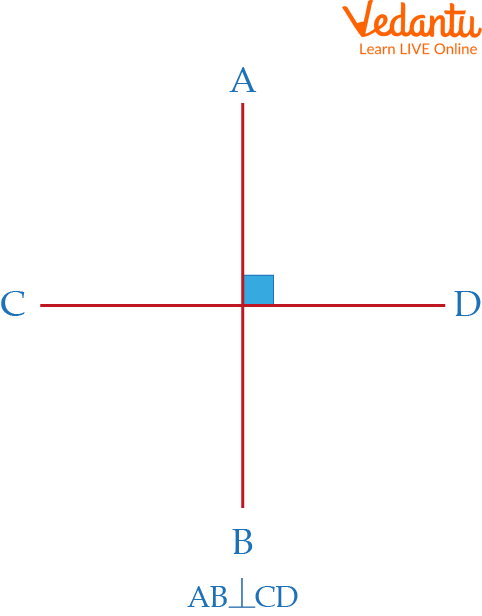
Perpendicular Lines
CD is perpendicular to AB because CD and AB intersect each other at 900.
Properties of Perpendicular Lines
Earlier in this lesson, we have already seen what a Perpendicular Line looks like. If an ‘L’ shape is formed in the figure, then the corresponding angle at the peak forms a right angle. Therefore, perpendicular lines always intersect, but all intersecting lines are not always perpendicular to each other. There are a few properties of perpendicular lines:
Perpendicular lines always intersect or meet each other.
If two lines are perpendicular to the same line, then the lines are parallel to each other, and they will never meet or intersect each other.
The angle between two perpendicular lines is 900.
How to Draw a Perpendicular Line?
A Perpendicular line can be drawn by using a protractor as well as a compass. So firstly, we are going to look at the construction of perpendicular lines by using a protractor and then we will learn how to draw a perpendicular line with the help of the compass.
In mathematics concerning geometry, the protractor is an important tool to measure and construct. To draw a perpendicular line, follow the given steps of construction:
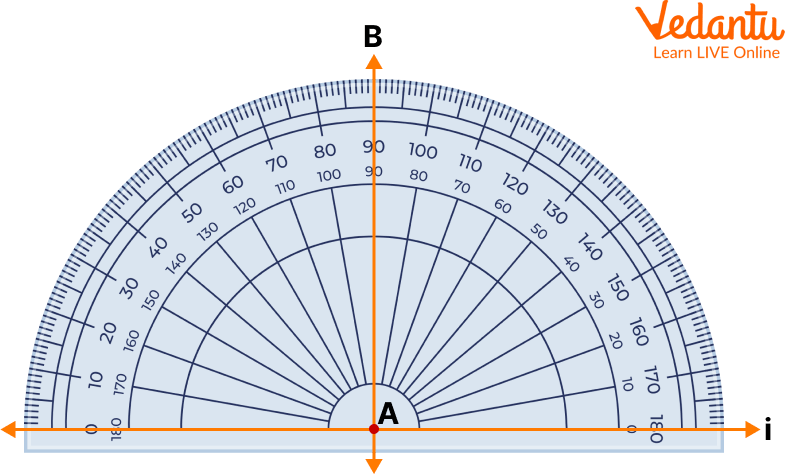
A Protractor Showing How To Draw A Perpendicular Line
Step 1: First, draw a horizontal line on any sheet of paper.
Step 2: Mark a point A on it which will be the meeting or intersecting point.
Step 3: Place the protractor in the centre of the line named A and align it with the horizontal line made earlier.
Step 4: On the protractor, mark a point at 900.
Step 5: Remove the protractor from the line and join both points A and B.
So, we obtain AB perpendicular to l.
We can construct a perpendicular line by using the compass. There are some steps of construction which need to be followed while drawing the perpendicular line.
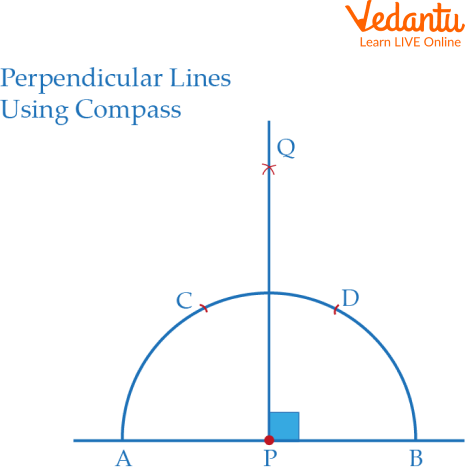
Perpendicular Lines Using Compass
Step 1: Place the tip of the compass on a point named P, then take an appropriate radius and draw a semi-circle that cuts the lines A and B.
Step 2: In the second step, stretch the compass widely and place the compass tip above the line at the new point Q. There will be an intersection between the two new arcs made.
Step 3: With the help of a ruler, join the two points P and Q, where both the arcs intersect.
So, we obtain PQ perpendicular to AB.
Difference Between Perpendicular Lines and Parallel Lines
Solved Examples
Q 1. State whether the given diagrams are of perpendicular lines or parallel lines.
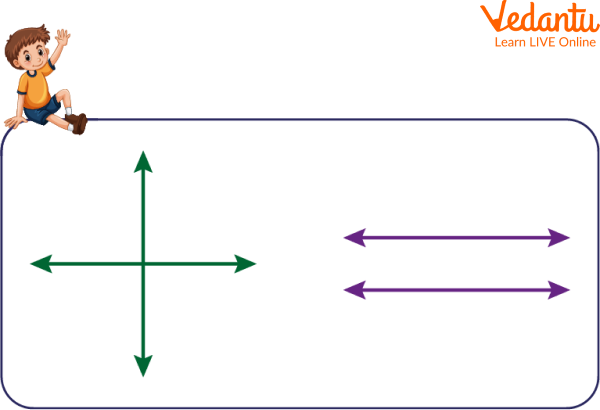
Perpendicular and Parallel Lines
Ans. The lines given in green colour represent the perpendicular lines because they are intersecting at the right angle i.e. 900 and the lines given in violet colour represent the parallel lines because they never meet each other at any angle.
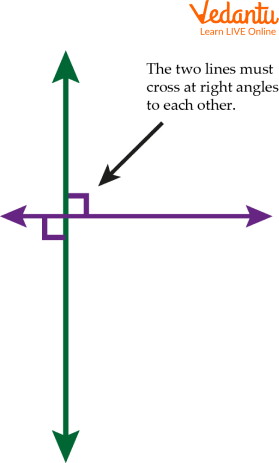
Q2. Is this a perpendicular line?
Perpendicular Lines
Ans. These lines represent a pair of perpendicular line because here, the lines meet or intersect at right angles, i.e. 900.
Practice Questions
Q 1. Which of the following objects can be described as perpendicular lines?
Apple, Designs in Windows, Television, Banana, and Railway Track Crossing
Ans. Designs in Windows, Television, and Railway Track Crossing.
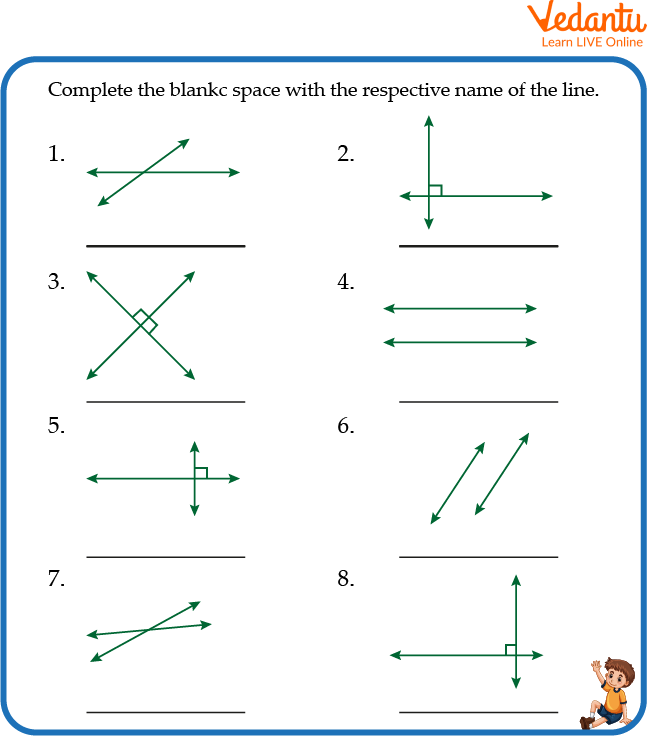
Q2. Identify the following diagram.
Practice Question
Ans. 2, 3, 5, and 8 represent perpendicular lines.
Summary
If we take a moment to notice our surroundings then we will realize that the lines are everywhere. Thus, it is necessary to know the lines. Mathematically, a line can be defined as a path which is straight having no ends. Some of the times when lines intersect or meet each other at a right angle at a given point then such lines are called perpendicular lines. The above article has explained the perpendicular lines deeply by using creative images.
FAQs on Construction Of Perpendicular Lines in Geometry
1. What is the construction of perpendicular lines in geometry?
The construction of perpendicular lines is the geometric process of drawing two lines that meet at a 90° angle using only a compass and straightedge. In geometry, perpendicular lines intersect to form four right angles. This construction is commonly used to create right angles, squares, rectangles, and perpendicular bisectors. The key idea is to use equal arcs from a point to locate two points and join them to form a line that makes a 90° angle with the original line.
2. How do you construct a perpendicular line from a point on a given line?
To construct a perpendicular line from a point on a given line, use a compass to create equal arcs on both sides of the point and join their intersections. Steps:
- Draw a line and mark point P on it.
- With P as centre, draw an arc cutting the line at two points A and B.
- With A and B as centres and equal radius, draw arcs that intersect above or below the line.
- Join P to the intersection point of the arcs.
3. How do you construct a perpendicular line from a point outside a line?
To construct a perpendicular from a point outside a line, draw arcs from the external point to cut the line and use those intersection points to locate the perpendicular. Steps:
- Let P be the external point and l be the line.
- With P as centre, draw an arc cutting line l at two points A and B.
- With A and B as centres and equal radius, draw arcs intersecting at point Q.
- Join P and Q.
4. What tools are required to construct perpendicular lines?
The tools required to construct perpendicular lines are a compass and a straightedge (ruler without markings). These classical geometric tools are used in compass-and-straightedge constructions. The compass helps draw equal arcs, while the straightedge is used to draw straight lines through intersection points. No protractor is needed for standard geometric construction.
5. What is the perpendicular bisector and how is it constructed?
A perpendicular bisector is a line that cuts a line segment into two equal parts at a 90° angle. Steps to construct it:
- Given line segment AB, place the compass at A and draw arcs above and below the segment.
- With the same radius, place the compass at B and draw arcs intersecting the previous arcs.
- Join the intersection points of the arcs.
6. What is the formula for perpendicular lines using slopes?
Two lines are perpendicular if the product of their slopes equals −1, that is m₁ × m₂ = −1. This means the slopes are negative reciprocals of each other. For example:
- If slope of first line m₁ = 2
- Then slope of perpendicular line m₂ = −1/2
7. Why do perpendicular lines form a 90 degree angle?
Perpendicular lines form a 90° angle because they intersect to create four equal right angles. By definition in Euclidean geometry, when two lines meet so that one straight angle (180°) is divided equally, each angle measures 90°. This right angle property is the defining feature of perpendicular lines.
8. Can you give an example of constructing a perpendicular line?
An example of constructing a perpendicular line is drawing a right angle at a point on a horizontal line. Example steps:
- Draw horizontal line AB.
- Mark point P on AB.
- With P as centre, draw an arc cutting AB at C and D.
- With C and D as centres and equal radius, draw arcs intersecting at E.
- Join P and E.
9. What is the difference between perpendicular and parallel lines?
The difference is that perpendicular lines intersect at a 90° angle, while parallel lines never intersect and remain the same distance apart. Key differences:
- Perpendicular lines meet at one point.
- Parallel lines do not meet at any point.
- Slopes of perpendicular lines satisfy m₁ × m₂ = −1.
- Slopes of parallel lines are equal (m₁ = m₂).
10. Where are perpendicular lines used in real life?
Perpendicular lines are used in real life wherever right angles (90°) are required for accuracy and stability. Common examples include:
- Construction of buildings and walls
- Designing tables, doors, and windows
- Road intersections and grid maps
- Engineering drawings and blueprints
